







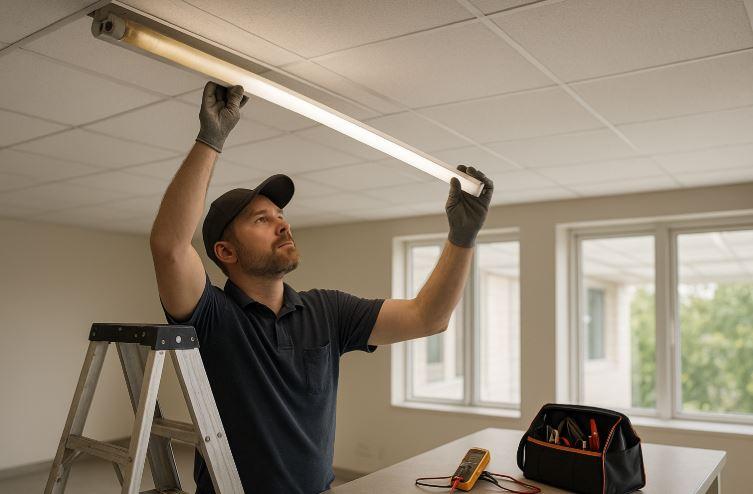
Updating a property requires a careful balance of respecting the past while making the most of current technology. It is a balance that can be hard to strike, particularly where timelines are tight and disruption is to be kept to a minimum.
Reducing operating costs in period properties, in particular, is important, but it shouldn’t harm their charm and character. Improvement work is often necessary to deliver safety enhancements, improve occupant comfort and to satisfy regulatory standards.
Retrofit lighting projects satisfy all of these aims, delivering almost invisible yet hugely impactful change without compromising the project schedule.
How Can Easy Retrofit Lighting Upgrades Improve Your Space?

1. Swap Out Old Lamps for LED Retrofits
Where the property’s wiring meets acceptable standards, replacing old lamps with LED retrofits is a quick win that delivers long-term cost savings and increased energy efficiency.
LEDs use up to 75% less power than traditional fluorescent or incandescent lamps and boast a considerably longer lifespan. They also reduce maintenance needs and provide a more pleasing, flicker-free form of light.
Where a project’s aim is to achieve industry certifications for energy efficiency, this single measure can deliver an impressive impact.
2. Install Smart Controls on Existing Circuits
One reason that older lighting is inefficient is that it is binary, being either on or off. Installing smart controls allows automation features to be introduced without complex rewiring.
For example, lights can be set to shut off automatically when no movement is detected, to adjust their brightness automatically to compensate for fluctuating levels of natural light and even to harvest daylight.
Smart controls ensure that the brightness of the space always remains at comfortable and consistent levels, illuminating only the occupied spaces. This minimises energy spent by reducing waste.
Smart controls also allow lights to be linked to the building management system, delivering valuable usage data and helping facilities management staff to identify patterns of occupancy. Fine-tuning lighting schedules results in greater cost savings and energy efficiency.
3. Upgrade Emergency Lighting Units
Emergency lighting units are designed to automatically illuminate escape routes and exits in the event of an evacuation. They are vital to the safety and compliance of buildings; however, older systems tend to operate on outdated fluorescent lamps, hard-wired into the building’s electrical system. This makes the system inefficient, both in terms of performance and energy efficiency.
There are two main ways in which emergency lighting can be upgraded. Firstly, by replacing old fixtures with LED equivalents. A simple retrofit kit can transform an old emergency lighting unit, making it more efficient and reusing the existing wiring.
Secondly, the control system could be replaced with a central controller that enables remote monitoring and testing. This enables facility managers to routinely check the system readiness without needing to perform physical inspections.
They can also synchronise the emergency lighting systems with other aspects of evacuation preparedness, including alarm and sprinkler systems. This is an excellent way of reducing operator burden and expediting safe egress.
4. Replace High-Burn Fixtures First

By identifying and replacing high-burn fixtures at the start of a project, energy efficiency gains, safety enhancements, and cost savings are achieved rapidly. This can boost morale as early results encourage continued momentum for the subsequent retrofit phases.
Because high-burn fixtures tend to be situated in high-traffic zones such as reception spaces, corridors and stairwells, as they are lit for prolonged periods.
High-burn fixtures pose a greater fire hazard because they are more susceptible to overheating and most likely to experience premature failure. They are the fixtures most prone to performance fluctuations, and replacing them early will deliver noticeable enhancements.
5. Retrofit External or Sign Lighting Separately
Often in retrofit lighting projects, there is a desire to conduct all lighting work at the same time before moving on to a different workstream. However, this can quickly result in bottlenecks and reduced productivity.
Instead, planning to retrofit external or sign lighting separately to internal improvement works delivers a more streamlined approach. It enables technicians to update wiring, refurbish fixtures and install efficient external lighting at a point when no other internal work can easily be conducted.
Exterior lighting can also be carried out separately, so it is possible to address external lighting upgrades during periods of dry weather without impacting the project schedule or interfering with workflow.
Conclusion
Retrofit lighting upgrades are a powerful tool in preserving properties while enhancing occupant comfort and reducing energy bills. Lighting upgrades contribute significantly to the achievement of sustainability goals.
By prioritising low-disruption solutions such as those outlined above, it is possible to deliver measurable improvements on a rapid timescale.
Leave feedback about this