








Gifting during your lifetime is often considered a thoughtful way to pass on wealth and reduce the inheritance tax (IHT) bill after death. However, without proper understanding of HMRC rules, well-intentioned gifts can trigger unexpected tax liabilities, legal complications, or financial disputes. This article explores what can go wrong with gifts in relation to inheritance tax and how to avoid costly mistakes.
What Is Inheritance Tax and How Do Gifts Fit Into It?
 Inheritance Tax in the UK is charged on the value of a person’s estate when they pass away. While many are aware of the tax applied to property and possessions, fewer realise that gifts made during a person’s lifetime can also be subject to IHT. If a gift is made within seven years of death, its value might be added back into the estate, potentially resulting in a higher tax bill.
HMRC defines a gift as anything that holds value this includes money, personal items, property, and even selling something to someone at a price below its market value. Some gifts can be exempt from IHT if they meet specific conditions, such as the seven-year rule or annual exemptions. However, if these rules are misunderstood or ignored, the gift may not be exempt at all.
Why Do Some Gifts Trigger Inheritance Tax Later?
The most common reason a gift triggers inheritance tax is because the donor dies within seven years of making it. In such cases, the gift is treated as a potentially exempt transfer (PET) that has failed. The value of the gift is added to the estate, and if the combined total exceeds the nil-rate band of £325,000, inheritance tax becomes due.
The timing of death after the gift is crucial. If the donor survives for more than seven years, the gift becomes fully exempt. If not, the recipient may face a tax charge. This is where taper relief comes into play, gradually reducing the tax owed depending on how many years have passed between the gift and the death.
What Is the Gift with Reservation of Benefit Rule?
Gifting doesn’t always remove an asset from your estate, especially if you continue to benefit from it. The gift with reservation of benefit (GROB) rule means that if the donor retains any benefit from the asset after gifting it such as continuing to live in a property without paying market rent the gift is not considered valid for IHT exemption.
In this case, the gifted asset remains part of the estate for inheritance tax purposes. For example, if someone transfers their home to their child but continues to live there rent-free, the home is still counted in the estate’s value. This rule is designed to prevent individuals from giving away assets in name only while still enjoying their benefits.
How Can Lifetime Gifts Lead to Tax Troubles?
Lifetime gifts are often made with the goal of reducing the estate’s value, but if not handled correctly, they can do more harm than good. A failed PET due to the donor’s death within seven years will reintroduce the gift into the estate’s taxable value. If several large gifts were made, these can cumulatively push the estate above the IHT threshold.
To soften the impact, taper relief may reduce the tax owed on gifts made more than three years before death. Here’s how taper relief works:
Years Between Gift and Death |
Inheritance Tax Payable |
| 0 to 3 years | 100% of the tax due |
| 3 to 4 years | 80% |
| 4 to 5 years | 60% |
| 5 to 6 years | 40% |
| 6 to 7 years | 20% |
| 7+ years | No tax due |
It’s important to remember that taper relief applies to the tax on the gift, not the value of the gift itself. Gifts must also exceed the nil-rate band for taper relief to be applicable.
Could Giving Away Too Much Be Seen as Deprivation of Assets?
 In some cases, gifting may be challenged on the grounds of deprivation of assets. This happens when someone deliberately gives away assets to avoid care fees or qualify for means-tested benefits. Local authorities and HMRC can reverse such gifts, arguing that the donor intended to reduce their wealth to gain a financial advantage.
An investigation into deprivation of assets looks at the timing of the gift, the health and financial status of the donor, and whether there was a clear need for care or state support when the gift was made. If the motive is deemed questionable, the gift may be disregarded, and the donor treated as if they still owned the asset.
What Are the Tax Implications When Gifting Property or Money?
Gifting property can have two major tax consequences: inheritance tax and capital gains tax (CGT). If the donor is alive and gives away a property that has appreciated in value (and it’s not their main residence), CGT may apply on the gain, even if no money was exchanged. The recipient may also face CGT in the future if they later sell the property.
For cash gifts, inheritance tax rules still apply. While you can gift up to £3,000 each year tax-free, any amount above this may be counted towards your estate if you die within seven years. There are also exemptions for wedding gifts and small gifts under £250, but if a gift doesn’t qualify, it could later become a tax burden for the recipient.
What Are the Biggest Mistakes People Make When Gifting Assets?
One of the most common errors is failing to document the gift properly. Without clear records, HMRC may question the legitimacy or timing of a gift. Another frequent mistake is misunderstanding the rules about GROB, particularly in relation to gifting property while still residing in it.
Gifting without professional advice can also result in unintended tax consequences, especially when large sums or property are involved. In many cases, individuals act with good intentions but lack the legal and financial knowledge to structure their gifts efficiently. This can lead to avoidable tax bills or even disputes among beneficiaries.
How Can You Protect Your Family from Gifting Gone Wrong?
Careful planning and professional advice are key to avoiding problems. Estate planning should be done with a solicitor or tax adviser who can help ensure that gifts are structured to meet exemption criteria and are fully documented. This includes making use of annual exemptions, keeping track of gifts with written evidence, and considering the use of trusts where appropriate.
Combining gifting with other estate planning tools such as a properly drafted will and life insurance policies can also help reduce the IHT burden. Taking action early and reviewing your financial position regularly ensures that your intentions are clear and legally sound, protecting your family from future tax complications.
What Should You Do If a Gift Is Already Under Investigation?
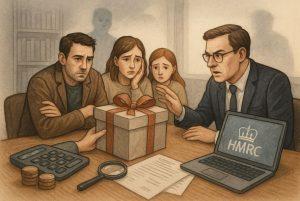 If HMRC is investigating a past gift, it’s important to act quickly and transparently. You may be asked to provide documentation, bank statements, and correspondence that explain the nature and timing of the gift. It’s advisable to seek legal advice to ensure your response is accurate and compliant.
In cases where you disagree with HMRC’s findings, there are formal appeal procedures available. You can request a review or take the case to a tax tribunal. In more complex situations, a tax adviser or solicitor with inheritance tax expertise can help you challenge the decision and potentially reduce any penalties or liabilities.
Conclusion
The rules around gifts and inheritance tax in the UK are complex and often misunderstood. A generous gift given with the best intentions can later become a tax burden or source of legal conflict if the rules are not followed correctly.
To avoid costly mistakes, it’s essential to understand HMRC regulations, document all gifts clearly, and consult professionals before making significant transfers. By planning ahead, you can ensure your loved ones benefit from your generosity without facing avoidable financial consequences.
FAQs About Gifts and Inheritance Tax
What counts as a gift under UK inheritance tax laws?
A gift is defined as anything of value transferred to someone else without full compensation. This includes money, property, and items of value.
Can parents gift money to children without paying inheritance tax?
Yes, they can gift up to £3,000 each year tax-free. Larger gifts may be subject to IHT if the parent dies within seven years of making the gift.
What happens if you don’t declare a gift?
Failure to report a gift can lead to HMRC investigations, especially if it affects the estate’s IHT calculation. Executors are required to disclose relevant gifts.
Are birthday and wedding gifts taxable?
Not usually. Wedding gifts are exempt up to specific limits (£5,000 for children, £2,500 for grandchildren), and small gifts under £250 are generally tax-free.
How far back can HMRC investigate gifts?
HMRC can investigate gifts made up to seven years before death. In cases of suspected tax evasion, there is no time limit for investigation.
Is it better to gift property or leave it in a will?
It depends on your financial goals, life expectancy, and tax position. Gifting may reduce IHT, but it can trigger capital gains tax and legal issues if not handled properly.
Can gifting affect eligibility for state benefits?
Yes, gifting large sums or assets may be seen as deliberate deprivation of assets, which could affect your ability to qualify for care funding or benefits.