







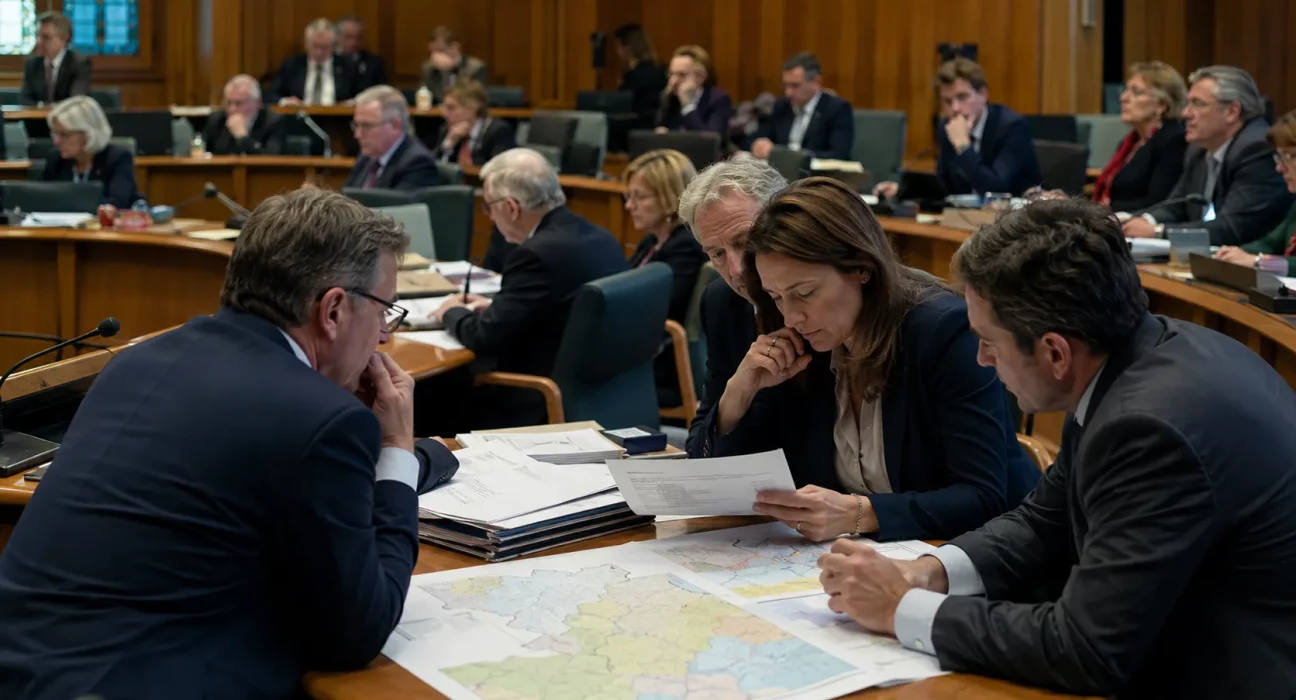
Suffolk Council Merger Legal Challenge: Key Details
| Main Issue | Reform UK is preparing a legal challenge against the Government’s plan to replace Suffolk’s six councils with three unitary authorities. |
| Who Is Challenging? | Reform UK’s new leadership at Suffolk County Council. |
| Government Plan | Suffolk County Council and five district or borough councils would be replaced by three new unitary councils from May 2028. |
| Main Criticism | Opponents say the legal challenge could waste public money and may have weak grounds for judicial review. |
| Why It Matters | The case could become part of a wider Reform UK pushback against local government restructuring across England. |
Reform UK’s newly installed leadership at Suffolk County Council is set to fire the opening shot in a high-stakes Suffolk council merger legal challenge this week, issuing a formal pre-action letter to the Government as its very first act in power a move that has drawn fierce cross-party criticism and reignited the debate over Labour’s sweeping local government restructuring agenda across England.
What Is the Suffolk Council Merger Legal Challenge Actually About?

At the heart of the dispute is the Government’s decision, announced on 25 March 2026, to abolish Suffolk’s existing six councils Suffolk County Council plus the five district and borough authorities of Babergh, East Suffolk, Ipswich, Mid Suffolk, and West Suffolk and replace them with three new unitary authorities from May 2028.
The three proposed councils would cover Western Suffolk, Central and Eastern Suffolk, and Ipswich and Southern Suffolk respectively. The restructuring forms part of the Government’s broader English Devolution White Paper, published in December 2024, which seeks to simplify the two-tier council system operating across much of England by replacing county and district councils with single-tier unitary bodies capable of delivering all local public services.
Reform UK, which swept to power at Suffolk County Council at the May 2025 local elections winning 41 of the 70 available seats has vowed to fight the decision in the courts. Incoming council leader Michael Hadwen, who is formally expected to be confirmed in his role at the council’s annual general meeting on Thursday, 22 May, has called the Government’s plans nothing short of “madness.”
Hadwen stated, branding the restructuring a “pipe dream made up in Westminster” that the “majority of people did not ask for.”
Why Does Reform UK Believe There Are Grounds for a Judicial Review?
Reform UK’s case for a judicial review rests on several contested arguments, though the party has yet to formally set out its specific legal grounds ahead of the pre-action letter. Hadwen has pointed to what he describes as an inadequate public consultation process and a rushed timetable for finalising the new council boundaries as the principal areas of concern.
Drawing on his own experience of working with unitary authorities in Wales, Hadwen argued that larger unified structures create systemic problems for councils serving sizeable populations. He warned that when district council services are absorbed into a single budget alongside county council responsibilities, residents routinely see a deterioration in standards.
“When the services that the district council offers are merged into one budget with the county council, often you see a decline in services,” he said.
The incoming Reform leader also raised financial alarm bells, arguing that splitting Suffolk into three separate authorities would create damaging competition for funding and resources between areas including between Ipswich and Felixstowe and push up the cost of major services such as adult social care.
Crucially, he argued that Felixstowe residents, despite their historical ties to Ipswich as the county town, had no desire to be administratively absorbed into an Ipswich-centred authority.
Who Is Opposing the Legal Challenge and Why?
The proposed judicial review has attracted immediate and unusually broad opposition, spanning parties from the Conservatives to Labour and the Greens.
Councillor Richard Rout, the new leader of Suffolk’s Conservative Group whose party had itself campaigned against the three-unitary model and in favour of a single countywide council nonetheless came out firmly against the legal action. He argued that personal or political disagreement with a government decision does not constitute sufficient grounds for a successful judicial review.
He added that council officers had previously advised the Reform group that the legal threshold for a judicial review namely demonstrating that a decision was illegal, irrational, or procedurally flawed was not met in this instance.
He went further, suggesting the challenge could be politically motivated:
Labour’s Neil MacDonald, Leader of Ipswich Borough Council, was equally scathing, framing the move as a reckless misuse of public money. He estimated the challenge could cost taxpayers in the region of £100,000 money he argued would be far better invested in practical local priorities.
Green and independent councillor Andrew Stringer, the principal opposition leader at county council level, described the announcement as a “poor start” for the new administration, insisting that unitary government offered Suffolk residents the strongest possible foundation for integrated public services.
What Is the Government’s Local Government Restructuring Plan and Why Is It So Controversial?

To understand why the Suffolk council merger legal challenge carries such significant political weight, it is important to grasp the wider context of the Government’s local government restructuring programme.
The English Devolution White Paper, published in December 2024 by Communities Secretary Steve Reed, set out an ambitious agenda to abolish the two-tier system of county and district councils across England, replacing it with larger unitary authorities intended to be more efficient, better funded, and clearer in their lines of accountability to local residents. The Government argues the current system in which residents are often served by multiple overlapping councils is confusing, costly, and poorly suited to delivering modern public services.
What Were the Competing Proposals for Suffolk Specifically?
In Suffolk, the restructuring debate exposed a fundamental disagreement between the county council and the district and borough authorities about what form reorganisation should take.
Suffolk Council Restructuring Proposals Comparison
The district and borough councils Babergh, East Suffolk, Ipswich, Mid Suffolk, and West Suffolk jointly submitted the three-council model to Government in September 2025, arguing it was “big enough to deliver, local enough to care.” Their business case claimed annual savings of £34 million, with £20 million of that to be reinvested directly into council services. An additional £67.5 million per year, they argued, could be unlocked by localising adult and children’s services.
The county council, by contrast, championed a single “One Suffolk” mega-council, arguing this was the only structure capable of genuinely improving services for residents. When the Government sided with the district councils’ three-unitary model in March 2026, county council leader Matthew Hicks described the decision as one based on “politics, not on evidence.”
Is Reform UK Alone in Challenging the Government’s Restructuring Plans?
Suffolk is not an isolated battleground. Reform UK, which made sweeping gains across English county councils in the May 2025 local elections, has coordinated a broader legal resistance to the Government’s local government restructuring agenda.
Both Norfolk County Council and Essex County Council where Reform also emerged as the leading political force have already announced their intention to seek judicial reviews of Government restructuring decisions in their own areas.
In Essex, the incoming Reform leader Peter Harris wrote to Communities Secretary Steve Reed in May, describing the Government’s proposals as “ill-thought, expensive and purely ideological in nature,” and confirmed he had instructed lawyers to prepare a pre-action protocol letter.
The coordinated nature of the legal challenges signals that Reform UK views the judicial review strategy not merely as a local tactic in Suffolk but as a national political tool to resist what the party characterises as top-down, Westminster-driven interference in local democracy.
What Happens Next and What Are the Realistic Prospects?
The pre-action letter from Suffolk County Council is expected to be submitted to the Government this week, following the council’s annual general meeting on Thursday, 22 May 2026, at which point the formal legal grounds for the challenge will be made public for the first time.
Should the Government fail to respond satisfactorily, Reform UK would then need to file a full judicial review claim in court. The legal bar remains high: courts will scrutinise whether the Government’s decision was unlawful, irrational, or procedurally improper not simply whether it was the right policy choice. Given that council officers have already advised Reform that those tests are unlikely to be met, legal experts and political opponents alike are sceptical the challenge will succeed.
Cllr Hadwen has conceded there will be a financial cost to taxpayers, but maintains that any legal bill would be “considerably less” than the long-term cost of implementing the three-unitary model. Critics, however, question whether deploying public funds on a challenge widely regarded as politically motivated rather than substantively meritorious can be justified at a time of tight local authority budgets.
Ministers will still need to pass primary legislation through Parliament later this year to formally abolish and replace the existing council structures. Shadow authority elections are scheduled for May 2027, with the new unitary councils set to assume full responsibilities from May 2028.
FAQs
What is the Suffolk council merger legal challenge?
The Suffolk council merger legal challenge is a judicial review being pursued by Reform UK’s newly elected leadership at Suffolk County Council against the Government’s decision to abolish Suffolk’s existing six councils and replace them with three new unitary authorities by May 2028. Reform UK argues the decision was made without adequate public consultation and that the boundary timetable was rushed.
Why is Reform UK launching a judicial review over local government restructuring in Suffolk?
Reform UK objects to the Government’s three-unitary model on several grounds. The party’s incoming council leader, Michael Hadwen, argues that splitting Suffolk into three separate authorities will drive up costs for services such as adult social care, create competition for funding between areas, and result in a decline in service quality outcomes he says residents did not ask for and were not properly consulted about.
What are the three new unitary councils that would replace Suffolk’s existing authorities?
Under the Government’s Local Government Reorganisation (LGR) decision of 25 March 2026, Suffolk’s six councils would be replaced by three unitary authorities: Western Suffolk, Central and Eastern Suffolk, and Ipswich and Southern Suffolk. Detailed boundaries are still being finalised, but the new councils are set to become operational in May 2028.
How much could the judicial review cost Suffolk taxpayers?
Critics estimate the legal challenge could cost approximately £100,000 in public money. Cllr Neil MacDonald, Leader of Ipswich Borough Council, cited this figure when condemning the action. Michael Hadwen has acknowledged there will be a cost, but insists it would be “considerably less” than the long-term expense of implementing the three-unitary restructuring plan.
What are the legal grounds needed for a successful judicial review?
For a judicial review to succeed, the claimant must demonstrate that the government decision in question was illegal, irrational, or procedurally flawed. Simply disagreeing with a policy decision is not sufficient. Cllr Richard Rout, leader of Suffolk’s Conservative Group, has noted that council officers previously advised Reform UK that none of these three legal tests were met in relation to the LGR decision.
Is Suffolk the only area where Reform UK is challenging local government restructuring?
No. Reform UK has coordinated legal resistance across multiple counties. Both Norfolk County Council and Essex County Council where Reform also became the leading political force following the May 2025 local elections have announced plans to seek judicial reviews of their own Government restructuring decisions. In Essex, incoming Reform leader Peter Harris confirmed he had instructed lawyers to prepare a pre-action protocol letter to Communities Secretary Steve Reed.
How much money could the three-unitary model save Suffolk each year?
The business case put forward by Suffolk’s five district and borough councils dubbed the “Three Councils for Suffolk: Case for Change” projected annual savings of £34 million under the three-unitary model, with £20 million earmarked for reinvestment into council services. A further £67.5 million per year was said to be unlockable by localising adult and children’s services. Reform UK and the county council have disputed these projections.
What is the timeline for the Suffolk council restructuring?
The key dates in the Suffolk LGR process are as follows: the Government’s three-unitary decision was announced in March 2026; Reform UK’s pre-action letter to the Government is expected in May 2026; elections to new shadow authorities are scheduled for May 2027; and the three new unitary councils are set to formally take over all responsibilities from May 2028.
What is England’s English Devolution White Paper?
The English Devolution White Paper was published by the UK Government in December 2024. It sets out a national programme to abolish the two-tier system of county and district councils across England and replace it with single-tier unitary authorities. It also introduces directly elected regional mayors in areas that agree devolution deals including a planned Mayor of Norfolk and Suffolk, whose election has been delayed to May 2028.
Where can I follow the latest news on the Suffolk council merger legal challenge?
For ongoing coverage of the Suffolk council merger legal challenge, Reform UK’s judicial review strategy, and the wider local government restructuring debate across England,