








In recent years, the UK’s traditional high street banks have seen an extraordinary shift in where customers choose to keep their money. Between 2019 and 2024, high street lenders such as NatWest, Barclays, Lloyds and others lost roughly £100 billion in customer deposits a dramatic sign that UK savers are reassessing the value they receive from legacy banks and seeking higher returns elsewhere.
Understanding the forces behind this trend is vital for anyone looking to protect and maximise their savings in 2026 and beyond.
What’s Behind the £100 Billion Deposit Exodus from High Street Banks?
 The simplest answer is that UK savers are no longer willing to accept low returns from traditional banks when better rates and services are available elsewhere. According to industry reports, the cumulative deposit market share of high street banks slipped from 84 % in 2019 to just 80 % by 2024, representing the £100bn outflow.
This is not merely a statistical blip it reflects a structural shift in consumer behaviour, driven by technology, interest rate trends, and competitive pressures from new banking models.
How Interest Rates and Inflation Are Driving Savers Away?
As of February 2026, the Bank of England’s base rate stands at 3.75 %, after several cuts since August 2024 and expectations of further reductions this year.
Yet despite this relatively elevated base rate, the average interest paid on many standard easy‑access savings accounts has fallen, sometimes to levels barely above inflation. One market analysis highlighted that average easy‑access rates dropped by roughly 0.50 percentage points in a year, even as inflation moderated.
This dynamic higher central bank rates but lower savings returns has widened the gap between what customers should earn and what they actually earn, motivating many to look for more rewarding alternatives.
The Rise of Challenger Banks and Fintech Alternatives
Traditional high street banks are no longer the only game in town.
Challenger banks newer digital‑first banks often without branch networks have aggressively competed for savers by offering more attractive rates, streamlined apps and lower fees, appealing to a generation comfortable with mobile banking.
These challengers, along with building societies and specialist digital lenders, have successfully drawn deposits away by passing on better yields more quickly than many legacy banks.
This increased competition is part of a broader trend in financial technology that has intensified competition for deposit funds, pushing legacy banks to rethink their pricing and customer strategies.
Where Are the Deposits Going? A Look at Switching Trends in 2026
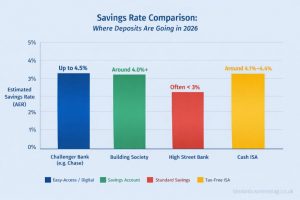 Savers aren’t simply withdrawing cash they’re placing it with alternatives that offer better returns or benefits.
According to recent savings market data, the best easy‑access accounts in 2026 can pay up to 4.5 % AER, while regular saver and fixed‑rate accounts sometimes exceed this. These rates often outstrip what many established high street banks offer for basic savings products.
Here’s a snapshot of how different providers compare:
| Bank / Provider | Estimated Savings Rate (AER) | Product Type |
| Challenger Bank (e.g. Chase) | Up to 4.5 % | Easy‑access / digital |
| Building Society | Around 4.0 %+ | Savings account |
| High Street Bank | Often < 3 % | Standard savings |
| Cash ISA (various providers) | Around 4.1 %–4.4 % | Tax‑free ISAs |
These comparatively attractive options, coupled with user‑friendly interfaces and rapid account switching tools, are drawing savers away from traditional high street offerings.
Are High Street Banks Still Safe? Trust, FSCS Protection and Perception
Amid talk of deposit loss, it’s essential to stress that high street banks remain safe and well‑regulated. Deposits in authorised UK banks and building societies are protected up to £120,000 per person under the UK’s Financial Services Compensation Scheme (FSCS) a safety net designed to protect customers if a firm fails.
This protection applies automatically and is free, ensuring that consumer confidence in the overall financial system isn’t undermined by individual institutional shifts.
Decline in Market Share: What the Numbers Reveal
The scale of the shift is best seen in market share analysis:
- 84 % of UK deposits were held by traditional high street banks in 2019.
- By 2024, this had declined to roughly 80 %, equivalent to a £100bn movement of savers’ money.
While remaining dominant, this four‑percentage‑point shift over five years suggests a meaningful rebalancing of the market a trend likely influenced by savers chasing better yields and digital convenience.
Expert Insights: What 2025–2026 Reports Say About UK Retail Banking
The outlook for UK retail banking is evolving rapidly, and top industry experts have weighed in with revealing assessments about the future of deposits, interest rates, and customer expectations.
In its 2025–2026 UK banking sector review, KPMG notes that traditional banks are facing intensifying pressure from digital challengers and diminishing profit margins on deposit products. The firm’s senior economist, Yael Selfin, points to shifting monetary policy as a key influence:
“We expect the Bank to cut interest rates twice in 2026, taking the Bank rate down to 3.25 %.”— Yael Selfin, Vice Chair and Chief Economist at KPMG UK
This expectation of further base rate reductions suggests savers could face even lower returns from traditional banks in the near term, unless those institutions adjust their strategies.
Additionally, a 2025 report from PwC UK highlighted a structural shift in consumer behaviour, noting that nearly 1 in 4 banking customers now consider digital‑only banks their primary provider, up from 1 in 10 just five years ago. (Source)
Bank of England commentary has also reinforced the message that deposits are increasingly mobile. As the financial landscape becomes more competitive, customer loyalty is no longer guaranteed by inertia rates, user experience, and trust now dominate decision making.
Together, these expert insights signal that the UK’s retail banking sector is entering a critical phase of transformation. Legacy banks that fail to offer value on savings or upgrade their digital offerings may continue to see outflows in both deposits and relevance.
What Can Savers Do in 2026 to Get Better Returns?
 If you want your savings to work harder without unnecessary risk, consider these practical steps:
1. Compare Rates Regularly
Use comparison tools such as MoneyfactsCompare and MoneySuperMarket to track the best available savings and ISA rates.
2. Switch Accounts Strategically
Don’t let your money sit in low‑yield accounts switching to a higher‑rate option can significantly boost your returns over time.
3. Use Tax‑Efficient Wrappers
Maximise your ISA allowances where appropriate to shield savings from tax while still earning competitive interest.
Remember that switching accounts is usually straightforward and protected under UK banking regulations, with most providers making the process relatively hassle‑free.
Conclusion
The flight of £100bn in deposits from high street banks reflects more than a temporary cyclical trend it underscores a significant shift in savers’ expectations and behaviour.
As interest rates fluctuate, inflation pressures evolve, and digital alternatives continue to flourish, traditional banks face a critical choice: adapt or risk further market share erosion.
For UK savers in 2026, the landscape offers more choice than ever and with the right approach, that choice can work for your financial goals, not against them.
FAQ
Are high street banks going bankrupt in the UK?
No, the deposit shifts reflect customer choice, not widespread insolvency. FSCS protections ensure that authorised deposits are safe.
How do I safely switch my savings account?
Most UK banks and building societies offer straightforward switching tools; always check for fees, notice periods, and FSCS coverage.
Which banks offer the best interest rates now?
Challenger banks and specialist providers often offer higher rates than many traditional high street products, but savings markets change quickly check live comparison services regularly.
Is my money safe if I leave it in a high street bank?
Yes, FSCS protection covers eligible deposits up to £120,000 per person per authorised institution.
Why are digital banks offering higher rates?
They typically have lower operating costs and can pass savings on to customers more readily than branch‑based incumbents.
What is FSCS protection?
It’s the UK’s statutory compensation scheme guaranteeing deposits if a bank or building society fails.
Will high street banks increase their interest rates soon?
That depends on broader economic conditions and Bank of England policy; expert forecasts suggest potential base rate shifts could influence future savings returns.