







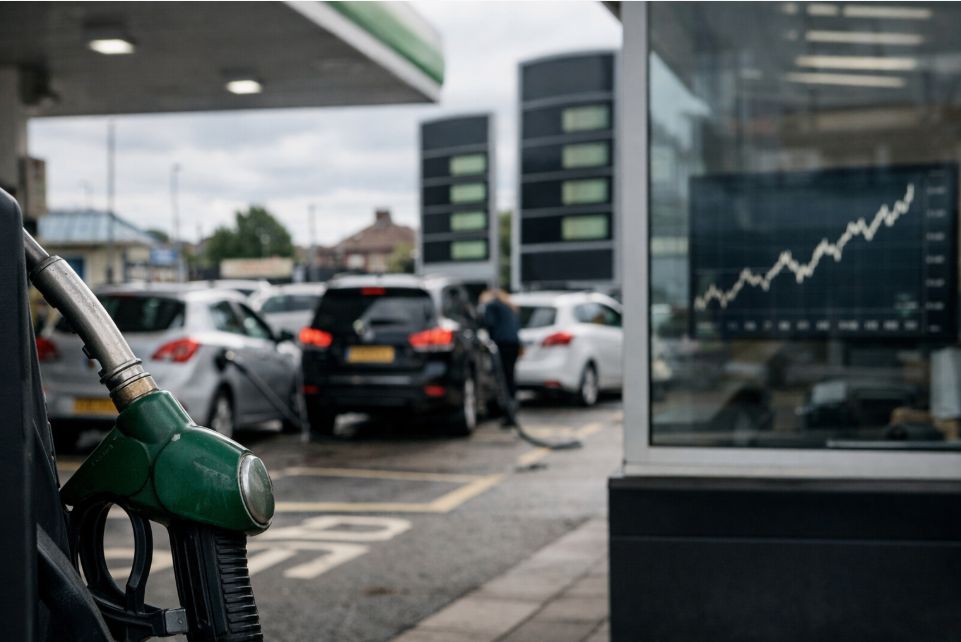
Oil prices remain one of the most closely monitored economic indicators in the United Kingdom. From petrol forecourts to business transport costs, fluctuations in global crude markets directly influence household budgets and company operating expenses.
In 2026, many UK consumers and businesses are asking the same question: how much has oil prices gone up, and what does it actually mean in practical terms?
“Petrol prices are likely to return to levels seen at the start of 2026 around 136p per litre if oil remains at current levels.”
This statement reflects the connection between crude oil markets and UK pump prices. To understand the full picture, it is important to examine confirmed market data, long-term trends, and the wider economic context.
How Much Has Oil Prices Gone Up in the UK in 2026?
 The UK uses Brent crude as its primary benchmark. Although oil is traded globally in US dollars, for UK analysis it is helpful to convert prices into pounds sterling.
In early 2026:
- Brent crude has averaged approximately £68–£72 per barrel
- In 2025, the average was closer to £63–£65 per barrel
This represents an increase of roughly 7–12% year-on-year, depending on exchange rate fluctuations.
Confirmed Price Comparison
| Year | Average Brent Price (Approx.) | Change |
| 2024 | £60 per barrel | — |
| 2025 | £64 per barrel | +6% |
| 2026 | £70 per barrel | +9–12% |
These figures show a moderate rise rather than an extreme spike. Prices remain below the peak levels experienced during the 2022 energy crisis.
How Do 2026 Oil Prices Compare to Previous Highs?
When asking how much has oil prices gone up, context matters.
During 2022, Brent crude briefly exceeded the equivalent of £95 per barrel following global supply shocks. By comparison, 2026 levels are elevated relative to 2025 but remain significantly below historic crisis peaks.
This distinction is important because:
- Current increases are gradual.
- Markets are functioning normally.
- Supply chains are not experiencing severe disruption.
In other words, while oil prices have risen in 2026, they are not at record-breaking highs.
Why Have Oil Prices Increased in the UK This Year?
Several confirmed global factors explain the increase.
1. Global Demand Recovery
Economic stability across Europe and Asia has kept oil demand steady. When demand outpaces supply growth, prices rise.
2. OPEC Production Management
OPEC+ continues to manage output levels. Even small reductions in production can support higher global prices.
3. Exchange Rate Movements
Because oil is priced internationally in dollars, fluctuations in the pound affect UK import costs. A weaker pound increases the sterling cost per barrel.
4. Geopolitical Risk
Tensions in energy-producing regions create market uncertainty. Even when supply is not physically disrupted, prices can rise due to risk premiums.
5. UK Fuel Duty
Fuel duty affects retail petrol prices but does not directly change global crude oil costs. Planned adjustments are subject to political debate.
How Is the Rise in Oil Prices Affecting Petrol and Diesel Costs?
 Crude oil typically accounts for around 35–45% of the pump price in the UK. The remainder includes:
- Fuel duty
- VAT
- Refining
- Distribution
- Retail margins
If oil rises by 10%, pump prices might increase by around 3–5%, assuming duty remains unchanged.
For example:
- Petrol at 132p per litre in 2025
- Could move to approximately 136–140p per litre in 2026
For a commuter driving 12,000 miles annually, this could mean an additional £150–£300 per year in fuel costs.
What Does This Mean for UK Households?
Oil price increases extend beyond petrol.
Heating Oil
Rural households using heating oil may experience higher winter bills.
Food and Goods
Transport costs feed into supermarket pricing over time.
Public Transport
Bus and rail operating costs may gradually rise.
Practical Household Example
A family in Leeds commuting daily and using heating oil could see monthly expenses rise by £30–£50. While not a sudden shock, it adds to overall cost-of-living pressure.
How Are UK Businesses and the Wider Economy Impacted?
Oil prices influence:
- Logistics firms
- Airlines
- Manufacturing
- Construction
- Agricultural operations
Higher energy costs can contribute to inflation. The Bank of England monitors oil prices closely because sustained increases may influence interest rate decisions.
However, the current rise in 2026 remains moderate compared to crisis-level spikes.
What Are Experts Forecasting for the Rest of 2026?
 Confirmed Market Range
Analysts suggest Brent crude could remain within £65–£75 per barrel, provided supply remains stable.
Risks That Could Push Prices Higher
- Escalating geopolitical conflict
- Unexpected supply disruptions
- Further production cuts
Factors That Could Stabilise Prices
- Increased global production
- Slower economic growth
- Stronger pound sterling
It is important to separate forecasts from confirmed data. Projections reflect market modelling, not certainty.
Are There Misconceptions About Oil Prices Rising in 2026?
Yes, several claims require clarification.
Myth: Oil prices are at record highs.
Fact: They are below 2022 peak levels.
Myth: The UK government controls global oil prices.
Fact: Oil is traded internationally.
Myth: Fuel duty alone drives petrol prices.
Fact: Crude oil cost and VAT are significant contributors.
What Can UK Households and Businesses Do to Manage Rising Oil Prices in 2026?
While the question of how much has oil prices gone up in 2026 UK is important, many readers are equally concerned about what practical steps can be taken.
Although global oil prices cannot be controlled domestically, households and businesses can reduce exposure to rising energy costs.
Practical Steps for UK Households
Improve fuel efficiency
Simple driving adjustments smoother acceleration, steady speeds, and correct tyre pressure can reduce fuel consumption by up to 10%.
Review heating systems
For homes using heating oil, annual boiler servicing improves efficiency and reduces unnecessary fuel use.
Consider fixed energy contracts
Where available, fixing energy tariffs can provide short-term budget certainty during volatile periods.
Use price comparison tools
Monitoring petrol prices locally can help motorists save several pence per litre.
Practical Steps for UK Businesses
Businesses, particularly in transport, logistics, and construction, may consider:
- Reviewing fleet fuel efficiency
- Planning delivery routes more strategically
- Hedging fuel purchases where appropriate
- Investing gradually in hybrid or electric vehicles
For SMEs operating on tighter margins, even a 3–5% rise in fuel expenses can affect profitability. Forward planning and cost forecasting therefore become essential.
Why Preparation Matters More Than Panic?
Confirmed data shows oil prices have risen moderately in 2026 not at crisis levels. However, volatility remains a feature of global energy markets. By focusing on efficiency and planning rather than reacting to headlines, both households and businesses can reduce the practical impact of higher oil prices. Understanding how much oil prices have gone up provides clarity. Acting strategically provides control.
Conclusion
So, how much has oil prices gone up in 2026 UK?
Based on current data, oil prices have increased by approximately 7–12% compared to 2025 averages, with Brent crude rising to around £70 per barrel. While noticeable, this increase is moderate rather than extreme.
The impact on petrol prices, household costs, and business operations is gradual, not sudden. Understanding the drivers behind oil price movements helps UK consumers and businesses interpret market headlines calmly and make informed decisions.
FAQs About oil prices in the UK
How often do oil prices change in the UK?
Oil prices fluctuate daily in international markets, although pump prices adjust more gradually.
Does the UK still produce oil?
Yes, the UK produces oil from the North Sea but trades within the global market.
Why is Brent crude used as the benchmark?
Brent crude reflects North Sea production and is widely used across Europe.
Can oil prices fall quickly?
Yes, particularly if global demand weakens or supply increases.
How do oil prices affect inflation?
Higher energy costs can increase transport and production expenses, contributing to inflation.
Are UK fuel prices among the highest in Europe?
They are relatively high due to taxation, though not always the highest.
What practical steps can drivers take to reduce fuel spending?
Maintaining tyre pressure, smooth driving, and route planning can improve fuel efficiency.
Leave feedback about this