







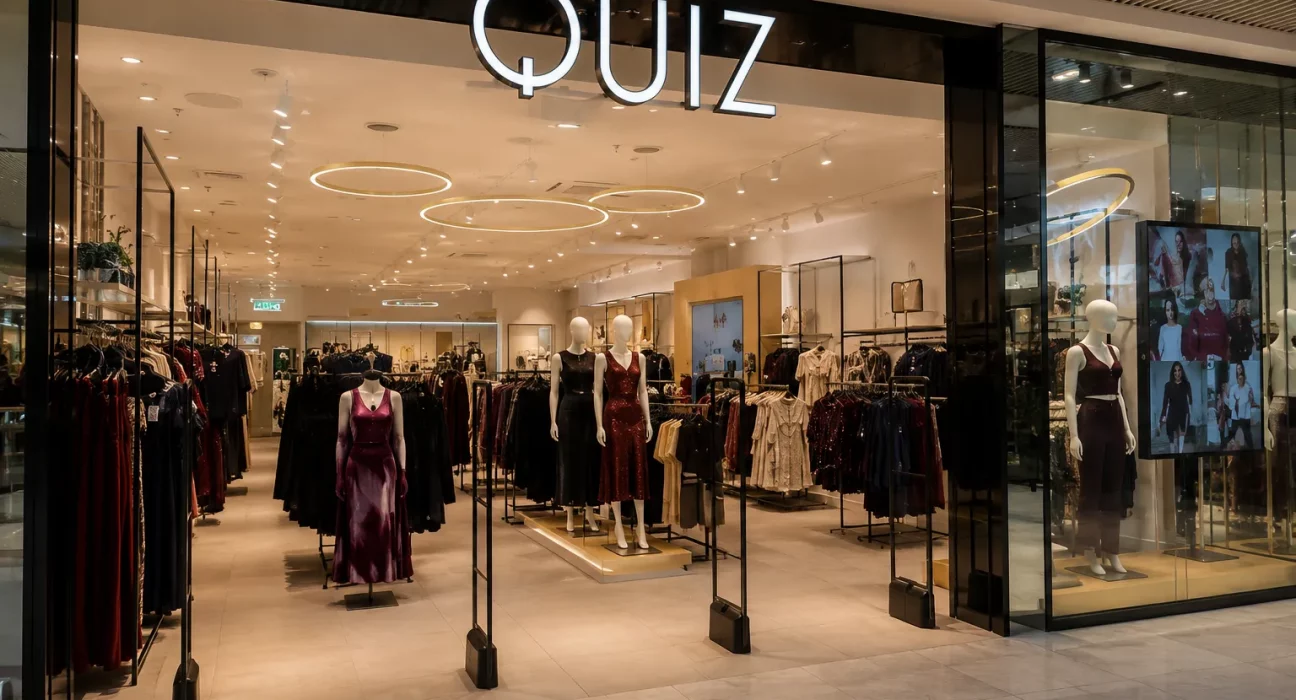
🚨 Quiz Administration: At a Glance
Quiz Clothing entered administration on 5 February 2026, resulting in
109 immediate redundancies and the closure of its remaining standalone stores across the UK.
The collapse marks the retailer’s latest restructuring effort and highlights the growing challenges facing Britain’s fashion sector.
Key Takeaways
- Quiz entered administration after disappointing Christmas 2025 trading and rising operating costs.
- 109 employees lost their jobs immediately at the Glasgow head office and Bellshill distribution centre.
- The retailer’s online store shut down on the day administrators were appointed.
- All remaining standalone stores are closing permanently by the end of June 2026.
- Matalan and New Look concessions were excluded from the administration process and continue trading.
Quiz Clothing has entered administration, resulting in 109 immediate job losses and the closure of its remaining standalone stores across the UK. The Scottish fashion retailer, once regarded as a prominent player in the affordable occasionwear market, has become the latest casualty of mounting pressures facing Britain’s high street.
On 5 February 2026, joint administrators Alistair McAlinden and Geoff Jacobs of Interpath Advisory were appointed to Orion Retail Limited, Tarak International Limited, and Zandra Systems Limited, the companies collectively responsible for operating the Quiz business. The appointment marked the beginning of a structured wind-down process that included the immediate closure of the retailer’s e-commerce platform and the gradual shutdown of its standalone store network.
The administration represents more than the collapse of a single retailer. It highlights the challenges facing mid-market fashion brands as they navigate rising operating costs, changing consumer behaviour, and an increasingly competitive retail landscape. For Quiz, the latest insolvency process is particularly significant because it follows a previous rescue attempt in 2025, making this the company’s third insolvency-related restructuring in six years.
What Happened to Quiz Clothing?
Quiz entered administration on 5 February 2026 after experiencing severe financial difficulties that left the business unable to continue operating in its existing form.
Interpath Advisory was appointed to oversee the administration of the retailer’s core operating entities. Following the appointment, Quiz’s online store ceased trading immediately, while administrators launched a controlled wind-down of standalone stores across the UK.
The objective of the process was to maximise returns for creditors while managing the orderly closure of operations. As part of the strategy, stores commenced clearance sales, with significant discounts applied to remaining inventory.
Not all parts of the Quiz business were affected. Concession locations operating within Matalan and New Look stores were excluded from the administration process and continued trading normally. These concession partnerships remain among the few surviving retail channels associated with the Quiz brand.
The administration effectively marked the end of Quiz’s direct high street presence after more than three decades in business.
How Did the Quiz Administration Result in 109 Job Losses?
One of the most immediate consequences of the administration was the loss of 109 jobs.
The redundancies were concentrated within two key operational sites:
The redundancies took effect shortly after administrators assumed control of the business.
Although 109 employees were made redundant immediately, approximately 456 members of staff were initially retained from the company’s total workforce of around 565 employees. Their role was to assist administrators in managing stock clearance activities, overseeing store operations, and supporting the wider wind-down process.
However, these positions were only temporary. As stores continued to close and leases expired throughout spring and early summer 2026, further redundancies followed as part of the phased closure programme.
The job losses have had a particularly significant impact in Scotland, where Quiz maintained its corporate headquarters and distribution infrastructure.
How Did Quiz Grow from a Scottish Fashion Brand to a UK High Street Retailer?
Founded in Scotland in 1993, Quiz built a strong presence within the UK’s fast-fashion sector by targeting women aged between 16 and 35.
The brand specialised in affordable occasionwear, evening dresses, party outfits, and trend-driven collections designed to appeal to fashion-conscious consumers seeking value for money.
Over the following decades, Quiz expanded through a combination of standalone stores, concessions, and digital channels. At the beginning of 2026, the retailer operated 40 standalone stores across the UK and seven concession locations in the Republic of Ireland.
The company remained closely linked to the founding Ramzan family, who retained significant involvement throughout multiple corporate restructurings and ownership arrangements.
For many consumers, Quiz occupied a unique position within the market, bridging the gap between value-focused fashion retailers and more premium occasionwear brands.
However, shifts in shopping behaviour, increased online competition, and changing consumer expectations gradually transformed the market in which Quiz operated.
Why Did Quiz Enter Administration Again?

The administration was not caused by a single event. Instead, it resulted from a combination of financial, operational, and market pressures that intensified over several years.
Christmas Trading Disappointment Triggered a Cash Flow Crisis
One of the most significant factors behind the collapse was weaker-than-expected trading during the 2025 Christmas period.
The festive season traditionally generates a substantial proportion of annual sales for fashion retailers. While Quiz had reported a temporary improvement in like-for-like sales during July and August 2025 following inventory and supply chain adjustments, this momentum failed to continue into the crucial Christmas trading period.
The disappointing performance significantly affected cash flow and reduced the retailer’s ability to manage ongoing operating expenses.
Rising Employment Costs Increased Pressure on Margins
Retail businesses across the UK have experienced increasing labour costs in recent years.
For Quiz, higher wage obligations, increased National Minimum Wage requirements, and broader employment-related expenses contributed to growing financial pressure.
These costs were particularly challenging within a sector already characterised by tight profit margins and intense pricing competition.
High Street Operating Costs Continued to Weigh on Performance
The economics of maintaining physical stores have become increasingly difficult.
Quiz continued to face significant fixed costs, including:
- Business rates
- Commercial rents
- Energy bills
- Property maintenance costs
- Service charges
Unlike online-only competitors, traditional retailers must absorb these expenses regardless of customer footfall levels.
As consumer shopping habits increasingly shifted online, maintaining profitability across a large store estate became more challenging.
Consumer Spending Weakness Hit Fashion Retailers Hard
The UK’s cost-of-living pressures have altered consumer spending patterns.
Many households have reduced discretionary spending on non-essential purchases, including fashion and occasionwear.
Because Quiz’s business model relied heavily on occasion-led purchases, the retailer was particularly exposed to changing consumer priorities.
Reduced demand for event-related fashion and more cautious spending habits contributed to declining sales across the sector.
Why Is This Quiz’s Third Insolvency Process in Six Years?
The latest administration is particularly notable because it follows a previous rescue attempt that occurred only a year earlier.
In February 2025, Quiz entered administration and was subsequently acquired through a pre-pack administration deal involving Orion, a company connected to the founding Ramzan family.
The 2025 restructuring resulted in:
At the time, the restructuring was presented as an opportunity to stabilise operations and position the business for long-term recovery.
Despite those efforts, the retailer remained vulnerable to broader market pressures. The return to administration within twelve months demonstrates the scale of the challenges facing the business and the wider retail sector.
What Does the Quiz Collapse Reveal About the State of UK Fashion Retail?
Quiz’s difficulties reflect broader structural challenges affecting the UK fashion industry.
The retailer joins a growing list of well-known brands that have faced financial distress, restructuring, or insolvency proceedings in recent years.
Several factors continue to reshape the retail environment:
- Increased competition from online-first retailers
- Rising operating costs
- Reduced high street footfall
- Inflationary pressures
- More cautious consumer spending
- Evolving shopping habits
Recent difficulties experienced by retailers including Ted Baker, Matches Fashion, Wilko, and The Body Shop demonstrate that these challenges are not limited to a single business model or market segment.
For mid-market fashion retailers, balancing affordability, profitability, and investment in digital capabilities has become increasingly difficult.
Quiz’s collapse serves as another indicator of the ongoing transformation occurring across Britain’s retail sector.
What Happens to Quiz Stores, Employees and Customers Now?
Following the appointment of administrators, a structured closure programme was implemented across the retailer’s remaining standalone stores.
Clearance sales featuring discounts of at least 60 per cent were introduced to accelerate stock liquidation and maximise recoveries for creditors.
All remaining standalone stores were scheduled to close permanently by the end of June 2026.
For employees, the administration has created uncertainty regarding future employment opportunities, particularly as phased redundancies continue throughout the closure process.
Customers have also been affected by the immediate closure of the retailer’s online platform and the gradual withdrawal of physical store operations.
Meanwhile, suppliers, landlords, and other creditors continue to be impacted by the administration process.
Can the Quiz Brand Survive Beyond 2026?
Although Quiz’s standalone retail operations are ending, the future of the brand itself remains uncertain rather than completely closed.
Concessions operating within Matalan and New Look stores were excluded from the administration process and continue to trade.
Potential future outcomes include:
- Acquisition of the Quiz brand by another retailer
- Intellectual property sales
- Licensing agreements
- Expansion through concession partnerships
- Relaunch under new ownership
The Quiz name retains recognition among consumers, particularly within the affordable occasionwear market.
Whether this recognition can support a future revival will depend on investor interest, market conditions, and the commercial value attributed to the brand’s remaining assets.
What Lessons Can Other Retailers Learn from the Quiz Administration?
The administration of Quiz offers valuable lessons for retailers navigating an increasingly challenging commercial environment. While every business faces unique circumstances, the retailer’s collapse highlights several broader issues affecting the UK fashion sector and the wider high street.
Financial Restructuring Alone Does Not Guarantee Long-Term Recovery
Quiz had already undergone a significant restructuring in 2025, including store closures, job cuts, and a pre-pack administration deal designed to stabilise the business. While these measures provided short-term relief, they were ultimately insufficient to address the deeper challenges affecting profitability and consumer demand.
The experience demonstrates that restructuring can buy time, but sustainable recovery often requires a broader transformation strategy that addresses operational efficiency, customer engagement, market positioning, and long-term growth opportunities.
Retailers Must Balance Physical and Digital Operations
The retail landscape has changed dramatically over the past decade, with consumers increasingly expecting seamless experiences across both online and physical channels. While stores remain important for brand visibility and customer engagement, maintaining a large physical estate can create significant financial pressure when footfall declines.
Retailers that successfully integrate e-commerce, mobile shopping, social commerce, and in-store experiences are generally better positioned to adapt to changing consumer behaviour. The challenges faced by Quiz underline the importance of continuously evaluating the balance between digital investment and high street presence.
Consumer Behaviour Can Change Faster Than Business Models
Consumer preferences are evolving more rapidly than ever. Economic uncertainty, inflationary pressures, and shifting lifestyle habits have altered spending priorities across many households. Products that once enjoyed strong demand may become more vulnerable when consumers reduce discretionary spending.
For fashion retailers, understanding these changes and responding quickly is essential. Businesses that rely heavily on specific categories, such as occasionwear or trend-led purchases, may face greater risks if consumer demand shifts unexpectedly.
Cost Control Remains Critical in Challenging Markets
Rising wages, business rates, energy costs, and supply chain expenses continue to place pressure on retail margins. Even well-established brands can struggle when operating costs rise faster than revenue growth.
The Quiz administration highlights the importance of maintaining financial discipline and operational flexibility. Retailers that regularly review costs, optimise store portfolios, strengthen supply chain efficiency, and protect cash flow are often better equipped to withstand periods of economic uncertainty.
Adaptability Is Increasingly a Competitive Advantage
Perhaps the most important lesson from Quiz’s collapse is that adaptability has become one of the defining factors of retail success. The pace of change across consumer behaviour, technology, and market conditions means businesses can no longer rely solely on strategies that worked in the past.
Retailers that continuously innovate, respond quickly to market signals, and invest in long-term resilience are more likely to remain competitive in an industry that continues to undergo significant transformation.
What Does the Quiz Fashion Chain Administration Mean for Britain’s High Street?
The administration of Quiz Clothing highlights the pressures facing many UK retailers as they navigate an increasingly complex operating environment.
The immediate loss of 109 jobs and the closure of stores nationwide illustrate the human and economic consequences of prolonged financial strain. More significantly, the retailer’s third insolvency-related restructuring in six years underscores the difficulty of achieving sustainable recovery within a rapidly changing retail market.
For investors, policymakers, and business leaders, Quiz serves as a reminder that many of the structural issues affecting Britain’s high street remain unresolved. As operating costs continue to rise and consumer behaviour evolves, adaptability, financial resilience, and strategic investment will increasingly determine which retailers survive the next phase of retail transformation.
FAQs
Why did Quiz Clothing enter administration in 2026?
Quiz Clothing entered administration on 5 February 2026 after facing a combination of financial pressures, including weaker-than-expected Christmas trading, rising employment costs, increasing business rates, and reduced consumer spending on discretionary fashion purchases. Despite undergoing a restructuring in 2025, the retailer was unable to overcome ongoing challenges affecting both the business and the wider UK fashion retail sector.
How many employees were affected by the administration?
A total of 109 employees were made redundant immediately following the appointment of administrators. The job losses primarily affected staff at Quiz’s Glasgow head office and Bellshill distribution centre. Approximately 456 employees were initially retained to support the administration process and store wind-down activities, although further redundancies occurred as stores closed throughout 2026.
Are Quiz stores closing permanently?
Yes. Following the administration, Interpath Advisory implemented a structured closure programme for Quiz’s remaining standalone stores. All 37 standalone UK stores were scheduled to close permanently by the end of June 2026, with clearance sales launched to liquidate remaining stock.
Which companies were included in the administration process?
The administration involved three key operating companies within the Quiz business: Orion Retail Limited, Tarak International Limited, and Zandra Systems Limited. These entities collectively operated the Quiz Clothing retail business and were placed into administration on 5 February 2026.
Were Quiz concessions affected by the administration?
No. Quiz concessions operating within Matalan and New Look stores were excluded from the administration process and continued trading as normal. As a result, elements of the Quiz brand remained visible in the retail market despite the closure of standalone stores.
Has Quiz entered administration before?
Yes. Quiz previously entered administration in February 2025 and was rescued through a pre-pack administration deal involving Orion, a company linked to the founding Ramzan family. That restructuring resulted in the closure of 23 stores and the loss of approximately 200 jobs. The 2026 administration represents the retailer’s third insolvency-related restructuring within six years.
Could the Quiz brand return under new ownership?
Although Quiz’s standalone retail operations have ceased, the brand itself may still have value. Potential outcomes include acquisition by another retailer, intellectual property sales, licensing agreements, or expansion through concession partnerships. Whether the brand returns under new ownership will depend on investor interest and market conditions.