







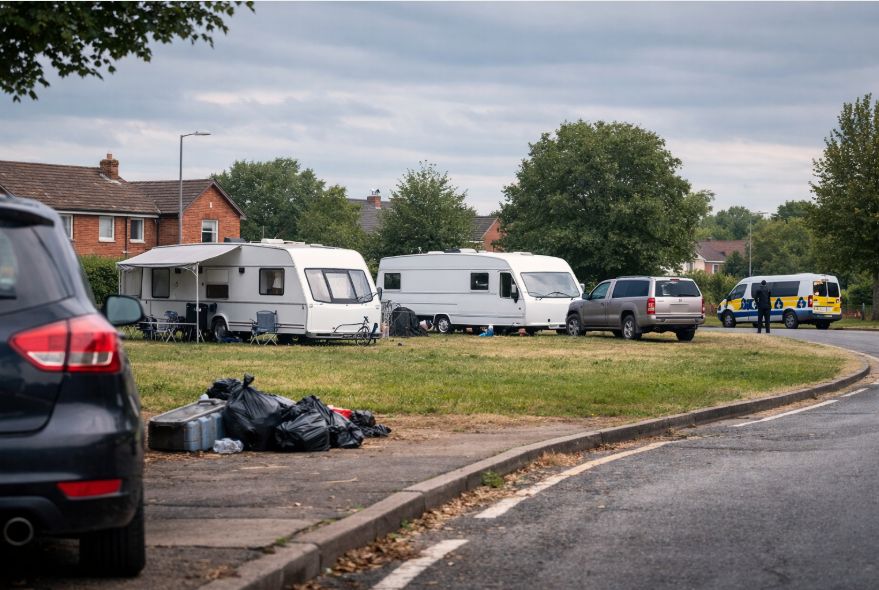
Key Takeaway
Travellers are not allowed to break the law. The delay in enforcement is usually due to
legal procedures, human rights protections, and lack of authorised sites. Police must follow strict rules before taking action, which often creates the perception of unequal treatment.
Quick Snapshot
- No group in the UK is above the law
- Trespass is often a civil issue, not always criminal
- Police powers increased under the 2022 Act
- Evictions require welfare and human rights checks
- Lack of legal sites is a major cause of encampments
| Situation | Legal Status | Police Action | Why It Takes Time |
|---|---|---|---|
| Unauthorised encampment | Usually civil trespass | Conditional powers | Legal checks required |
| Refusal to leave land | Can become criminal | Arrest & vehicle seizure | Must meet legal threshold |
| Presence of vulnerable individuals | Protected under law | Delayed enforcement | Welfare assessments needed |
| Lack of authorised sites | Structural issue | Limited alternatives | No legal stopping options |
The question “why are travellers allowed to break the law?” often arises from visible tensions between settled communities and Gypsy, Roma, and Traveller (GRT) groups. When unauthorised encampments appear or enforcement seems delayed, it can create a strong public perception that certain groups are treated differently.
However, the reality is not about being “above the law.” In the UK, the law applies equally to everyone, but how it is enforced depends on legal procedures, human rights obligations, and the nature of the situation itself.
What many people interpret as inaction is often a legal process unfolding in the background one that requires authorities to balance competing rights, assess welfare concerns, and follow strict procedural steps before taking action.
This article explores the legal framework, recent law changes, and the deeper reasons behind enforcement delays.
Are Travellers Actually Above the Law in the UK?
 The Difference Between Civil Trespass and Criminal Offence
To understand the issue properly, it’s important to recognise that not all “illegal activity” is treated the same under UK law.
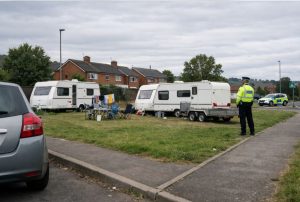
Traditionally, unauthorised encampments fall under civil trespass, not criminal law. This means that simply occupying land without permission does not automatically result in arrest. Instead, landowners must pursue legal action through the courts, which takes time.
This distinction is critical because it explains why police cannot always act immediately. Trespass only becomes a criminal matter when certain thresholds are crossed, such as damage, intimidation, or refusal to leave when directed.
The Police, Crime, Sentencing and Courts Act 2022
The introduction of this Act marked a significant shift in how authorities can respond.
Under the 2022 law, police now have enhanced powers to:
- Direct individuals to leave land
- Arrest those who refuse to comply
- Seize vehicles, including caravans
Despite these stronger powers, enforcement is still not automatic. Officers must determine whether the legal conditions are met, and whether taking action is proportionate in the circumstances.
This is why the perception of inconsistency persists because legal thresholds must be satisfied before enforcement begins.
Why Is Enforcement Not Always Immediate in Traveller Cases?
Human Rights and Welfare Assessments
One of the most important factors influencing enforcement is the requirement to consider human rights protections.
Authorities must assess whether eviction would interfere with an individual’s right to family and home life under Article 8 of the European Convention on Human Rights. This is especially relevant because, for many Travellers, a caravan is their primary residence.
Before any eviction, councils often carry out welfare checks to identify:
- Children or vulnerable individuals
- Medical conditions
- Educational needs
Rosie Brighouse, a lawyer at Liberty, highlights this principle clearly:
This legal obligation ensures fairness but it also means enforcement cannot always be immediate.
Lack of Legal Transit Sites
Another major reason for unauthorised encampments is the shortage of designated stopping places.
Many councils across the UK do not provide enough authorised sites for Traveller communities. As a result, families often have no alternative but to stop on land without permission.
Jim Davies from The Traveller Movement explains:
This highlights a key issue: enforcement alone does not solve the problem it often shifts it elsewhere.
What Do the Different Types of Encampments Mean in Legal Terms?
Understanding these distinctions helps explain why some situations are resolved quickly while others take significantly longer.
Why Is Nomadism Protected by Law in the UK?
The UK legal system recognises Romany Gypsies and Irish Travellers as distinct ethnic groups under the Equality Act 2010.
This recognition means their traditional lifestyle, including nomadism, is protected from discrimination. Authorities must take this into account when making decisions about eviction or enforcement.
This does not mean the law does not apply it means that decisions must be fair, proportionate, and non-discriminatory.
When Do Police Decide an Encampment Becomes a Criminal Matter?
 The Threshold for Police Action
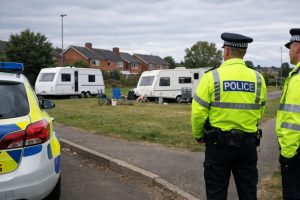
Police powers are often misunderstood. Under Section 61 of the Criminal Justice and Public Order Act 1994, officers can act only when certain criteria are met.
These typically include:
- Evidence of damage to land or property
- Threatening or abusive behaviour
- A significant number of vehicles involved
Even when these conditions are present, police must still consider the wider situation. They are not legally required to act immediately if doing so could escalate tensions or create further risks.
This is known as operational discretion, and it plays a major role in how situations are handled on the ground.
How Do Human Rights and Property Rights Conflict in These Situations?
At the heart of the issue is a legal balancing act between two competing rights.
On one side is the landowner’s right to use and protect their property. On the other is the Traveller’s right to a home and family life.
Courts must decide whether eviction is proportionate, taking into account the circumstances of both parties.
A legal expert summarises this challenge:
This balancing process is one of the key reasons why enforcement can appear slow or inconsistent.
Do Travellers Pay Taxes and What Are the Financial Impacts?
One of the most common misconceptions is that Traveller communities do not contribute financially.
In reality, many Travellers pay:
- VAT on goods and services
- Fuel duties
- Vehicle tax and insurance
- Council tax (for those on permanent sites)
However, unauthorised encampments can lead to significant cleanup costs for local authorities. These costs are often borne by taxpayers and contribute to public frustration.
This financial tension is a major factor behind the perception that laws are not being enforced effectively.
How Have Recent Legal Changes and Court Rulings Affected the Situation?
Recent High Court rulings have brought renewed attention to the balance between enforcement and rights.
Some provisions introduced under the Police, Crime, Sentencing and Courts Act 2022 have been challenged for being disproportionate, particularly where there are no authorised sites available.
Sarah Mann, CEO of Friends, Families and Travellers, stated:
These developments show that the legal landscape is still evolving, and future changes may further reshape enforcement practices.
What Are the Most Common Misconceptions About Travellers and the Law?
The debate is often driven by misunderstandings rather than facts.
A few key misconceptions include:
- Travellers are allowed to break the law freely
- Police refuse to act out of fear
- Traveller communities do not contribute financially
In reality, the law applies equally, but enforcement is shaped by legal procedures, human rights, and practical limitations.
How Can Residents and Landowners Respond to Unauthorised Encampments Legally?

For those affected by unauthorised encampments, there are clear legal steps available.
The most effective approach is to follow official channels, which may include contacting the local council, reporting concerns to the police if criminal activity is involved, and applying for a civil possession order.
Acting within the legal framework ensures that enforcement is carried out properly and reduces the risk of escalation.
Can Travellers Be Arrested for Trespassing?
When Does Trespass Become a Criminal Offence?
Yes. travellers can be arrested but only under specific conditions.
The 2022 Act makes it a criminal offence to reside on land with a vehicle without permission if individuals refuse to leave when directed or cause damage or disruption.
This means that while trespass alone may not lead to arrest, refusal to comply with legal directions can result in criminal consequences.
Why Don’t Police Move Travellers Immediately in Every Case?
Police must assess whether legal thresholds are met before acting. They also need to consider welfare concerns, potential risks, and human rights obligations.
Immediate removal is not always possible or lawful without completing these steps.
Do Travellers Have Different Laws Compared to Others?
No, travellers do not have separate laws.
However, they are protected under equality legislation as ethnic groups, which influences how laws are applied in practice.
This distinction ensures fairness but can create the impression of unequal treatment.
What Is the Final Verdict on This Issue?
The idea that travellers are “allowed to break the law” is a misconception rooted in visible delays and complex legal processes.
In reality:
- The law applies equally to all
- Enforcement is governed by strict legal rules
- Human rights protections play a key role
- Lack of authorised sites is a major underlying issue
As many experts point out, the long-term solution is not simply stricter enforcement, but better infrastructure and policy.
Understanding the full picture helps move the conversation from frustration to informed discussion and ultimately, more effective solutions.
FAQs
Can travellers be arrested for trespassing?
Yes, travellers can be arrested if they refuse to leave land and meet the legal conditions under the 2022 Act.
Why don’t police move travellers immediately?
Police must first assess legal thresholds, welfare concerns, and human rights before taking action.
Do travellers have different laws?
No, the same laws apply to everyone, but travellers have additional protections under the Equality Act 2010.
Leave feedback about this