







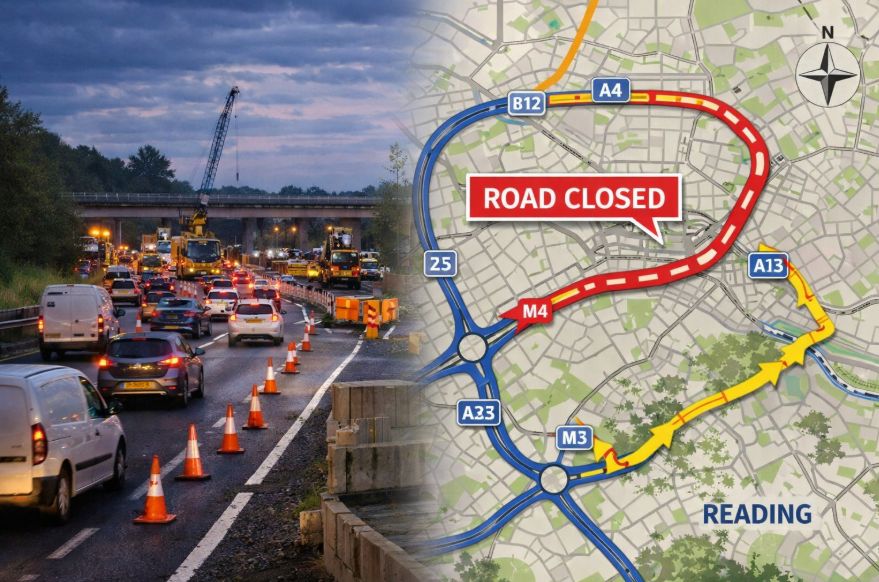
Motorway travel plays a critical role in the UK’s economy, particularly along the M4 corridor, which connects London with the South West and South Wales. When M4 closures are announced, they often raise immediate concerns for commuters, freight operators, and businesses that depend on reliable transport links.
This guide explains why M4 motorway closures happen, where they are most common, how long they usually last, and how drivers can plan effectively. The aim is to provide clear, factual information in a calm and practical manner, helping UK motorists understand what closures mean for them.
What Are M4 Closures?
 M4 closures refer to temporary or planned restrictions on sections of the M4 motorway. These closures may affect individual lanes, entire carriageways, or specific junctions.
They typically occur for the following reasons:
- Planned roadworks and maintenance
- Smart motorway upgrades
- Bridge repairs and resurfacing
- Emergency incidents such as accidents
- Severe weather conditions
- Infrastructure improvements
The M4 is managed by National Highways, which is responsible for maintaining and operating England’s motorways. In Wales, responsibility falls under the Welsh Government’s transport authority.
It is important to distinguish between confirmed, scheduled works and unexpected emergency closures. Most M4 road closures today are planned well in advance and publicly announced to minimise disruption.
Where Do M4 Motorway Closures Happen Most Often?
The M4 stretches from West London to South Wales, covering several high-traffic commercial zones. Certain sections experience closures more frequently due to traffic volume and infrastructure upgrades.
Commonly Affected Areas
| Section | Location | Common Reasons for M4 Closures |
| Junction 3–12 | West London to Reading | Smart motorway works, heavy congestion |
| Junction 10–15 | Reading to Swindon | Upgrade projects, resurfacing |
| Junction 19–23 | Bristol area | Maintenance and high freight traffic |
| Prince of Wales Bridge | England–Wales border | Weather checks, structural inspections |
| Near Heathrow | West London corridor | Traffic management and improvement schemes |
Why These Areas?
- London Corridor (J3–J12): Extremely high commuter traffic.
- Reading & Technology Corridor: Major business parks and logistics hubs.
- Bristol & South Wales: Freight movement and cross-border trade.
- Prince of Wales Bridge: Exposed to strong winds, requiring safety closures in rare cases.
These patterns are based on confirmed maintenance schedules and historical traffic reports rather than speculation.
Planned Roadworks vs Emergency M4 Closures: What’s the Difference?
Understanding the type of closure helps drivers assess likely disruption.
Planned M4 Closures
Planned closures are scheduled in advance and often occur:
- Overnight (typically 9pm–6am)
- Over selected weekends
- During phased smart motorway upgrades
- For resurfacing or bridge repairs
Authorities provide diversion routes and public notices ahead of time.
Emergency M4 Closures
Emergency closures occur due to:
- Multi-vehicle accidents
- Vehicle fires
- Severe flooding
- Structural safety concerns
These closures are temporary but unpredictable.
Confirmed Facts vs Misinformation
There are occasionally rumours online suggesting long-term permanent shutdowns of major sections. In reality:
- Permanent closures of the M4 are extremely rare.
- Most closures are temporary and necessary for safety.
- Smart motorway works are upgrades, not road removals.
Staying informed through official traffic updates reduces confusion.
How Can Drivers Check Live M4 Traffic Updates?
 For those concerned about M4 traffic updates, reliable sources include:
- National Highways live traffic map
- Local council transport pages
- Radio travel bulletins
- Trusted UK traffic apps
- Google Maps and navigation systems
Drivers are encouraged to check for M4 road closures today before starting long journeys, particularly during peak commuter hours or bank holiday weekends.
What Are the Official Diversion Routes During M4 Closures?
When closures occur, clearly marked diversion routes are implemented. These routes are symbol-based rather than signposted with full text, ensuring consistency even if drivers join mid-route.
How Diversions Work?
- Drivers follow a specific shape symbol (e.g., triangle, square).
- The symbol guides traffic until rejoining the motorway.
- Diversions aim to avoid narrow residential streets.
Example Scenario
A commuter travelling from Reading to London discovers an overnight M4 closure between Junction 11 and Junction 10. Instead of panic, the driver follows the marked diversion via the A33 and A329(M), adding approximately 15–20 minutes to the journey.
With advance planning, disruption remains manageable.
How Do M4 Closures Affect Businesses and Commuters in the UK?
The M4 corridor is sometimes referred to as the “Silicon Valley of the UK” due to its concentration of technology and multinational firms.
Business Impact
- Freight delays affecting delivery schedules
- Staff lateness during peak closures
- Heathrow-related logistics disruptions
- Increased fuel costs due to longer diversion routes
Commuter Impact
- Extended travel times
- Increased congestion on A-roads
- Greater reliance on rail alternatives
For example, a logistics firm operating between Bristol and West London may adjust departure times when weekend M4 motorway closures are scheduled, reducing risk to delivery commitments.
In most cases, businesses adapt quickly once clear timelines are provided.
How Long Do M4 Road Closures Usually Last?
 The duration of M4 closures depends on the type of work:
- Overnight works: 6-9 hours
- Weekend closures: 24-48 hours
- Major upgrade schemes: Several months (phased, not continuous closure)
- Accident-related closures: Typically cleared within hours
Smart motorway works between Junction 3 and Junction 12 have previously involved extended projects, but traffic management systems were introduced to reduce full carriageway shutdowns.
Clear communication from authorities helps manage expectations.
Practical Tips to Avoid Delays During M4 Closures
Drivers can reduce stress by planning ahead.
Preparation Advice
- Check traffic updates before leaving.
- Allow extra travel time.
- Consider rail alternatives for London travel.
- Avoid peak hours when possible.
- Keep fuel levels sufficient for diversions.
Remaining calm and flexible is key. Most motorway maintenance is scheduled to improve long-term safety and efficiency.
Conclusion
M4 closures are a normal part of maintaining one of the UK’s most important transport routes. While they can cause short-term inconvenience, they are usually planned, clearly communicated, and essential for road safety and infrastructure improvement.
For businesses and commuters alike, preparation makes a significant difference. By checking official updates, understanding diversion routes, and allowing additional travel time, disruption can be minimised.
Rather than viewing closures as unexpected obstacles, they can be seen as necessary steps in keeping the M4 motorway safe and operational for millions of users each year.
FAQs About M4 Closures
Why are overnight motorway closures common on the M4?
Overnight closures reduce disruption to daytime traffic and allow maintenance crews to work safely with minimal vehicle flow.
Do M4 smart motorway works mean fewer lanes permanently?
No. Smart motorway schemes are designed to improve traffic flow using technology and controlled lane management rather than permanently reducing lanes.
Are weekend M4 closures more disruptive than weekday ones?
Weekend closures may affect leisure travel more heavily, but weekday closures often impact commuters. The level of disruption depends on location and timing.
How far in advance are planned M4 roadworks announced?
Major planned closures are typically announced weeks in advance through official channels, though minor works may have shorter notice periods.
Can severe weather shut the entire M4 motorway?
Full motorway closures due to weather are rare. However, specific sections such as exposed bridges may temporarily close during high winds for safety reasons.
Do diversion routes add significant travel time?
Diversions usually add between 10 and 30 minutes depending on traffic levels and route length.
Is there compensation for delays caused by M4 closures?
Motorway closures do not typically qualify for compensation unless part of a separate service disruption