







UK Driving Test Crisis: Quick Snapshot
The UK driving examiner shortage in 2026 continues to affect learner drivers, instructors, and employers, with long practical test waits linked to DVSA backlog pressures, examiner recruitment challenges, and high post-pandemic demand.
Learners should book early, check DVSA cancellations regularly, remain flexible on test centre location, and avoid expensive third-party slot resellers.
Booking a driving test in the United Kingdom has never felt more like a lottery. Across England, Scotland, and Wales, hundreds of thousands of learner drivers are staring at booking calendars that stretch well beyond six months, refreshing pages in the hope that a cancellation slot appears. The UK driving examiner shortage has reached a critical tipping point in 2026, with the Driver and Vehicle Standards Agency (DVSA) struggling to deliver enough tests to meet demand and learners, instructors, and employers all bearing the consequences.
This in-depth guide unpacks everything you need to know: why the shortage has become so severe, who is most affected, what the government and DVSA are doing, and crucially what practical steps learners can take right now to secure an earlier test date.
The Scale of the Problem: Where Things Stand in 2026
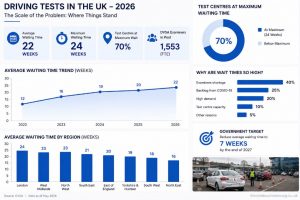 The statistics alone tell a sobering story. Average waiting times for a practical car driving test in Great Britain stood at 22 weeks as of September 2025, compared with just over five weeks in early 2020. By 2026, the situation has barely improved . According to official DVSA and National Audit Office reporting, around 70% of UK driving test centres were operating at the maximum 24-week waiting time heading into 2026.
The backlog is not a new problem, but it has proved stubbornly persistent. The DVSA set itself a target of reducing waiting times to seven weeks by the end of 2025. That target has since been revised to the end of 2027 a delay that has frustrated learners, driving instructors, and transport policy experts alike.
To put the scale in wider context:
- DVSA backlog figures indicated that more than 630,000 learner drivers remained in the system during 2025.
- The pandemic-era backlog is estimated at approximately 1.1 million tests.
- Around 360,000 of those pandemic-related tests had still not entered the booking system by late 2025.
- Nearly 1 in 3 learners have resorted to booking through third-party websites, sometimes paying up to £500 compared with the standard DVSA weekday fee of £62.
These are not abstract figures. Behind each statistic is a young person unable to get to work, a tradesperson unable to start a new job, or a carer unable to transport a family member. The UK driving examiner shortage is, at its heart, a socioeconomic problem as much as a transport one.
Why Is the UK Driving Examiner Shortage So Bad?
 Understanding the crisis requires examining several overlapping causes, each of which has compounded the others over time.
1. The COVID-19 Pandemic and Its Lasting Backlog
The most visible origin point of today’s crisis is the coronavirus pandemic. During lockdowns, driving tests were suspended almost entirely. The DVSA conducted around 437,000 tests in 2020–21, compared with the approximately 1.7 million it would typically deliver in a normal year. That enormous gap nearly 1.3 million tests lost was never fully recovered.
When restrictions lifted, demand surged, but supply was unable to keep pace. Theory test pass rates had risen sharply in the interim there was a 43% increase in theory test passes between 2019–20 and 2024–25 meaning the queue of learners ready to book a practical test grew even faster than the DVSA anticipated.
The agency has been playing catch-up ever since, but structural weaknesses in its workforce mean it has been unable to do so at the speed the situation demands.
2. A Chronic Shortage of Driving Examiners
At the heart of the UK driving examiner shortage is a workforce problem that has proved resistant to repeated intervention. Since 2021, the DVSA has launched 19 separate recruitment campaigns in an attempt to bring in more examiners. The results have been deeply underwhelming: despite all that effort, there are only 83 more examiners in post today than there were in February 2021 against a target increase of 400.
In 2025 alone, the figures from recruitment efforts were stark: just 327 of 11,132 applicants were successfully hired into examiner roles a success rate of roughly 3%. While some attrition at the application stage is normal, the AA Driving School’s managing director, Emma Bush, publicly noted that the figures appeared high and deserved continued scrutiny.
Meanwhile, around 12% of examiners leave the role each year approximately 186 staff annually. The DVSA is essentially trying to fill a bucket that has a significant hole in the bottom.
As of February 2026, there were 1,553 full-time equivalent examiners in post an improvement of 108 compared with February 2025, as confirmed in parliamentary debates. Progress is being made, but not at the pace required to meaningfully reduce waiting times in the near term.
3. Uncompetitive Pay and Safety Concerns
Why are examiners leaving and why is it so hard to recruit new ones? Two factors stand out consistently in official reports and industry commentary: pay and safety concerns.
The National Audit Office (NAO) identified high exit rates among examiners as being directly linked to perceived uncompetitive pay. Industry observers have also pointed out that the standard weekday test fee of £62 has not changed since 2009, yet the full cost of delivering a single test is calculated by the DVSA at approximately £86 meaning each test is delivered at a loss of around £24.
This financial pressure limits the DVSA’s ability to offer pay packages that compete with the private sector or other civil service roles. Examiners also report safety concerns conducting up to seven or eight tests per day in busy urban environments involves real risk, and some feel that risk is not sufficiently acknowledged or compensated.
The examiner attrition rate is double the civil service average, according to the ADI National Joint Council (ADINJC), underlining just how serious the retention problem has become.
4. Automated Bots and Third-Party Slot Reselling
A less obvious but highly damaging contributor to the UK driving examiner shortage crisis is the systematic abuse of the DVSA’s online booking system. Automated programmes commonly referred to as “bots” have been used to bulk-book available test slots the moment they appear, often with the intention of reselling them to desperate learners at inflated prices.
The DVSA closed 880 business accounts between January and September 2025 due to breaches in booking terms and conditions. Web traffic to the booking system increased fivefold between September 2024 and September 2025, with much of that surge attributed to automated activity. This not only makes it near-impossible for real learners to find slots but also distorts the DVSA’s ability to understand true demand a problem the NAO explicitly flagged in its December 2025 report.
In November 2025, Transport Secretary Heidi Alexander announced that from spring 2026, only learner drivers themselves would be able to book practical test slots, removing the ability for instructors and driving schools to book on behalf of pupils. This measure was specifically designed to combat bot activity and slot reselling.
5. Post-Pandemic Surge in Demand
The pandemic did not simply create a backlog it also triggered a fundamental shift in how many people wanted to drive. As public transport anxieties grew and remote workers began commuting in cars rather than trains, demand for driving tests climbed above pre-pandemic levels. The steady increase in theory test passes a leading indicator of future practical test demand has not translated into a corresponding increase in examiner capacity.
Furthermore, the DVSA has been slow to model and anticipate this elevated demand. The NAO criticised the agency for having been “slow to react” to the factors increasing test volumes, including rising theory test activity. As a result, the organisation has often found itself reacting to demand rather than planning ahead of it.
6. Regional Shortages and Geographic Imbalance
The UK driving examiner shortage does not affect every part of the country equally. Urban centres bear a disproportionately heavy load. London, Birmingham, Manchester, and Glasgow consistently report the longest waits, with some test centres operating at or beyond the 24-week maximum. Rural areas, while not immune, often see wait times in the 10–12 week range, though availability fluctuates significantly.
This geographic imbalance is partly a consequence of population density, but it is also a reflection of how examiners are allocated and how test centres are resourced. Learners in cities face a compound disadvantage: higher population, higher demand, and test slots that disappear within seconds of becoming available.
How 24-Week Waits Are Affecting Learners and Instructors?
The practical consequences of the UK driving examiner shortage ripple far beyond inconvenience.
Impact on Learner Drivers
For learners, a six-month wait is not simply a matter of patience it is a significant financial burden. Learners who are test-ready must continue paying for driving lessons simply to maintain their skills, adding hundreds of pounds to an already costly process. For those who passed their theory test early, there is also a risk of their certificate expiring before they can sit the practical test, requiring them to pass the theory test again.
Around 30% of respondents to a DVSA survey indicated they need to be able to drive for their jobs. For these individuals, the delay is not merely inconvenient it actively prevents them from taking up employment, progressing in their careers, or fulfilling caring responsibilities. As one constituent’s account raised in Parliament vividly illustrated, the financial and motivational toll of the wait is causing some young people to abandon their driving ambitions altogether.
Impact on Driving Instructors
For approved driving instructors (ADIs), the shortage creates significant business disruption. When pupils remain in the queue for months beyond when they are ready to test, lesson scheduling becomes complicated and revenue streams are disrupted. The decision to remove instructor booking access as part of anti-bot measures has created extra administrative work for legitimate driving instructors, many of whom previously helped learners organise test appointments more efficiently.
Cancellation policies have also tightened: learners now need to give 10 working days’ notice to avoid losing fees, meaning short-notice gaps are harder to fill. For driving schools in high-demand urban areas, these changes combined with the underlying examiner shortage represent a meaningful threat to business continuity.
The Black Market in Test Slots
Perhaps the most troubling consequence of the UK driving examiner shortage is the emergence of a shadow market in test slots. With legitimate avenues exhausted, some learners turn to third-party websites and apps that promise earlier dates. Prices can reach £500 or more for a slot that costs £62 through the official DVSA channel a markup of more than eight times the standard rate.
While the DVSA has taken enforcement action and introduced new booking rules to close loopholes, the black market persists as long as supply remains far short of demand.
What the Government and DVSA Are Doing?
Criticism of the government’s handling of the crisis has been fierce and bipartisan. The NAO’s December 2025 report concluded that the Department for Transport had “limited involvement” in helping the DVSA tackle waiting time backlogs up to mid-2024. Opposition MPs have used recent parliamentary debates to press the government on why more of 26,000 driving examiner applicants are not in training or in post.
Ministers have, however, outlined a range of measures intended to address the crisis:
- Expanding examiner training capacity so that newly recruited examiners can start delivering tests sooner.
- Reintroducing overtime pay incentives for those involved in delivering driving tests.
- Deploying Ministry of Defence examiners to provide additional test capacity, though critics have noted the contribution 36 examiners for one day per week is limited.
- Hiring 450 new examiners and adding approximately 10,000 additional test slots per month.
- Replacing the 20-year-old TARS booking system with a new Driver Services Platform (DSP) at a cost of £181 million, with a phased rollout planned through 2026–2030.
- Restricting learner-only bookings to eliminate bot activity and slot reselling.
- Launching a consultation on requiring a mandatory waiting period of three to six months between passing the theory test and sitting the practical, partly as a road safety measure, partly as a demand management tool.
Transport Secretary Heidi Alexander has pledged to reduce waiting times to seven weeks, though the revised target date for achieving this is now the end of 2027. There are, as parliamentary Hansard records show, early signs that the increase in examiner numbers is beginning to have an effect the DVSA delivered 124,000 more tests in 2025–26 than in 2024–25 but the progress remains far short of what is needed to resolve the backlog in the near term.
Practical Tips: How to Book an Earlier Driving Test?
 While the structural causes of the UK driving examiner shortage will take time to resolve, learners are not entirely powerless. There are a number of evidence-based strategies that can significantly improve the chances of securing an earlier slot.
Book Now – Even If the Date Is Far Away
The first step is to book a test as soon as you have a provisional licence, even if the earliest available date is months away. Having a booking in the system gives you a date to work towards and you can always bring it forward later.
Check for Cancellations Regularly and at the Right Times
Cancellations are released continuously as learners and instructors cancel or rearrange. The official DVSA booking portal is the safest place to monitor for these. Early morning and late evening are typically the best times to check, as cancellations often appear outside standard working hours. Refresh the page frequently rather than relying on a single daily check.
Be Flexible About Location
Many learners restrict their search to their nearest test centre. Expanding the search radius to include centres 30 – 40 miles away can significantly open up availability. Rural and suburban test centres often have shorter queues than city centres.
Consider a Less Popular Test Time
Early morning slots and Friday afternoon slots tend to be less in demand. Selecting these can sometimes reveal availability that standard midday bookings do not.
Use Only DVSA-Approved Channels
While third-party cancellation monitoring apps exist, learners should exercise extreme caution. Stick to the official DVSA booking service and be wary of any service that charges premium fees or promises “guaranteed” earlier slots these are often in violation of DVSA terms and potentially fraudulent.
Ask Your Instructor for Guidance
Experienced ADIs often have knowledge of which local test centres are least congested and which cancellation patterns to look for. Even though instructors can no longer book tests directly on behalf of learners under the new 2026 rules, their experience and local knowledge remain valuable.
Only Book When You’re Ready
One underappreciated way to ease the backlog and avoid personal cost is to only book a test when genuinely ready. Booking too early, taking the test unprepared, failing, and rebooking adds to waiting times for everyone. A failed test is not just discouraging; it adds weeks or months to the total journey.
Explore Intensive Driving Courses
Some driving schools offer intensive or semi-intensive courses that combine structured lesson programmes with access to test slots in less congested areas. These can be more expensive upfront but may result in a faster overall journey to obtaining a licence.
The Broader Picture: What Needs to Change
The UK driving examiner shortage is, ultimately, a systemic failure in workforce planning and public service management. The DVSA has responded to a predictable post-pandemic demand surge with measures that have been widely criticised as too slow, too limited, and insufficiently funded.
Closing the examiner pay gap, accelerating training pipelines, addressing safety concerns that drive attrition, and genuinely suppressing bot activity are not optional additions they are prerequisites for resolving a crisis that affects hundreds of thousands of people every year. Until those structural issues are addressed, the measures announced so far are unlikely to deliver the seven-week target within any near-term timeframe.
For now, learners, instructors, and policymakers must navigate a system under significant strain and the burden, as is so often the case, falls disproportionately on those who can least afford it.
Conclusion
The UK driving examiner shortage in 2026 is the product of years of underinvestment, a pandemic that exposed structural fragility, a recruitment crisis shaped by pay and safety concerns, and a booking system exploited by bots and resellers. With 70% of test centres at maximum capacity, average waits of 22 weeks, and some areas approaching six months, the impact on learner drivers, driving instructors, and the wider economy is substantial.
The government has taken steps more examiners, more tests, new booking rules, and a major technology overhaul but the revised target of seven-week waits by the end of 2027 underscores that there is no quick fix. For learners navigating the system today, flexibility, persistence, and strategic use of official booking tools remain the most effective tools available.
FAQs About UK Driving Examiner Shortage
How long is the current wait for a driving test in the UK?
In 2026, UK driving test waiting times remain exceptionally long, averaging around 22 weeks. High-demand urban locations including London, Birmingham, and Manchester typically experience the most severe delays.
Why is there a UK driving examiner shortage in 2026?
The shortage is the result of several overlapping factors: a massive backlog created by COVID-19 test suspensions, chronic difficulties recruiting and retaining examiners due to uncompetitive pay and safety concerns, automated bots hoarding test slots, and post-pandemic demand that significantly exceeded pre-2020 levels.
How many examiners does the DVSA currently have?
As of February 2026, there were 1,553 full-time equivalent driving examiners in post — up by 108 compared with February 2025, but still well short of the 400 additional examiners the DVSA needs to meet its waiting time targets.
What is the government doing to fix driving test wait times?
The government has committed to hiring 450 new examiners, adding 10,000 extra test slots per month, reintroducing overtime incentives, deploying Ministry of Defence examiners, restricting bookings to learner drivers only, and replacing the outdated TARS booking system with a new platform. The target is to reduce wait times to seven weeks by the end of 2027.
Can I pay for a faster driving test in the UK?
No. The DVSA does not offer a fast-track service. The standard weekday practical test fee is £62. Any third-party service offering “guaranteed” earlier slots for hundreds of pounds is operating outside DVSA rules and may breach DVSA booking rules or expose learners to unnecessary financial risk.
What happens if my theory test expires while I’m waiting for a practical test?
Theory test certificates are valid for two years from the date of passing. If your certificate expires before you sit your practical test, you will need to pass the theory test again before you can book a new practical test date.
What can learner drivers do to get an earlier driving test?
Key strategies include booking a test immediately (even if the date is far away), checking the official DVSA portal regularly at off-peak hours for cancellations, being flexible about test centre location, considering quieter test time slots, and working with an experienced driving instructor who knows local availability patterns.
Are there enough driving test centres in the UK?
The issue is not primarily the number of test centres but the shortage of qualified examiners to staff them. Many existing test centres have capacity that cannot be used because there are not enough examiners available to conduct tests.