








Key Takeaway
The Aberdeen clothing manufacturer closure highlights how rising energy costs, post-Brexit supply chain disruption, and weakening UK textile demand are forcing even long-established firms out of business.
Quick Snapshot
North East Rig Out (Aberdeen) Limited (NERO) has entered liquidation after approximately 40 years, reflecting broader pressures on the UK garment manufacturing sector in 2026.
A 40-year-old Aberdeen garment firm has entered liquidation, marking one of the most significant Aberdeen clothing manufacturer closures in the North East of Scotland’s recent industrial history. North East Rig Out (Aberdeen) Limited widely known in the trade as NERO has ceased trading after four decades of continuous operation, falling victim to a toxic combination of energy cost inflation, post-Brexit supply chain disruption, and the structural collapse of traditional UK garment contracting. The closure is not merely a local story. It is a diagnostic signal from the front line of British manufacturing.
What Was NERO and Why Does Its Collapse Matter?
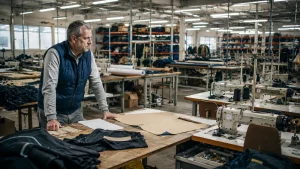
A Four-Decade Legacy Ended
Founded in the mid-1980s during Scotland’s industrial expansion, NERO built its reputation supplying workwear, specialist garments, and contract-manufactured clothing to industrial, retail, and institutional clients across the UK. Operating from Aberdeen a city whose economic identity was historically anchored in oil and gas NERO served a clientele that demanded durability, volume, and reliability.
For four decades, the firm navigated recessions, globalisation pressures, and the structural shift away from domestic manufacturing. That it survived all of those pressures, only to succumb now, tells us something critical about the severity of the current macroeconomic environment for UK producers.
The Immediate Human and Economic Impact
The liquidation of a company with this operational longevity sends an immediate chilling effect through peer businesses. Suppliers reassess credit terms. Clients accelerate diversification of their manufacturing base. And the workforce often holding niche skills with limited direct transferability faces a constrained regional labour market.
Why Did a 40-Year Business Fail? The Macroeconomic Case?
What Specific Cost Pressures Broke UK Garment Manufacturers?
NERO’s collapse did not happen in isolation. It is the latest casualty in a sustained attrition of UK domestic garment and textile producers. The firm faced a convergence of pressures that individually were survivable. Together, they were fatal.
Energy Cost Inflation
UK commercial energy prices have remained materially elevated since the 2022 energy crisis, with only partial relief for mid-sized manufacturers. Garment production is energy-intensive: industrial sewing machinery, cutting equipment, steam presses, and climate-controlled storage all carry continuous energy overhead. For a firm of NERO’s scale too large to benefit from small business energy schemes, too small to absorb costs through economies of scale sustained energy bills above pre-2021 norms represented a structural margin compression with no short-term remedy.
Post-Brexit Supply Chain Friction
Pre-Brexit, UK garment firms sourced fabrics, trims, and components from EU suppliers under frictionless customs arrangements. Since 2021, import documentation requirements, customs delays, and additional administrative costs have added both direct cost and lead-time uncertainty to sourcing. For firms operating on tightly managed production schedules as workwear and contract manufacturers typically must unpredictable lead times create downstream problems with contract fulfilment, penalty clauses, and client retention.
Raw Material Cost Inflation
Cotton, polyester blends, technical fabrics, and ancillary materials all saw significant price increases between 2021 and 2024. While global commodity prices have partially normalised, they remain above historic averages. Firms with fixed-price contracts common in institutional and workwear supply absorbed these increases against static revenue, a structural impossibility over a sustained period.
Shifting Contract Structures and Retail Demand
The UK retail landscape has undergone a fundamental shift. The rise of direct-import fast fashion, the growth of South and South-East Asian manufacturing capacity, and the collapse of several mid-market UK retail chains have eroded the domestic contract base for British producers. Institutional clients local authorities, NHS trusts, housing associations increasingly route procurement through large national framework agreements, frequently won by overseas-manufacture-backed distributors rather than domestic producers.
How Does the NERO Closure Compare to Wider UK Textile Sector Trends?
The Data Behind the Decline
The closure is not an anomaly. It reflects a documented pattern across British textile and garment manufacturing.
UK Garment Industry Trends (2020–2026)
These figures contextualise NERO’s failure within a sector-wide structural stress event one that is eliminating businesses not because of poor management, but because the operating environment has fundamentally repriced the viability of domestic production.
What Can Surviving UK Manufacturers Learn From This Closure?

This section is not retrospective it is operational. The businesses that survive the current manufacturing environment will do so through deliberate strategic adaptation, not through hoping conditions improve.
Strategy 1: Build Dynamic Energy Cost Management Into Core Operations
Fixed-rate energy contracts, once the default risk-management tool for manufacturers, now carry significant exposure if market prices fall after locking in. Conversely, variable rates expose firms to spikes.
Practical steps:
- Conduct a formal energy audit to identify the top five consumption points and prioritise reduction
- Evaluate on-site renewable generation (solar, in particular, offers strong ROI for flat-roofed industrial units)
- Negotiate energy contracts with pass-through clauses that allow renegotiation upon significant market movement
- Explore industrial energy buying groups collective procurement available through several sector trade associations including Make UK and the Manufacturing Technologies Association
Strategy 2: Restructure Supply Chain Contracts for Post-Brexit Reality
The assumption that EU supplier relationships operate as they did pre-2021 is now commercially dangerous.
Practical steps:
- Audit every key supplier relationship for customs documentation compliance and lead-time performance since January 2021
- Identify alternative UK-domiciled or non-EU suppliers for critical materials to reduce border friction
- Build minimum 15–20% additional lead-time buffers into production scheduling for EU-sourced inputs
- Review Incoterms on all import contracts many UK SMEs are still operating under pre-Brexit DDP arrangements that have become difficult to sustain
Strategy 3: Reprice Contracts to Reflect Current Cost Realities
Many UK manufacturers are operating under contracts particularly public sector frameworks that were priced before the 2021–2024 inflation cycle. Continuing to service these contracts at original rates is not relationship management; it is subsidising clients at the expense of business viability.
Practical steps:
- Audit every active contract against current material and energy cost baselines
- Identify contracts where margin has been eliminated or inverted by cost inflation
- Initiate formal renegotiation conversations with all major clients, presenting documented cost evidence procurement teams at institutional clients are increasingly receptive when evidenced correctly
- Where contracts cannot be repriced, conduct a hard-edged analysis of whether fulfilment should continue at all
Strategy 4: Diversify Revenue Streams Beyond Traditional Contract Manufacturing
NERO’s model volume contract supply to industrial and retail clients is precisely the model most exposed to the current pressures. Manufacturers that have added adjacent revenue streams are demonstrably more resilient.
Practical steps:
- Evaluate direct-to-business sales of finished products, bypassing contract intermediaries
- Assess whether specialist or premium product niches (technical workwear, sustainable textiles, heritage manufacturing) offer margin expansion versus commodity volume production
- Explore licensing or white-label arrangements that monetise manufacturing capacity without the full cost burden of finished-goods contracts
- Investigate R&D tax credit eligibility many UK garment manufacturers qualify under HMRC’s definition and are not claiming
What Is the Outlook for UK Textile and Garment Manufacturing in 2026?

A Sector at a Structural Crossroads
The honest answer is that the UK garment and textile sector is contracting and further consolidation is likely before any stabilisation occurs. The firms that will survive are those that have moved, or are actively moving, away from cost-competition with overseas manufacturers and towards value-differentiated domestic production.
There are genuine growth signals in the sector. Reshoring interest from UK brands responding to consumer sustainability pressure is real, if early-stage. The government’s Made in Britain frameworks and public procurement preferences for domestic suppliers create structural demand but only for firms able to meet quality, compliance, and traceability standards that many traditional manufacturers have not yet built.
The NERO closure should be read as a leading indicator, not a lagging one. Similar businesses characterised by volume dependency, energy intensity, and EU-sourced material supply chains face equivalent structural exposure. The question is not whether the pressure exists; it is whether management teams are acting on it with sufficient urgency.
The Bottom Line for UK Manufacturers
The closure of North East Rig Out (Aberdeen) Limited is a hard, factual reminder that operational longevity does not guarantee survival. Four decades of manufacturing expertise and client relationships were insufficient protection against a sustained structural repricing of energy, materials, and market demand.
For business owners, supply chain directors, and financial controllers reading this the question is not whether to act, but how quickly. Review your energy contracts. Audit your supply chain for post-Brexit friction. Reprice any contracts where inflation has inverted your margins. And stress-test your cash flow against a scenario in which current pressures persist for another 18 months because the evidence suggests they may.
The UK manufacturing sector needs businesses that survive and adapt. NERO’s closure is a loss. It should also be a catalyst.
FAQs
What caused North East Rig Out (Aberdeen) Limited to go into liquidation?
NERO’s liquidation reflects the combined impact of sustained energy cost inflation, post-Brexit supply chain cost increases, raw material price rises, and erosion of the domestic contract manufacturing base pressures that have disproportionately affected mid-sized UK garment producers operating on fixed or semi-fixed contract terms.
How many jobs were lost in the NERO Aberdeen closure?
The exact number of positions affected is subject to the formal liquidation process. Given the firm’s 40-year operational history and its scale as a regional garment manufacturer, the closure affects both direct employees and indirect roles within the local supply chain.
Is the Aberdeen clothing manufacturer closure part of a wider UK trend?
Yes. NERO’s closure is part of a documented pattern of contraction across UK garment and textile manufacturing. Active firm numbers in the sector have declined significantly since 2019, driven by the same macroeconomic pressures that affected NERO.
What support is available for UK manufacturers facing similar pressures?
UK manufacturers under financial pressure should contact Make UK (the manufacturers’ trade body), seek advice through the British Business Bank’s business support finder, and engage their regional Growth Hub for signposting to emergency business support, energy efficiency grants, and supply chain restructuring advisory services. Early engagement with an insolvency practitioner before a crisis point preserves significantly more options than reactive liquidation.
Can UK garment manufacturing survive long-term against overseas competition?
Yes, but only through strategic repositioning. Volume cost-competition with overseas manufacturers is not a viable long-term model for most UK firms. Survival lies in premium positioning, traceability credentials, technical specialisation, and domestic procurement frameworks areas where proximity and compliance capability create genuine competitive advantage.
What happens to NERO’s clients following the closure?
Clients who relied on NERO for contract garment supply will need to identify alternative manufacturers. Given the contraction of UK domestic capacity, some will turn to overseas suppliers; others may seek alternative UK producers. The closure creates both disruption for existing clients and opportunity for competing manufacturers able to absorb additional capacity.