








Last Updated: 12 October 2026
Are holiday prices going up in 2026, or are UK travellers finally seeing some relief from expensive flights, accommodation and package holidays?
The latest official statistics suggest a more complicated picture than headlines about rising travel costs might indicate. Some holiday-related prices are still increasing, but inflation across package holidays and accommodation has slowed considerably compared with previous years. Meanwhile, airline fares remain volatile, and changes to aviation taxes and local tourist levies are influencing what travellers ultimately pay.
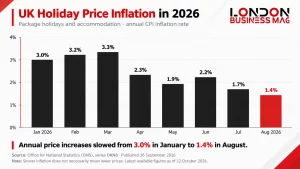
According to the Office for National Statistics (ONS), annual inflation for the combined package holidays and accommodation category stood at 1.4% in August 2026, compared with 3.6% in August 2025. At the same time, overall UK consumer price inflation was 3.1%.
For families planning a summer holiday in 2027, that distinction matters. Slower price increases do not necessarily mean holidays are cheaper, but they can make it easier to budget than during periods of rapid inflation.
This guide examines what official UK data reveals about travel costs, why flight and hotel prices continue to fluctuate, how tourism taxes affect holiday budgets and what travellers can do to obtain better value.
Are Holiday Prices Still Going Up in the UK in 2026?
Yes, holiday prices are still rising in some areas, but not at the same rate across every type of travel.
The most important distinction is between the overall price of a holiday and the inflation rate for particular travel services.
A package holiday might increase in price by a relatively small percentage over a year, while a particular flight becomes much more expensive because seats are limited or demand is especially strong.
Equally, a traveller may find cheaper accommodation outside the peak summer season even when the national accommodation price index is rising.
What Do the Latest UK Holiday Inflation Figures Show?
The ONS publishes a dedicated Consumer Prices Index series covering package holidays and accommodation.
| Month | Annual Price Inflation |
|---|---|
| January 2026 | 3.0% |
| February 2026 | 3.2% |
| March 2026 | 3.3% |
| April 2026 | 2.3% |
| May 2026 | 1.9% |
| June 2026 | 2.2% |
| July 2026 | 1.7% |
| August 2026 | 1.4% |
The figures show that annual price growth was higher at the beginning of 2026 and subsequently moderated.
One important finding is that travel-related inflation in this combined category is now lower than general UK inflation.
However, these figures should not be interpreted as proof that every holiday destination, travel provider or accommodation category has become cheaper.
What Does Slower Holiday Inflation Mean for Travellers?
Consider an illustrative holiday costing £2,000.
If the price increased by 3.6%, the additional cost would be £72. At an increase of 1.4%, the additional cost would be £28.
That represents £44 less in hypothetical annual price growth.
These calculations help explain why slower inflation matters to household budgets. They are not forecasts for the cost of any specific 2027 holiday.
Why Are Flight Prices Going Up in 2026?

Flight prices remain one of the least predictable components of a holiday budget.
Ticket prices depend on booking demand, seat availability, flight schedules, operating costs and the time of year. Changes in fuel costs and aviation taxation may also influence airline pricing.
What Do Official UK Airfare Figures Show?
The ONS reported that airfares rose by 6.2% between July and August 2026, compared with a 2.1% increase over the equivalent period in 2025.
The ONS identified long-haul routes as an important contributor to the larger monthly increase.
It is important to understand that this is a comparison between two consecutive months, not a claim that all flights became 6.2% more expensive over the year.
The figures illustrate how seasonal demand and changing route conditions can affect the price of air travel.
Frequent travellers may also consider how airline loyalty programmes influence their travel decisions. For example, changes to the British Airways Club in 2026 affect how members earn Tier Points and obtain status benefits, although loyalty rewards should never be confused with guaranteed fare savings.
How Are Fuel Costs and Environmental Rules Affecting Airlines?
Aviation fuel is an important operating expense for airlines, while aircraft availability, maintenance, airport charges and staffing also influence costs.
The UK has introduced a Sustainable Aviation Fuel (SAF) Mandate, requiring fuel suppliers to meet increasing sustainable aviation fuel obligations.
The main obligation is equivalent to 3.6% of total jet fuel supplied in 2026, compared with 2% in 2025.
Sustainable aviation fuel policies could place upward pressure on airline operating costs, although their precise effect on an individual ticket cannot be calculated simply from the mandate percentage.
Airlines may absorb some costs, offset them through operational efficiencies or pass some of them to customers.
The practical implication is that travellers should compare complete ticket prices rather than assume that every fare increase has the same cause.
How Much Has Air Passenger Duty Increased in 2026?
Air Passenger Duty (APD) is a UK tax on eligible passengers departing from UK airports.
The amount depends on the destination band and travel class, subject to specific exemptions.
New rates took effect on 1 April 2026.
UK Air Passenger Duty Rates for 2026/27
| Destination Band | Economy/Reduced Rate | Standard Rate |
|---|---|---|
| Domestic UK flights | £8 | £16 |
| Band A: Up to 2,000 miles | £15 | £32 |
| Band B: 2,001–5,500 miles | £102 | £244 |
| Band C: More than 5,500 miles | £106 | £253 |
Source: HM Revenue & Customs – Air Passenger Duty Rates. Rates apply from 1 April 2026 to 31 March 2027. Higher rates applicable to certain aircraft are not shown.
The destination bands generally use the distance from London to the capital of the destination country.
For example, two adults departing the UK on a Band B long-haul journey in the lowest class of travel would incur a combined APD liability of £204, subject to the applicable rules.
This does not mean they pay an extra £204 at the airport. APD is generally incorporated into the ticket price by the airline.
Children under 16 travelling in the lowest class of travel are generally exempt from APD, subject to eligibility requirements.
Does Flying From London Make Holidays More Expensive?
London travellers often have several airport options, including Heathrow, Gatwick, Stansted, Luton and London City.
However, choosing the airport with the cheapest advertised flight does not automatically produce the cheapest journey.
For example, a £65 flight from an airport requiring £45 in additional ground transport may cost more overall than an £85 flight from a more convenient airport.
Parking, transfers, luggage requirements and departure times should all be included before deciding which airport represents better value.
For international journeys, travellers should also check documentation requirements early. London Business Mag’s guide to the HM Passport Office warning for business travellers explains why passport validity and entry requirements deserve attention before booking overseas travel.
Are Hotel and Accommodation Prices Increasing in 2026?

Hotels, holiday apartments and short-term accommodation are affected by local demand, operating expenses and seasonal booking patterns.
The ONS recorded annual inflation of 4.1% for the broad UK restaurants and hotels category in August 2026.
However, this measure includes restaurant services and should not be confused with the price of overseas hotel accommodation.
A hotel in London, for example, may charge higher rates during major events or conferences, while a comparable hotel in a quieter location may discount rooms to increase occupancy.
Why Does the Length of a Stay Matter?
Small changes to nightly accommodation rates can make a substantial difference to longer holidays.
The following table is an original calculation showing how changes to nightly rates affect the total accommodation cost.
| Nightly Rate | Seven-Night Stay | Ten-Night Stay |
|---|---|---|
| £100 | £700 | £1,000 |
| £125 | £875 | £1,250 |
| £150 | £1,050 | £1,500 |
| £175 | £1,225 | £1,750 |
Illustrative calculations, not live hotel quotations. Taxes and additional charges are excluded.
A family paying £150 instead of £125 per night spends £175 more over seven nights.
That extra £175 could represent a significant proportion of its restaurant, transport or entertainment budget.
Travellers should therefore compare the total cost of a stay rather than concentrate exclusively on the advertised nightly rate.
Hotels offering breakfast, airport transport or family facilities may provide better overall value even when their room rate appears higher.
How Are Tourist Taxes Affecting Holiday Prices in 2026?
Tourist taxes are becoming another important consideration when comparing holiday destinations.
Unlike general inflation, a tourist levy can create an identifiable additional charge that travellers need to include in their accommodation budget.
How Does Edinburgh’s New Visitor Levy Work?
Edinburgh introduced a 5% visitor levy on eligible paid overnight accommodation stays beginning on 24 July 2026.
The levy applies to the accommodation-only cost before VAT and is limited to the first five consecutive nights.
The booking date also matters. Stays booked and paid for, in part or full, before 1 October 2025 are exempt under the scheme’s transitional arrangements.
These details are confirmed by the City of Edinburgh Council’s visitor levy guidance.
Original Calculation: How Much Does Edinburgh’s Tourist Tax Add?
Consider a visitor booking five nights in Edinburgh at an accommodation rate of £160 per night, excluding VAT.
| Cost Component | Amount |
|---|---|
| Nightly accommodation | £160 |
| Number of nights | 5 |
| Accommodation subtotal | £800 |
| Visitor levy at 5% | £40 |
| Total before VAT and other charges | £840 |
London Business Mag calculation: The visitor levy adds £40 to the pre-VAT cost of this illustrative five-night booking.
For a seven-night booking at the same rate, the levy would still be calculated on the first five nights, rather than the full seven.
This highlights an important distinction: tourist taxes do not necessarily rise in direct proportion to the total length of a stay.
Holidaymakers planning European breaks should also check destination-specific accommodation taxes, as charging methods can differ between cities and countries.
Are Package Holidays Cheaper Than Booking Flights and Hotels Separately?
A package holiday can sometimes cost less than booking individual travel components, but the cheapest option depends on the destination, dates and services included.
Travel operators may negotiate accommodation and transport rates at scale, while independent travellers can sometimes find competitive deals by selecting their own flights and hotels.
The most reliable approach is to compare two complete, equivalent itineraries.
Original Cost Comparison: A Seven-Night Family Holiday
To demonstrate how a comparison should work, London Business Mag has calculated two hypothetical prices for a family of four travelling for seven nights.
The package and independently booked trip include the same basic travel components.
| Holiday Expense | Package Holiday | DIY Booking |
|---|---|---|
| Return flights for four | Included | £900 |
| Seven nights’ accommodation | Included | £1,260 |
| Hold luggage | Included | £160 |
| Airport transfers | Included | £150 |
| Total | £2,520 | £2,470 |
These figures are illustrative planning assumptions, not quotations collected from airlines, hotels or travel agents. Meals, travel insurance, local taxes and activities are excluded from both options.
In this example, booking separately saves £50.
However, this difference represents less than 2% of the overall travel cost.
That relatively small saving should be considered alongside cancellation conditions, financial protection, booking convenience and the responsibility for resolving disruption.
Why Financial Protection Matters?
Qualifying flight-inclusive package holidays sold by UK travel businesses are generally covered by the Air Travel Organisers’ Licensing (ATOL) financial protection scheme.
The Civil Aviation Authority explains that ATOL is intended to protect eligible customers if their travel organiser ceases trading.
According to figures published by the regulator on 7 October 2026, approximately 20 million passengers had travelled on ATOL-protected holidays in the period up to the end of August 2026.
Travellers should verify that their particular booking is protected and keep the ATOL certificate where one is issued.
A combination of separately booked flights and accommodation does not automatically provide equivalent package-holiday protection. Consumer rights depend on how the arrangements were purchased and the applicable rules.
How Much Should a Family Budget for a Holiday in 2027?
With holiday-related inflation moderating, families may have greater scope to plan expenditure, but the total cost still depends on several variables.
Flights and accommodation often attract the most attention, yet meals, local transport, tourist taxes, insurance and activities can collectively add a substantial amount.
Original Family Holiday Budget Calculation
The following model represents a hypothetical seven-night overseas holiday for two adults and two children.
| Expense | Illustrative Cost |
|---|---|
| Return flights | £900 |
| Accommodation for seven nights | £1,050 |
| Baggage | £160 |
| Airport transfers | £120 |
| Food and drinks | £490 |
| Attractions and activities | £200 |
| Travel insurance | £90 |
| Local transport | £100 |
| Estimated Total | £3,110 |
London Business Mag illustrative budget; not a forecast or an observed market price.
This model produces a total cost of £3,110, equivalent to approximately £111.07 per person per day for four travellers over seven days.
It demonstrates why a family concentrating only on an advertised £900 flight price could significantly underestimate its full holiday expenditure.
If the family wanted to build a 10% contingency into its budget, it would need an additional £311, bringing its planning allowance to £3,421.
A contingency is particularly useful when exchange rates, transfers or discretionary spending may change before or during a holiday.
Passport renewals may also need to be included when planning an international trip. Travellers can consult London Business Mag’s article on when UK passport prices are going up for background on the April 2026 fee changes.
How Do Exchange Rates Influence the Price of Overseas Holidays?
Currency movements can influence the amount UK travellers spend abroad, even when foreign hotels and attractions have not changed their local prices.
A stronger pound generally increases the purchasing power of travellers spending in another currency. A weaker pound can have the opposite effect.
What Happens When the Pound Falls Against the Euro?
Consider a traveller who expects to spend €2,000 on accommodation, meals and activities.
| Assumed Exchange Rate | Cost of €2,000 |
|---|---|
| €1.20 per £1 | £1,666.67 |
| €1.15 per £1 | £1,739.13 |
| Difference | £72.46 more |
Illustrative exchange rates only. These are not actual October 2026 market quotations. Card conversion fees and other charges are excluded.
Even though the euro-denominated holiday budget stays at €2,000, a change in the exchange rate increases the sterling cost by approximately £72.46.
This means an overseas holiday could become more expensive for a UK traveller without the hotel or restaurant raising its prices.
For families planning holidays several months ahead, currency exposure is therefore another factor worth monitoring.
How Are Rising Travel Costs Affecting UK Businesses?
Holiday price inflation also matters to British businesses whose employees travel for meetings, conferences, training and international assignments.
Airfares, hotels, airport transfers and meals can all influence corporate travel budgets.
For London-based businesses, the impact is particularly noticeable when several employees need to attend the same event.
Original Calculation: The Cost of a Business Trip
Consider a company sending four employees on a two-night European business trip.
| Expense | Per Employee | Four Employees |
|---|---|---|
| Return flights | £220 | £880 |
| Hotel, two nights | £300 | £1,200 |
| Ground transport | £80 | £320 |
| Meals and incidentals | £100 | £400 |
| Total | £700 | £2,800 |
Illustrative calculation excluding employee working time, insurance and additional business expenses.
If the same company organises five such trips during a year, its direct travel expenditure would be £14,000 under these assumptions.
Reducing the number of trips from five to four would save £2,800 before accounting for possible changes to business outcomes.
However, cancelling business travel is not always the financially better decision. A trip that secures a valuable client contract or improves operational performance may justify its cost.
A more appropriate approach is to evaluate total trip expenditure against its business purpose and measurable outcomes.
How Can Businesses Control Corporate Travel Expenses?
Businesses can improve cost visibility by establishing clear booking policies, comparing transport options and monitoring expenditure across departments.
It may also be worth consolidating meetings into fewer trips, particularly where employees are travelling repeatedly to the same destination.
Where work travel is combined with personal leisure, employers should distinguish business expenses from personal expenditure and establish clear approval arrangements.
This is particularly important for tax reporting. London Business Mag’s guide to HMRC’s personal expenditure crackdown explains the importance of maintaining reliable records and distinguishing legitimate business costs from private spending.
The objective should not be to eliminate travel indiscriminately, but to understand which journeys justify their total cost.
Which Holiday Destinations Could Offer Better Value in 2027?
There is no reliable basis for declaring that one entire country will be cheaper than another in 2027 without comparing actual prices for equivalent travel dates, accommodation standards and flight arrangements.
A destination with inexpensive restaurants may still be costly to reach, while a higher-priced city could offer better value when discounted flights are available.
For UK travellers, Spain, Portugal, Greece, Poland and Albania may all be worth comparing, but none should automatically be described as the cheapest.
A useful destination comparison should include the following factors.
| Comparison Factor | Why It Matters |
|---|---|
| Return flight cost | Can represent a large proportion of short-break expenditure |
| Accommodation per night | Compounds over longer stays |
| Airport transfers | Remote resorts may involve additional travel |
| Food and drink | Influences daily spending |
| Local tourist taxes | May add fixed or percentage-based charges |
| Currency exchange | Changes sterling spending costs |
| Attractions and activities | Particularly relevant to families |
For instance, a low-cost flight is less attractive when it arrives late at night and requires an expensive private transfer.
Similarly, a hotel offering breakfast and access to public transport might deliver better value than a cheaper property in an inconvenient location.
The most useful measure is therefore total holiday cost per traveller, rather than the lowest advertised flight or hotel price.
When Is the Best Time to Book a Holiday for 2027?
There is no universal booking window that guarantees the cheapest holiday.
The ideal time to book depends on the route, season, availability, cancellation conditions and type of accommodation.
During school holidays, travel choices can become more limited because families often need to depart on similar dates.
Outside peak periods, flexible travellers may find better opportunities by comparing different days and alternative airports.
Is Booking Early Always Cheaper?
Not necessarily.
Booking early can provide greater choice and help travellers secure accommodation with flexible cancellation terms. However, airlines and hotels may also discount unsold inventory later.
A practical approach is to monitor comparable prices before booking, including the full cost of luggage, transfers and cancellation conditions.
Rather than following a rigid rule that every holiday should be booked nine or twelve months ahead, travellers should evaluate the actual prices available for their preferred itinerary.
How Can Travellers Reduce Holiday Costs Without Sacrificing Quality?
The most effective savings frequently come from changes to the structure of a trip rather than choosing lower-quality accommodation.
Flying one or two days earlier or later, comparing nearby departure airports and considering a shorter stay can change the overall cost materially.
For accommodation, compare the price of room-only bookings against breakfast-inclusive options. Families should also calculate whether self-catering facilities would reduce restaurant expenditure.
Travellers should not reduce essential financial protection simply to make a trip appear cheaper.
The UK Foreign, Commonwealth & Development Office recommends obtaining appropriate travel insurance as soon as possible after booking, with cover suited to the destination, medical needs and planned activities.
Insurance exclusions deserve particular attention when travelling to destinations affected by conflict or political instability. London Business Mag’s guide explaining whether travel insurance covers war examines the limitations of standard policies and the importance of checking cover before departure.
Travellers should also check passport validity and destination entry requirements before making non-refundable bookings.
British dual nationals may face additional documentation considerations when returning to the UK. The article on Home Office passport rules for dual nationals provides further background on these requirements.
Will Holiday Prices Continue Rising in 2027?
It is possible that some travel costs will continue rising in 2027, but the available evidence does not justify a precise, universal percentage forecast for holidays.
Several factors could influence future pricing, including aviation fuel costs, airline capacity, exchange rates, local taxation and international travel demand.
The UK’s sustainable aviation fuel requirements are also scheduled to increase over time, although their effect on consumer airfares will depend on how airlines and fuel suppliers respond.
Travellers booking for 2027 should therefore distinguish between three different kinds of information: confirmed taxes and regulatory changes, observed historical price movements, and predictions about future holiday prices.
Only the first two can be presented as established facts.
The 1.4% package holiday and accommodation inflation figure for August 2026 provides useful historical context, but it should not be treated as a forecast for the whole of 2027.
Conclusion: Are Holiday Prices Going Up or Stabilising?
The latest evidence suggests that UK holiday prices are still increasing in some areas, but the broader picture is no longer one of uniformly rapid travel inflation.
Official ONS data shows that inflation for package holidays and accommodation had slowed to 1.4% by August 2026, while flight fares remained vulnerable to seasonal and international pressures.
For travellers, the most important lesson is to consider total costs rather than headlines about cheap flights, expensive hotels or rising holiday prices.
Taxes, exchange rates, baggage charges, transfers and daily spending can substantially change the cost of a trip.
For UK businesses, the same principle applies: measuring the complete expense of corporate travel creates a stronger foundation for deciding which journeys offer worthwhile returns.
As households and businesses begin planning their 2027 travel, the strongest approach is to use verified price information, compare equivalent itineraries and avoid treating forecasts as guaranteed outcomes.
Frequently Asked Questions About Holiday Prices
Are Holiday Prices Going Up in 2026?
Yes, prices have risen in several travel categories. However, annual inflation for the combined package holidays and accommodation category slowed to 1.4% in August 2026, according to ONS data.
Are Flights More Expensive in 2026?
Some flights have become more expensive, but changes vary significantly by destination and booking date. ONS data shows that UK airfares rose 6.2% between July and August 2026. This was a monthly movement and does not mean all flights rose by that amount over the year.
Are Package Holidays Getting Cheaper?
The rate of price inflation has slowed, but that does not necessarily mean the average package holiday is cheaper than a year earlier. Individual deals may fall in price depending on demand and availability.
Are Holidays Likely to Be More Expensive in 2027?
Some holiday expenses could rise because of operating costs, taxes and market conditions. However, no single forecast reliably describes what every UK traveller will pay in 2027.
Is It Cheaper to Book a Package Holiday or Separately?
Either option can be cheaper. Travellers should compare equivalent flights, accommodation, baggage, transfers and financial protection before deciding.
How Can Families Save Money on Holidays?
Families can compare multiple departure dates, evaluate alternative airports, check total accommodation costs and set a separate allowance for meals, transport, activities and unexpected expenses.
Does Air Passenger Duty Apply to Children?
Children under 16 travelling in the lowest class of travel are generally exempt from Air Passenger Duty, subject to the relevant conditions. Families should verify how this is reflected in the price of their booking.
The calculations are produced specifically to explain how individual holiday expenses affect total expenditure. They do not represent independently collected airline quotations, hotel booking data or a survey of travellers.