







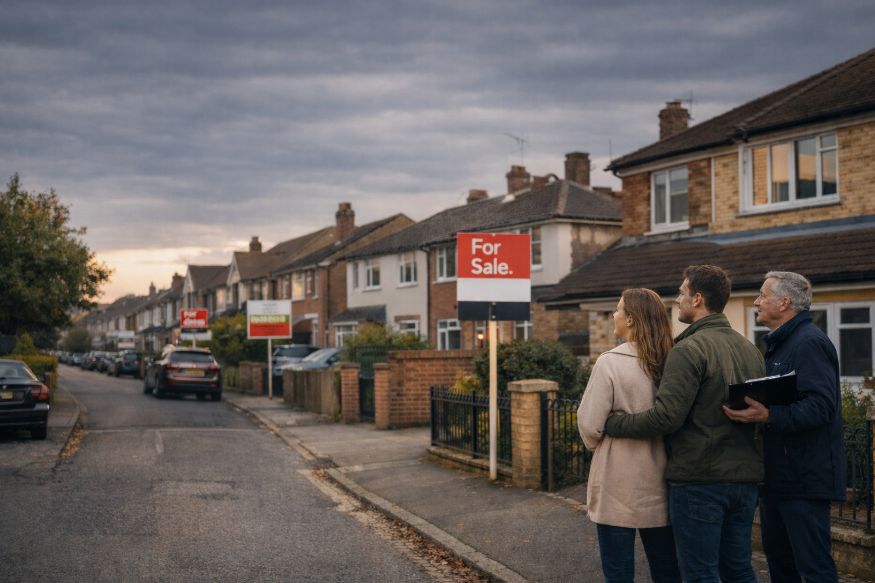
The UK housing market in 2026 is undergoing a noticeable shift. After years of rapid growth and intense competition, the pace has slowed, and conditions are changing. While the phrase “housing market slump UK” may sound alarming, the reality is more balanced than the headlines suggest.
Rather than signalling a collapse, the current environment reflects a transition towards stability. Prices are softening in some regions, supply is rising, and buyers are gaining more influence in negotiations. Understanding this shift is essential for anyone planning to buy, sell, or invest in property this year.
What Does the 2026 Housing Reset Really Mean for Buyers and Sellers?
 Current Price Trends: Nationwide, Halifax, and Land Registry Data
At the beginning of 2026, house prices across the UK recorded modest annual growth between 1.2% and 2.4%. This indicates that the market is not declining overall but growing at a much slower pace compared to previous years.
However, monthly fluctuations tell a more detailed story. A 0.5% dip reported by Halifax in March highlights the fragile nature of current demand. These short-term movements suggest that the market is stabilising rather than expanding rapidly.
For buyers, this means less urgency and fewer bidding wars. For sellers, it signals the need to price properties more realistically.
Supply at an 8-Year High: The Core Driver of the Slump
A key factor behind the housing market slowdown is the sharp increase in available properties. Estate agents entered 2026 with an average of 32 homes on their books, marking the highest level in nearly eight years.
This increase in supply has shifted the balance of power. Buyers now have significantly more options, which reduces pressure and encourages careful decision-making. As a result, many sellers are adjusting expectations, with a noticeable share of listings undergoing price reductions.
This change reflects a healthier market dynamic where pricing aligns more closely with actual demand.
Why Are House Prices Falling in Some UK Regions but Rising in Others?
The UK housing market does not behave uniformly. Regional differences are becoming more pronounced, with a clear divide between southern and northern areas.
Higher-value markets such as London and the South East are experiencing downward pressure due to affordability constraints and sensitivity to interest rate changes. In contrast, northern regions continue to perform well, supported by lower property prices and stronger buyer demand.
For buyers, this creates opportunities in traditionally expensive areas, while investors may find growth potential in more affordable regions.
Is the UK Heading Towards a Housing Market Crash in 2026?
Industry experts largely agree that a full-scale crash is unlikely. Instead, the current phase represents a correction following years of unusually strong growth.
2026 is expected to mark a return to a more stable and recognisable housing market after six years of exceptional volatility.
— Nick Leeming, Chairman of Jackson-Stops
Affordability is improving gradually as income growth outpaces house prices. We expect activity to strengthen, with prices remaining in a 2% to 4% growth range.
— Robert Gardner, Chief Economist at Nationwide
The underlying fundamentals of the market remain relatively strong. Employment levels are stable, and there is still a long-term shortage of housing across the UK. These factors reduce the likelihood of a dramatic downturn.
How Should Buyers and Investors Navigate the 2026 Market?
 The Mortgage Outlook: Interest Rate Impacts
The Bank of England base rate remains at 3.75% in early 2026. While this is lower than recent peaks, it is still significantly higher than pre-2022 levels.
Some forecasts suggest a gradual reduction towards 3% by the end of the year. However, global economic uncertainty continues to influence lender behaviour, leading to cautious mortgage offerings.
For buyers, this means affordability is improving slowly, but borrowing conditions remain tighter than in the past.
Tax and Regulatory Shifts: The “Mansion Tax” Factor
Changes in taxation are also influencing market behaviour. A High Value Council Tax Surcharge, often referred to as the “Mansion Tax,” is scheduled to take effect in 2028.
Although not yet implemented, this policy is already affecting buyer sentiment in the luxury segment. Properties above £2 million, particularly in London, are experiencing slower demand as buyers anticipate higher future costs.
Why Is the 2026 Housing Slump Different from the 2008 Crisis?
Negative Equity Risks vs. High Employment Levels
One of the key differences between 2026 and the 2008 financial crisis is the strength of the labour market. Employment levels remain relatively high, which supports household incomes and reduces the risk of forced property sales.
As a result, while some homeowners face higher mortgage costs, widespread distress selling is limited.
The End of Cheap Debt: Transitioning to the “New Normal” 3–4% Rates
The market is adjusting to a new reality where ultra-low interest rates are no longer available. Mortgage rates between 3% and 4% are becoming the standard.
This shift is encouraging more realistic pricing across the market. Buyers are factoring long-term affordability into their decisions, while sellers are adapting expectations accordingly.
How Are Landlord Sell-offs Influencing the Housing Market Slump UK?
Impact of the Renters’ Rights Bill on 2026 Supply
Recent regulatory changes have prompted many landlords to reconsider their positions. As a result, a growing number of rental properties are entering the sales market.
This increase in supply is contributing to the overall slowdown, particularly in areas with high concentrations of rental housing. Many of these properties require refurbishment, creating opportunities for buyers willing to invest in renovations.
EPC Rating Deadlines: The Cost of “Green” Compliance
Energy efficiency requirements are becoming increasingly important. Properties with lower EPC ratings are often less attractive to buyers due to the potential cost of upgrades.
This has led to more significant price reductions in older or less efficient homes, further contributing to the perception of a market slump.
Property Discounts and Market Behaviour in 2026
The data highlights how different property types are affected differently. Higher-value homes and older properties tend to stay on the market longer and require deeper discounts.
Are First-Time Buyers Benefiting from the 2026 Housing Market Conditions?
 The 2026 Help-to-Buy Successor: Who Qualifies?
Government support schemes continue to assist first-time buyers, particularly through shared ownership options. These programmes help maintain activity at the lower end of the market.
From “Generation Rent” to “Generation Negotiator”
First-time buyers are in a stronger position than they have been in years. With more properties available and less competition, they can negotiate more effectively.
For example, a buyer in Manchester who previously struggled with bidding wars may now secure a property at 5–10% below the asking price. This shift represents a significant change in market dynamics.
Can Office Conversions Help Stabilise the London Housing Market?
Repurposing the City: Can Office Conversions Save the London Market?
In response to changing work patterns, developers are increasingly converting underused office spaces into residential properties. This shift has accelerated since remote and hybrid working reduced demand for traditional office space, particularly in central London.
By increasing housing supply, these projects may help stabilise property prices over time while also reshaping the urban landscape.
One of the key advantages of office-to-residential conversions is speed. Compared to new-build developments, conversions can often be completed faster, helping to address short-term supply shortages in high-demand areas.
In addition, these projects are contributing to urban regeneration. Areas previously dominated by commercial buildings are gradually transforming into mixed-use neighbourhoods with residential, retail, and leisure spaces. This can improve local infrastructure and create more balanced communities.
However, there are limitations. Not all office buildings are suitable for conversion due to structural constraints, layout challenges, or planning regulations. In some cases, converted units may also lack the space or natural light found in purpose-built homes.
Despite these challenges, office conversions are becoming an important part of London’s housing strategy. While they may not fully resolve the housing shortage, they are playing a meaningful role in easing supply pressures and supporting market stability.
How Are Global Investors Responding to the UK Housing Market Slump?
The Weak Pound vs. High Entry Costs
The UK continues to attract international interest due to a relatively weak pound, which enhances purchasing power for overseas investors. For buyers from countries with stronger currencies, UK property particularly in London can appear more affordable compared to previous years.
This currency advantage is one of the main reasons why global investors remain active, even during a housing market slowdown.
However, this opportunity is balanced by several challenges. Higher stamp duty rates for overseas buyers, along with additional property taxes and stricter regulations, have increased the overall cost of investment. These factors are making investors more selective about where and what they purchase.
Another important consideration is market stability. While some investors are drawn to potential discounts in a slower market, others are adopting a cautious approach, waiting for clearer signals on interest rates and long-term price trends.
There is also a shift in investment strategy. Instead of focusing solely on high-end London properties, some international buyers are exploring regional cities with stronger growth potential and better rental yields.
At the same time, geopolitical factors and global economic conditions continue to influence investor behaviour. Uncertainty in other markets can either drive capital into the UK as a safe haven or reduce overall investment activity.
Overall, foreign investment in 2026 remains steady but highly selective. Investors are prioritising value, long-term returns, and regulatory clarity rather than short-term gains.
How Is Buyer Behaviour Changing During the Housing Market Slump UK?
 More Cautious Decision-Making and Longer Sales Cycles
Buyers in 2026 are approaching the market with greater caution. Unlike the urgency seen in previous years, decision making timelines have extended significantly. Properties are staying on the market longer, allowing buyers to evaluate options more thoroughly.
This shift is largely driven by higher borrowing costs and economic uncertainty. Buyers are no longer rushing into purchases but instead prioritising value, affordability, and long-term suitability.
As a result, sellers are experiencing longer sales cycles, often needing to adjust pricing strategies to attract serious interest.
Increased Negotiation Power and Price Sensitivity
One of the most notable changes is the growing confidence among buyers to negotiate. With more properties available and less competition, buyers are successfully securing discounts often between 5% and 10% below asking price in certain areas.
Price sensitivity has also increased. Buyers are scrutinising property condition, location, and energy efficiency more closely than before. Even minor issues can lead to renegotiation or withdrawal from deals.
This behavioural shift is a defining feature of the housing market slump UK, reinforcing the transition toward a buyer-driven market.
What Does the Future Outlook Hold for the Housing Market Beyond 2026?
Short-Term Stability vs Long-Term Growth Potential
Looking ahead, most forecasts suggest that the UK housing market will remain relatively stable in the short term. Price growth is expected to stay modest, with fluctuations depending on interest rates and broader economic conditions.
However, the long-term outlook remains more positive. Structural factors such as population growth, housing shortages, and urban development continue to support demand. These fundamentals are likely to drive gradual price increases over time.
Key Risks and Opportunities to Watch
Several factors will shape the market beyond 2026:
- Interest rate movements and inflation trends
- Government housing policies and taxation changes
- Supply levels, including new builds and conversions
- Investor activity, both domestic and international
At the same time, opportunities are emerging for buyers and investors who adopt a long-term perspective. Entering the market during a period of reduced competition can provide better value and stronger future returns.
Conclusion
The housing market slump UK in 2026 represents a transition rather than a collapse. Increased supply, stabilising interest rates, and changing buyer behaviour are reshaping the market into a more balanced and sustainable environment.
Buyers now benefit from greater choice and stronger negotiating power, while sellers must adapt to more realistic pricing expectations. Over time, this shift is likely to create a more stable housing market that supports long-term growth rather than short-term volatility.
FAQs About 2026 Property Market
Will UK house prices fall further this year?
Prices may fluctuate in the short term, particularly in higher-value regions, but overall trends suggest modest growth rather than continued decline.
Is now a good time to invest in UK property?
The current market offers opportunities, especially in regions with strong demand and affordability, such as the North West.
How are mortgage rates affecting buyers in 2026?
Mortgage rates remain higher than historical lows, which affects borrowing capacity, but conditions are gradually improving.
Which properties are hardest to sell right now?
Luxury homes and properties requiring significant energy efficiency upgrades tend to remain on the market longer.
Are landlords continuing to leave the market?
Some landlords are exiting due to regulatory pressures, increasing supply in the housing market.
What role does supply play in the current market slowdown?
Higher supply gives buyers more choice and reduces upward pressure on prices.
Will London property prices recover soon?
Recovery is expected to be gradual, influenced by interest rates, demand, and economic conditions.