







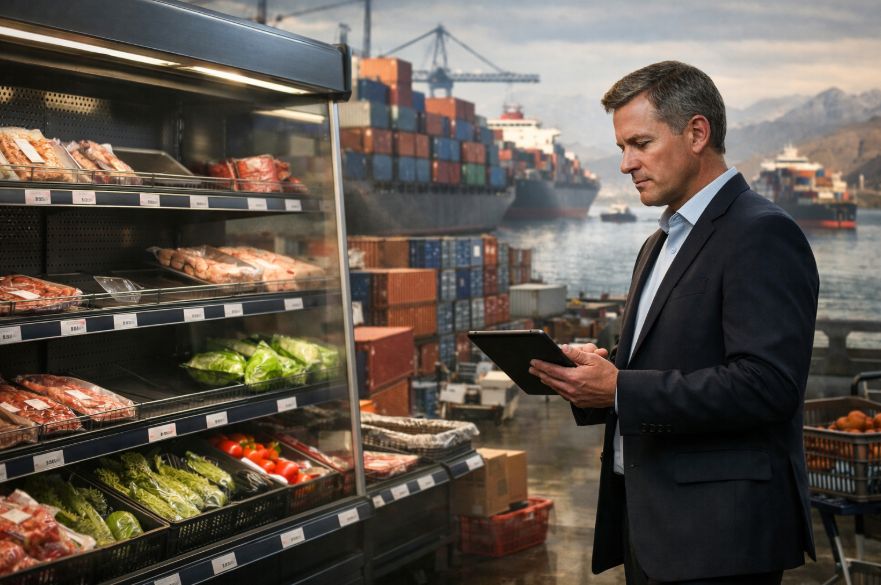
Crisis Snapshot for UK Businesses
UK Food Shortages & the Iran War: What Businesses Need to Know Before the Crisis Deepens
Key Takeaway
The 2026 UK food crisis is not simply about empty shelves. It is a wider supply chain emergency driven by
disruption in the Strait of Hormuz, rising fertiliser and energy costs, potential CO2 shortages,
shipping delays, and inflationary pressure. Businesses that review supplier exposure, build resilience, and
diversify sourcing now will be better placed to protect margins, maintain continuity, and respond with confidence.
Quick Snapshot
Iran war disruption affecting energy, trade routes, and food-related inputs
Higher costs, slower deliveries, and reduced operational predictability
Retail, hospitality, food manufacturing, wholesale, and agriculture
Diversify suppliers, increase buffer stock, and audit hidden dependencies
At-a-Glance Risk Table
| Risk Area | What Is Happening | Business Impact | Immediate Action |
|---|---|---|---|
| CO2 Supply | Potential shortages affecting food processing, packaging, and preservation | Pressure on meat supply, shelf life, and product availability | Review suppliers and identify CO2-dependent products |
| Fertiliser Costs | Global scarcity and higher energy-linked production costs | Reduced crop yields and higher agricultural input prices | Plan for supplier diversification and cost exposure |
| Shipping Delays | Rerouting through longer maritime paths due to regional instability | Longer lead times, higher freight charges, and inventory disruption | Increase safety stock on critical goods |
| Food Inflation | Rising costs across energy, logistics, and agricultural inputs | Margin compression and consumer price sensitivity | Stress-test pricing and procurement strategy |
| Compounding Risks | Environmental shocks and cyber disruption adding strain to fragile networks | Greater operational uncertainty across supply chains | Strengthen continuity planning and supplier visibility |
Business view: This crisis is not just about whether food is available.
It is about whether UK businesses can continue sourcing, producing, pricing, and delivering efficiently in a more volatile trading environment.
Recent developments linked to the UK government’s contingency planning often referred to as Exercise Turnstone have brought renewed scrutiny to the resilience of the UK’s food system. While official messaging remains cautiously reassuring, internal “reasonable worst-case scenario” modelling suggests that noticeable disruptions to supermarket supply could emerge by summer 2026 if geopolitical tensions continue to escalate.
At the centre of this concern is the instability affecting the Strait of Hormuz, a vital global trade artery through which a significant share of the world’s energy supply passes. What initially appeared to be a regional geopolitical conflict has now evolved into a multi-dimensional supply chain crisis with direct implications for UK food security.
The issue is not simply about food availability. It is about the systems that enable food to be produced, processed, transported, and delivered efficiently. Rising fertiliser costs, constrained carbon dioxide (CO₂) supply, shipping delays, and compounding environmental pressures are converging to create a complex risk environment.
For UK businesses particularly those operating in retail, hospitality, manufacturing, and agriculture this is a critical moment. The ability to understand and mitigate these risks will determine not only operational continuity but also long-term competitiveness.
What is Driving Concerns About UK Food Shortages Due to the Iran War?
 The concern surrounding UK food shortages is not based on a single failure point but rather on a chain reaction of interconnected disruptions.
At a high level, the Iran conflict is affecting three core pillars of the global food system:
- Energy supply
- Agricultural inputs
- Logistics and transportation
Each of these pillars feeds into the next, creating a cascading effect.
Confirmed systemic drivers
How this affects businesses?
For a UK-based food distributor, for example, rising fuel costs increase transport expenses, while fertiliser shortages reduce supply from farms. At the same time, delays at ports disrupt inventory planning. The result is a compounded operational challenge, not a single isolated issue.
Why is the Strait of Hormuz critical to UK food supply chains?
The Strait of Hormuz plays a central role in global trade, particularly in energy markets.
Roughly one-fifth of the world’s oil supply passes through this narrow corridor. Any disruption here has immediate and far-reaching consequences.
Strategic importance
Practical implications for UK businesses
When tankers are delayed or rerouted, energy prices rise. This, in turn, increases the cost of:
- Operating farm machinery
- Producing fertilisers
- Transporting goods across supply chains
Additionally, shipping disruptions force vessels to reroute around longer paths, such as the Cape of Good Hope, adding weeks to delivery times.
Real-world example
A UK importer relying on Middle Eastern fertiliser shipments may experience delays of up to 20 days. This delay can disrupt planting schedules, ultimately reducing crop output months later.
5 Critical Supply Chain Risks From the Iran War
1. The Carbon Dioxide (CO₂) Crisis: Beyond Fizzy Drinks
 Carbon dioxide is a foundational component of the modern food supply chain, yet its importance is often underestimated.
Confirmed uses of CO₂
- Humane stunning of poultry and pigs
- Modified atmosphere packaging (MAP) to extend shelf life
- Carbonation of beverages
- Refrigeration and cold chain logistics
Under severe disruption scenarios, CO₂ supply could fall to as low as 18% of normal capacity.
Operational impact
Business perspective
For a supermarket chain, reduced CO₂ availability could mean shorter shelf life for fresh products, leading to more frequent restocking requirements and increased waste costs.
2. Surging Fertiliser Costs & Global Scarcity
 Fertiliser is essential for maintaining agricultural productivity. The Iran conflict has intensified pressure on global fertiliser markets, particularly nitrogen-based products such as urea and ammonia.
The Gulf region accounts for a substantial share of global exports, making it highly sensitive to geopolitical instability.
Key challenges
Impact on UK agriculture
Farmers facing higher fertiliser costs may reduce usage, leading to:
- Lower crop yields
- Reduced domestic production
- Increased reliance on imports
Long-term implications
Unlike immediate disruptions, fertiliser shortages have a delayed but lasting effect, influencing harvest cycles months after the initial disruption.
3. Maritime Bottlenecks: The Strait of Hormuz & Red Sea
 Global logistics networks are under significant strain due to disruptions in key maritime corridors, including the Red Sea.
Key disruptions
- Closure or restriction of critical shipping routes
- Increased insurance costs for vessels
- Port congestion due to rerouted traffic
Operational consequences
Business scenario
A UK food manufacturer relying on imported ingredients may face production delays, forcing them to either halt operations temporarily or source more expensive alternatives.
4. Aggravated Food Inflation
 Food inflation is one of the most immediate and visible outcomes of supply chain disruption.
Forecasts suggest UK food inflation could reach 9% to 12% by the end of 2026, driven by rising costs across multiple inputs.
Inflation drivers
Impact on businesses
Businesses must navigate a delicate balance between:
- Passing costs onto consumers
- Maintaining competitive pricing
- Protecting profit margins
Consumer impact
Higher food prices reduce purchasing power, potentially leading to shifts in consumer behaviour, such as reduced spending on premium products.
5. Compounding Environmental & Cyber Risks
 The Iran conflict is not occurring in isolation. It is intersecting with other systemic risks, creating a multi-layered threat environment.
Environmental pressures
Climate patterns such as El Niño are already affecting yields for commodities like coffee, cocoa, and sugar.
Cyber risks
Retailers including Marks & Spencer and Co-op have experienced cyber disruptions, highlighting vulnerabilities in digital infrastructure.
Combined risk matrix
Strategic implication
The convergence of these risks creates a “perfect storm” scenario, where disruptions amplify each other rather than occurring independently.
How exposed is the UK to global food supply disruptions?
The UK imports approximately 40–50% of its food, making it particularly vulnerable to external shocks.
Dependency breakdown
Key insight
Import reliance means that global instability quickly translates into domestic pressure, even if local production remains stable.
What Do Current Data Trends Reveal About UK Food Security in 2026?
Interpretation
The data suggests a system-wide stress scenario, rather than isolated shortages. This distinction is important for businesses planning mitigation strategies.
How are experts interpreting the UK food supply crisis?
Experts increasingly frame food security as a strategic national priority, comparable to energy and cyber security.
The emphasis is on:
- Supply chain diversification
- Risk visibility
- Scenario planning
Key takeaway
Businesses that proactively identify vulnerabilities and develop contingency plans are significantly better positioned to manage disruption.
What practical steps can UK businesses take to mitigate supply chain risks?
Mitigation requires a structured and proactive approach.
Core strategies
Practical example
A hospitality chain that sources ingredients from multiple regions can maintain operations even if one supply route is disrupted.
How can businesses build long-term resilience against geopolitical shocks?
Long-term resilience involves structural changes rather than short-term fixes.
Key approaches
- Developing multi-supplier networks
- Investing in digital supply chain tools
- Strengthening local sourcing where feasible
- Conducting regular scenario planning exercises
Strategic outlook
Resilient organisations are those that treat disruption as a predictable risk, rather than an unexpected event.
Conclusion
The relationship between UK food shortages and the Iran war is grounded in real and measurable supply chain vulnerabilities. While widespread shortages have not yet materialised, the underlying pressures are intensifying.
For UK businesses, the priority is clear:
understand exposure, act early, and build resilience.
Those that take proactive steps now will be better equipped to navigate the uncertainties of 2026 and beyond.
FAQ About UK Food Shortages & Iran Conflict
Which UK sectors are most affected by supply chain disruptions?
Retail, hospitality, agriculture, and food manufacturing are particularly exposed due to their reliance on global supply chains.
How do energy prices influence food supply?
Energy costs affect fertiliser production, transportation, and processing, making them a key driver of food prices.
Are food shortages currently happening in the UK?
There is no evidence of widespread shortages, but supply pressures are increasing.
What makes CO₂ so important in food production?
It is essential for packaging, preservation, and livestock processing, making it critical to supply chain operations.
Can businesses eliminate supply chain risks entirely?
No, but they can significantly reduce exposure through diversification and planning.
How long could these disruptions last?
The duration depends on geopolitical developments, but effects could persist for months or longer.
Is local sourcing a complete solution?
It improves resilience but cannot fully replace global supply networks.