








Statutory Maternity Pay (SMP) in the UK plays a vital role in supporting employees during their time away from work after childbirth. For 2026, the SMP structure continues to follow a two-tier payment system, offering 90% of average weekly earnings for the first six weeks and a fixed statutory rate for the remaining weeks.
As these rates are revised annually, it’s important for both employers and employees to understand the latest figures, eligibility requirements, and how to navigate the application and payment process. This guide offers a full breakdown of SMP in 2026, aligned with the most recent government regulations.
What Is Statutory Maternity Pay (SMP) in the UK?
 Statutory Maternity Pay is a government-mandated payment that employers are legally required to provide to eligible employees during maternity leave. It is different from Maternity Allowance, which is handled by the Department for Work and Pensions (DWP) and intended for those who do not qualify for SMP.
SMP is managed through an employer’s payroll system and is treated similarly to a regular salary. This means the payments are subject to tax and National Insurance deductions. Employers can usually reclaim a significant portion of SMP costs from HMRC.
The purpose of SMP is to offer financial security to individuals taking time off to have a baby, ensuring a minimum level of income while they are away from work.
How Much Is Statutory Maternity Pay in 2026?
As of 6 April 2026, Statutory Maternity Pay is structured as follows:
- For the first six weeks of maternity leave, employees receive 90% of their average weekly earnings before tax.
- For the remaining 33 weeks, employees receive £184.03 per week or 90% of their average weekly earnings whichever amount is lower.
These rates reflect the annual increase set by HMRC and typically change every April in line with inflation and tax regulations.
Below is an illustrative table showing how SMP might look based on an average weekly earnings example of £400:
| SMP Period | Payment Basis | Estimated Amount |
| First 6 Weeks | 90% of £400 | £360.00 per week |
| Weeks 7 to 39 | Lower of £184.03 or 90% of AWE | £184.03 per week |
| Total SMP (39 Weeks) | – | Approx. £6,603.99 |
This total can vary depending on actual earnings and payroll scheduling.
What Are the Eligibility Criteria for SMP in 2026?
To qualify for SMP in 2026, employees must meet several conditions. They must have been continuously employed by the same employer for at least 26 weeks by the end of the 15th week before the expected week of childbirth. This is often referred to as the “qualifying week.”
Additionally, the employee must earn at least the Lower Earnings Limit, which is £123 per week in 2026. This threshold must be met during the eight-week reference period leading up to the qualifying week.
Employees are also required to provide a valid MATB1 certificate, typically issued by a midwife or doctor after the 20th week of pregnancy, and must give their employer at least 28 days’ notice before the date they intend to start their maternity leave and SMP.
How Is SMP Calculated and Paid to Employees?
 The calculation of SMP depends on the employee’s average weekly earnings, typically based on the eight-week period leading up to the end of the qualifying week. The employer uses this figure to calculate the initial 90% pay for the first six weeks.
After this period, the statutory flat rate £184.03 per week in 2026 applies unless 90% of the average earnings is lower. SMP is paid in the same way as wages, usually on the normal payday, and is subject to deductions for tax and National Insurance.
Employers must maintain accurate payroll records to ensure correct payment. Most payroll systems are equipped to handle SMP automatically, but manual intervention is often required to enter key dates and earnings information.
What Documents and Forms Are Required to Claim SMP?
To begin receiving SMP, an employee must submit their MATB1 certificate to confirm the pregnancy and expected due date. They must also notify their employer of their intention to take maternity leave, including the proposed start date.
Once the employer receives this documentation, they are responsible for confirming eligibility and setting up SMP through payroll. If an employee is not eligible, the employer must issue form SMP1, which allows the employee to claim Maternity Allowance instead.
What Are the Key Dates and Deadlines to Remember for SMP in 2026?
Employees must inform their employer at least 28 days before they want their SMP to begin. Maternity leave can start any time from 11 weeks before the expected week of childbirth.
The 15th week before the expected week of childbirth is crucial, as it marks the qualifying week. Employment and earnings assessments are based on the period up to this point. SMP payments start on the chosen maternity leave date and continue for up to 39 weeks.
Here’s a quick example:
- Baby due: 20 July 2026
- Qualifying week: Week beginning 6 April 2026
- Earliest SMP start date: 6 May 2026
- End of SMP period: Early February 2027
Understanding these timelines helps avoid delays or disqualifications.
Can Employers Offer Enhanced Maternity Pay in Addition to SMP?
 Yes, many employers offer enhanced maternity pay as part of their contractual benefits. These packages often go beyond the statutory minimum and may include full pay for a specified period, half pay for the following weeks, or additional bonuses upon return to work.
Such enhancements are at the employer’s discretion and typically detailed in the employment contract or staff handbook. They do not replace SMP but supplement it. If an employer offers enhanced pay, they still need to fulfil their legal obligation to pay SMP and handle payroll deductions accordingly.
How Does SMP Affect Taxes, Benefits, and Pensions?
SMP is considered taxable income and is subject to National Insurance contributions. It will appear on payslips and should be declared on any necessary tax documents.
It may affect eligibility for means-tested benefits such as Universal Credit. However, SMP does not impact Child Benefit, and entitlement continues during maternity leave.
Pension contributions during SMP depend on the employer’s pension scheme. In many cases, employers continue to make contributions based on the employee’s usual salary during the period of paid maternity leave, especially under auto-enrolment rules. Employees should confirm the specific terms with their HR or payroll department.
What Happens If an Employee Is Not Eligible for SMP?
Employees who do not meet the SMP criteria may still qualify for Maternity Allowance, which is paid directly by Jobcentre Plus. This benefit is available to individuals who have been employed or self-employed for at least 26 weeks in the 66 weeks before the baby is due and who earned at least £30 a week.
Maternity Allowance in 2026 is set at £184.03 per week or 90% of average weekly earnings, whichever is lower, for up to 39 weeks the same amount as SMP’s flat rate, but provided by the government rather than the employer.
The application process involves submitting form MA1, proof of earnings, and the MATB1 certificate.
How Can Employers Reclaim SMP Payments in 2026?
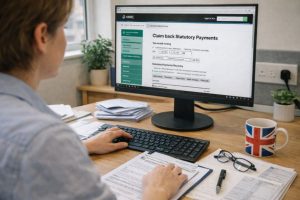 Employers can recover most, if not all, of the SMP they pay through their PAYE system. Most businesses can reclaim 92% of the SMP payments by declaring them on their Employer Payment Summary (EPS) submission to HMRC.
Small employers defined as those who paid less than £45,000 in Class 1 National Insurance in the previous tax year can reclaim 103% of the SMP paid. This additional 3% is to help cover administrative costs.
This reclaim process is generally automated within payroll software, but accurate records and timely submissions are essential to ensure the refund is processed correctly.
What Common Challenges Do Claimants and Employers Face with SMP?
One of the most common issues involves miscalculation of the qualifying period or the average weekly earnings. Employers sometimes misinterpret the qualifying week rules or fail to account for irregular earnings, leading to underpayment or overpayment of SMP.
There are also cases where forms are submitted late or are incomplete, delaying SMP approval. Employers may struggle with updating their payroll systems to reflect new rates, especially around April when the figures change.
In situations where there is confusion or dispute, both employees and employers can contact HMRC or use ACAS for guidance on resolving maternity-related pay issues.
Where Can You Find the Most Up-to-Date SMP Information?
The most reliable source for SMP information in the UK is the official government website. Employers and employees should regularly consult:
- gov.uk – Maternity Pay and Leave
- HMRC Employer Bulletins
- ACAS – Maternity Rights Guide
These sites are regularly updated, especially ahead of the April changes, and provide detailed guides, forms, and calculators to help navigate maternity pay and leave.
FAQs
How long do you have to work to qualify for SMP in 2026?
You must have been employed continuously for at least 26 weeks by the end of the 15th week before the baby is due.
Can SMP start before the baby is born?
Yes. SMP can start from 11 weeks before the expected week of childbirth or the day after the baby is born if early.
Do zero-hour contract workers qualify for SMP?
Only if they meet the employment and earnings criteria. Irregular hours do not automatically disqualify someone.
Can you receive SMP if you’re no longer working when the baby is born?
Yes, as long as you were employed during the qualifying period and meet the earnings criteria.
Is SMP affected by shared parental leave?
Yes. If you choose to end SMP early to take shared parental leave, the remaining balance is forfeited.
Will my job be protected while I’m receiving SMP?
Yes. Employees on maternity leave have the right to return to the same job or an equivalent one.
Does taking maternity leave affect future promotions or bonuses?
Legally, employees must not be disadvantaged for taking maternity leave. Employers must assess promotions fairly.