







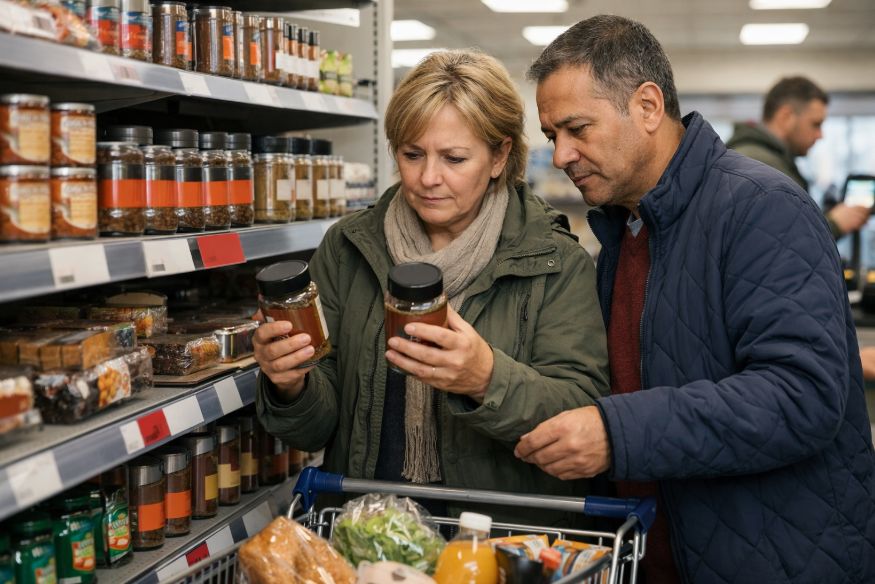
Quick Snapshot
Tesco and Sainsbury’s shoppers without loyalty cards are increasingly paying more for everyday branded groceries. In some cases, even Waitrose offers lower standard prices, exposing how dual pricing can make “member savings” look bigger than they really are.
Key Takeaway
The real issue is not just rising grocery costs. It is the growing two-tier pricing model, where shoppers without a Clubcard or Nectar card can pay noticeably higher prices. The smartest way to avoid overpaying is to compare standard prices, use loyalty schemes selectively, and stay flexible about where you shop.
Price Snapshot
| Branded Item | Tesco/Sainsbury’s (Non-Member) | Waitrose Price | Difference |
|---|---|---|---|
| Heinz Baked Beans (4-pack) | £4.75 | £4.00 | +18% |
| Nescafé Gold Blend (200g) | £8.10 | £7.00 | +15% |
| Mr Kipling Cakes | £2.75 | £2.25 | +22% |
For decades, Tesco and Sainsbury’s have been considered the dependable middle ground for UK shoppers offering a balance between affordability and quality. But recent findings suggest that this perception may no longer reflect reality.
A 2026 investigation has revealed a striking shift: Tesco and Sainsbury’s shoppers paying more is no longer an exception it is becoming increasingly common, particularly for those who do not use loyalty cards. In some cases, these shoppers are even paying more than customers at premium retailers like Waitrose for the same branded goods.
At the centre of this issue is a growing two-tier pricing system, where loyalty card holders receive discounted prices, while non-members face significantly higher standard prices. What appears to be a saving may, in reality, be a carefully structured pricing model.
This blog explains what is happening, why it matters to you, and how you can make more informed choices to avoid overpaying.
Why Are Tesco and Sainsbury’s Shoppers Paying More?
 Recent consumer research, including analysis from Which?, highlights a consistent pattern across major UK supermarkets. When loyalty pricing is removed from the equation, Tesco and Sainsbury’s often appear more expensive on everyday branded items.
What does the data show?
The data reveals that non-loyalty shoppers frequently pay between 15% and 22% more on selected branded groceries compared to competitors.
What is the direct takeaway?
Tesco and Sainsbury’s shoppers paying more is largely driven by the gap between loyalty and non-loyalty pricing, rather than a uniform increase across all products.
Confirmed facts
- Dual pricing is now a standard retail practice in the UK
- Branded goods show the largest pricing gaps
- Some premium supermarkets maintain more stable base prices
What is still being debated?
- Whether these pricing strategies are intentionally misleading
- The long-term impact on consumer trust
What Is the ‘Loyalty Card Trap’ and How Does It Work?
The term “loyalty card trap” describes a situation where shoppers feel compelled to join a scheme simply to avoid paying inflated prices.
The Illusion of Savings
At first glance, loyalty discounts appear to offer clear financial benefits. However, the structure behind them can be more complex.
The key issue is that standard prices may be increased first, allowing retailers to present loyalty prices as significant discounts. This creates a perception of savings, even when the discounted price is closer to the original market value.
As a result, shoppers may feel they are getting a deal when they are actually paying what used to be the normal price.
Data as Currency
Loyalty programmes are free to join, but they operate on an exchange of value that is not always obvious.
When you use a loyalty card, you provide data such as your purchase history and shopping habits. Retailers use this information to refine marketing strategies and personalise offers.
It is important to distinguish between what is confirmed and what remains speculative:
- Confirmed: Data is collected and used for targeted promotions
- Discussed: Data may influence how offers are presented
- Not proven: Individual shoppers receiving entirely different base prices
How Is the UK Retail Landscape Changing?
The rise of loyalty-based pricing reflects a broader shift in how supermarkets compete and engage with customers.
Expert insight
Retail analysts suggest that supermarkets are moving away from universal pricing models towards more controlled and data-driven systems. This shift changes the role of the customer from a passive buyer to an active participant in the pricing system.
What does this mean in practice?
Shoppers who engage with loyalty schemes benefit from discounts, while those who do not may face consistently higher costs. This creates a divide between different types of consumers.
What is the role of the CMA?
The Competition and Markets Authority (CMA) has begun examining whether loyalty pricing could be misleading or unfair.
Confirmed position
The CMA is reviewing:
- Transparency in pricing
- Accessibility for all consumers
- Potential disadvantages for vulnerable groups
Why does this matter?
Shoppers who are less digitally engaged or who prefer not to share personal data may be disproportionately affected by these changes.
How Can You Avoid Overpaying at the Checkout?
 Avoiding the loyalty card trap does not require drastic changes, but it does require awareness and a more deliberate approach to shopping.
1. Use Comparison Tools Before You Shop
Checking prices across supermarkets before purchasing can reveal significant differences. Tools like Trolley.co.uk allow you to compare products quickly and identify genuine savings.
2. Consider the “Waitrose Alternative”
Although traditionally seen as a premium option, Waitrose can sometimes offer lower standard prices on branded goods. This is particularly relevant for shoppers who do not use loyalty cards elsewhere.
3. Move to ‘Own-Brand’ Disruption
Own-brand products are less affected by dual pricing strategies. Discounters such as Aldi and Lidl continue to offer consistent pricing, making them a reliable option for reducing overall spend.
4. Clear Your Cache
For online shoppers, browsing behaviour can influence how offers are displayed. Clearing cookies or using private browsing may help ensure you are seeing standard offers rather than personalised ones.
5. Use Loyalty Cards Strategically
Loyalty cards can still be useful when used carefully. The key is to treat them as a tool rather than a default.
Focus on:
- Genuine discounts rather than perceived savings
- Products you already intend to buy
- Comparing loyalty prices with other supermarkets
What Are the Broader Implications for UK Shoppers?
The shift towards loyalty-based pricing reflects a deeper change in retail strategy. Pricing is no longer purely about cost it is increasingly about behaviour, data, and engagement.
Real-life example
A family in London recently adjusted their shopping habits after noticing rising costs. By comparing prices and splitting their shop across multiple supermarkets, they reduced their weekly grocery bill by nearly £20 without changing what they bought.
This example highlights a key point: awareness, rather than sacrifice, is often the most effective way to save money.
What Should You Remember About Tesco and Sainsbury’s Shoppers Paying More?
Tesco and Sainsbury’s shoppers paying more is not simply about rising prices it is about how prices are presented and who benefits from them.
Key takeaways
- Loyalty pricing creates a two-tier system
- Non-members often pay noticeably higher prices
- Branded goods are most affected
- Smart shopping now requires active comparison
Understanding these points allows you to make better decisions without completely changing where you shop.
Conclusion
The reality behind Tesco and Sainsbury’s shoppers paying more is not about abandoning these supermarkets—it is about understanding how their pricing works.
Loyalty cards, including supermarket schemes, fuel card programmes, and offers like Tesco double points, can offer value, but only when used with awareness. Without that understanding, it becomes easy to pay more than necessary for everyday essentials.
In today’s retail environment, the most effective shopper is not the most loyal but the most informed.
FAQ: Tesco & Sainsbury’s Price Hikes
Why do prices differ with and without loyalty cards?
Prices differ because supermarkets apply discounts specifically for loyalty members, while standard prices remain higher.
Are loyalty schemes becoming mandatory?
They are not officially mandatory, but pricing structures increasingly encourage their use.
Is it cheaper to shop at multiple supermarkets?
Yes, in many cases, splitting your shopping can reduce overall costs.
Do loyalty cards affect online and in-store prices equally?
Generally yes, although online offers may also be influenced by browsing behaviour.
Are own-brand products safer from price inflation?
They tend to be more stable in pricing compared to branded goods.
Could regulations change loyalty pricing?
There is ongoing review, and future regulations may increase transparency.
Is the loyalty card trap avoidable?
Yes, with awareness, comparison, and selective use of loyalty schemes.