








!
Key Context
The Energy Independence Bill represents the most significant legislative shift in North Sea policy since the creation of the North Sea Transition Authority.
Ed Miliband, the Secretary of State for Energy Security and Net Zero, is forging ahead with the Labour government’s most contentious energy policy since its 2024 election victory: a permanent, statutory ban on any new oil and gas exploration licences in UK waters. The proposed Energy Independence Bill has ignited fierce opposition from the offshore oil and gas sector, prompted warnings of accelerated industrial decline in Scotland’s north-east, and raised fundamental questions about the UK’s short-term energy security amid ongoing global volatility.
Yet Miliband remains unmoved. For his supporters, the Bill is a once-in-a-generation opportunity to lock in the UK’s net-zero transition and end what he has characterised as a costly and ultimately futile dependence on volatile fossil fuel markets. For his critics a coalition that spans energy executives, trade unions, and opposition MPs it represents a reckless gamble with the nation’s economic stability.
The Core Policy:
What Is the Energy Independence Bill?

The Energy Independence Bill is the legislative vehicle through which the Labour government intends to enshrine its licensing moratorium in permanent statute. Unlike the administrative freeze that took effect in 2024 a policy decision that could theoretically be reversed by a future government this Bill would amend the primary legislative framework governing the North Sea Transition Authority (NSTA), stripping it of the power to issue any new exploration or production licences for oil and gas.
The measure goes further than many in the energy sector anticipated. It does not simply pause the licensing round system; it fundamentally rewrites the NSTA’s mandate, redirecting the regulator’s focus exclusively towards managing the decommissioning of existing assets, overseeing the just transition of the offshore workforce, and facilitating the expansion of offshore wind, carbon capture, and hydrogen infrastructure.
How the legislative mechanism works?
The Bill works through three principal statutory mechanisms:
- Amendment to the Petroleum Act 1998: removing the Secretary of State’s authority to grant new petroleum licences in UK waters, replacing it with a duty to refuse any such applications.
- Revision of the NSTA’s statutory objectives: the Energy Act 2016 currently requires the NSTA to maximise economic recovery from the North Sea. The Bill proposes to replace this with a net-zero-aligned mandate centred on managed transition and decommissioning oversight.
- A sunset clause on existing extended licences: licence extensions granted before the moratorium came into force will remain valid but will be subject to tightened environmental conditions and production caps, which analysts expect to constrain the commercial viability of marginal fields.
Legislative Timeline at a Glance
Labour wins general election; administrative moratorium on new North Sea licences announced
Miliband signals intent to legislate the ban permanently within the first parliamentary term.
Great British Energy Act passed
Creates the publicly owned clean energy company as the positive counterpart to the drilling ban.
Energy Independence Bill introduced to Parliament
Second reading debate reveals deep cross-party disagreement; Scottish National Party voices concerns about economic impact on north-east Scotland.
Committee stage and Lords scrutiny
Industry lobbying intensifies; OEUK and trade unions brief MPs on projected job losses.
Royal Assent expected
Permanent licensing ban set to become law, fundamentally altering the NSTA’s statutory remit.
Ed Miliband vs. The Energy Sector: The Nature of the Backlash
The response from the oil and gas industry has been swift, sustained, and by the standards of a sector accustomed to navigating political headwinds unusually public. Offshore Energies UK (OEUK), the principal trade body representing companies operating on the UK Continental Shelf, has led the charge against the legislation, arguing that its consequences extend far beyond the boardrooms of Aberdeen and Houston.
The industry’s core arguments against the ban
Jobs at scale
OEUK estimates that the North Sea supports more than 200,000 jobs across its direct and supply-chain workforce. The trade body has warned that the Bill absent a credible and fully funded transition plan risks displacing workers into unemployment rather than into the green economy.
Tax revenue collapse
North Sea operators contribute significantly to the public finances through the Energy Profits Levy and corporation tax. Industry projections suggest the UK exchequer could face a cumulative loss of tens of billions of pounds in fiscal receipts over the coming decade as existing fields are run down without new production to replace them.
Import dependency
Perhaps the most politically potent argument: the UK will not reduce its oil and gas consumption simply because it stops producing its own. Demand will be met by imports from Norway, Qatar, the United States, and potentially less geopolitically reliable suppliers with the carbon footprint of liquefied natural gas imports estimated to be materially higher than domestically produced gas.
Fiscal regime uncertainty
The combination of the Energy Profits Levy windfall tax and the licensing ban has, executives argue, made the UK Continental Shelf one of the least attractive investment environments among mature oil and gas basins globally, accelerating capital flight at precisely the wrong moment.
“The North Sea is not a sunset industry it is the backbone of a transition that, if managed correctly, could make the UK a global leader in offshore energy. A blanket ban does not accelerate that transition; it simply offshores the emissions and the jobs.”
David Whitehouse, Chief Executive, Offshore Energies UK (OEUK)
What Is Miliband’s Counter-Argument on Stability, Energy Security, and Household Bills?
Miliband’s case for the Bill rests on three pillars that he argues the industry’s critique fundamentally ignores. First, he contends that the continued issuance of North Sea licences does not meaningfully reduce domestic energy prices North Sea oil and gas is sold at international market rates, meaning UK consumers derive no automatic price benefit from domestic production.
Second, he argues that the only durable route to lower household and business energy bills is to eliminate reliance on volatile global commodity markets altogether, through a clean energy system dominated by wind, solar, and nuclear power with zero fuel costs. Third, he insists that the investment certainty provided by a statutory ban rather than the stop-start policy environment of previous administrations will ultimately attract greater capital into the UK’s offshore clean energy sector than any continuation of the old licensing regime.
“The government’s analysis is correct that gas prices, not North Sea production levels, determine UK household energy bills. The uncomfortable truth for the industry is that more UK oil and gas does not equate to cheaper UK energy. The structural argument for clean energy is sound the execution risk is in the transition speed.”
Dr Helena Grant, Senior Energy Policy Fellow, Imperial College London Energy Futures Lab
The Impact on Major Projects: Rosebank, Jackdaw, and Beyond
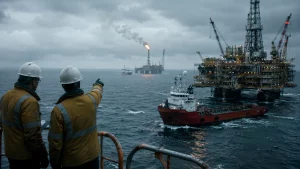
Few aspects of the licensing ban have generated more uncertainty and litigation than its implications for major developments already in the pipeline. Two fields in particular have become the defining battlegrounds for the policy: Rosebank and Jackdaw.
Rosebank: The flagship controversy
The Rosebank field, located approximately 80 miles north-west of Shetland, is one of the largest undeveloped oil and gas fields in UK waters. Operated by Equinor in partnership with Ithaca Energy, it holds an estimated 300 million barrels of oil equivalent. Its development approval was granted by the previous Conservative government and subsequently challenged in the courts by environmental groups on the grounds that environmental impact assessments had failed to account for the full downstream emissions from burning the extracted oil.
The UK Supreme Court’s 2024 ruling in Finch v Surrey County Council which established the principle that planning consents must consider the scope-three emissions of fossil fuel projects created fresh legal jeopardy for Rosebank’s development consent. The government has since declined to defend or reissue Rosebank’s approval, effectively leaving its future in limbo. Equinor has indicated it is reviewing its options, but the combination of legal uncertainty, the windfall tax, and the government’s hostility to new production has made further capital commitment increasingly unlikely.
“Rosebank has become a symbol of the entire policy debate. If it proceeds, the government’s net-zero credentials are undermined. If it does not, £8 billion of private investment and thousands of jobs disappear. There is no clean answer.”
Professor Stuart Haszeldine, Carbon Capture and Storage Research, University of Edinburgh
Jackdaw: A regulatory casualty
The Jackdaw gas condensate field, operated by Shell in the central North Sea, offers a cautionary tale in regulatory reversals. Its development plan was initially rejected by the NSTA in 2022, subsequently approved, then thrown into further doubt by the same legal developments that affected Rosebank. Shell has publicly described the uncertainty around Jackdaw as emblematic of a wider problem: that the combination of the fiscal regime and the regulatory environment has made it near-impossible to plan and finance major offshore developments in UK waters.
Investor Alert: Existing Fields vs. New Exploration
Existing producing fields are not directly affected by the licensing ban operators may continue production under current licences for the duration of those licences’ terms.
Field extensions and infill drilling within existing licence boundaries occupy a legal grey area; the Bill’s drafting will determine whether these require new consent.
New exploration acreage will be categorically prohibited under the Energy Independence Bill, with no ministerial discretion to override the ban.
Development approvals already granted (such as Rosebank and Jackdaw) remain subject to ongoing legal challenge independent of the new legislation.
What investors need to know?
For institutional investors with exposure to FTSE 350 energy companies including BP, Shell, Harbour Energy, and Ithaca Energy the Bill’s passage will have material implications for asset valuation and capital allocation. Analysts at several major investment banks have already begun adjusting their North Sea reserve assumptions, with the prospect of stranded assets on UK licences increasingly reflected in sector valuations.
- Companies with diversified international portfolios (BP, Shell) are better insulated than UK-focused E&P operators.
- Harbour Energy and Ithaca Energy, which derive the substantial majority of their production from the North Sea, face the most concentrated exposure to policy risk.
- Decommissioning contractors and specialist service providers may see a medium-term revenue uplift as the pace of asset retirement accelerates.
- Offshore wind supply chain companies particularly those with North Sea installation capabilities are positioned as the primary structural beneficiaries of the policy pivot.
How Do Geopolitical Factors Affect UK Energy Security?

The Energy Independence Bill does not exist in a geopolitical vacuum. It has been introduced at a moment of pronounced global energy market instability, with Middle Eastern supply disruptions, continued uncertainty over Russian pipeline gas to European markets, and fluctuating LNG prices all creating a backdrop of elevated risk for energy-importing nations.
The security paradox
Critics of the ban argue that it creates a dangerous paradox: the UK is curtailing domestic production at the precise moment when energy security has re-emerged as a core strategic imperative across NATO and G7 nations. The International Energy Agency, whilst broadly supportive of the transition away from fossil fuels, has consistently noted that domestic production of gas with its lower transportation emissions and shorter supply chains can play a legitimate bridging role during the transition period.
The government’s response is that true energy security does not come from extracting finite domestic reserves, but from building a clean energy system immune to commodity price shocks. Ministers point to the 2021–2022 gas price crisis during which the UK’s energy bills spiked despite North Sea production continuing at significant levels as evidence that domestic production provides no effective price shield for consumers.
“The lesson of the 2022 energy crisis is not that we need more North Sea gas. It is that we need far less gas — of any provenance. Every gigawatt of offshore wind we build is a permanent, price-stable contribution to UK energy security that no OPEC decision or Kremlin calculation can undo.”
Ed Miliband, Secretary of State for Energy Security and Net Zero
Net-zero ambition vs. short-term fuel security
The debate ultimately turns on a question of timeframes. In the short term the next five to ten years the UK will remain heavily reliant on gas for heating, industrial processes, and power system balancing. The infrastructure for a fully clean system (grid-scale storage, hydrogen networks, expanded interconnectors) does not yet exist at the scale required. Critics argue that eliminating domestic production before this infrastructure is in place creates a window of elevated import dependence and price vulnerability.
The government’s counterargument is that removing the option to issue new licences does not accelerate the depletion of existing fields, and that the policy signal it sends to clean energy investors, international partners, and domestic industry is worth the short-term risk. Whether that calculation proves correct will depend significantly on the pace of offshore wind deployment, the success of the North Sea’s hydrogen ambitions, and the reliability of LNG import contracts with partners in the United States, Qatar, and Norway.
Domestic Energy Security: The Import Dependency Risk
The UK currently produces approximately 50% of its gas demand domestically, down from near self-sufficiency in the early 2000s. By 2030, even without the licensing ban, domestic production was projected to cover roughly 25–30% of demand. With the ban in place and no new fields entering production, the UK’s import dependency in gas is expected to deepen materially through the 2030s a risk the government argues is mitigated by accelerated electrification of heat and transport.
Conclusion
The Energy Independence Bill represents the most consequential reorientation of UK energy policy in a generation. Ed Miliband is betting and it is unambiguously a bet that the economic disruption of foreclosing the North Sea’s future can be absorbed within a sufficiently accelerated clean energy build-out, and that the long-term reward of a price-stable, domestically generated clean power system justifies the short-term costs.
For UK businesses, investors, and energy sector stakeholders, the imperative is not to relitigate the political debate but to adapt to its consequences. The North Sea’s role as the engine of UK energy production is drawing to a close; the question now is who captures the value of what comes next. Those who move earliest to understand the new landscape its regulatory architecture, its investment flows, and its workforce demands will be best placed to compete in Britain’s emerging clean energy economy.
The industry’s backlash against Miliband may be loud, but the legislative arithmetic, the political will, and the trajectory of global energy markets all point in the same direction. The North Sea’s future, for better or worse, lies not in new drilling but in new energy.
FAQs
Will the Energy Independence Bill affect my existing North Sea investment?
The Bill is designed to prohibit new exploration and production licences, not to curtail production from fields operating under existing licences. If you hold equity in a producing North Sea asset, your production rights are not directly extinguished by the legislation. However, the Bill may restrict the scope for infill drilling, field life extensions, and licence transfers the precise drafting of the final statute will be critical. Investors should seek specialist energy law advice as the Bill proceeds through its parliamentary stages.
What happens to the North Sea Transition Authority under the new legislation?
The NSTA will continue to exist as a regulator but with a substantially altered mandate. Its core function of maximising economic recovery of North Sea hydrocarbons enshrined in the Energy Act 2016 is expected to be replaced with a net-zero-aligned mandate focused on managing decommissioning, facilitating the offshore energy transition, and regulating carbon capture and storage activities. The NSTA is also expected to take on an expanded role in overseeing the integrity of offshore hydrogen and CO₂ storage infrastructure as those sectors develop.
Can a future government reverse the licensing ban?
In theory, yes. Parliament is sovereign and any statute can be amended or repealed by a subsequent Parliament. However, the practical barriers to reversal are significant. By the time a different administration takes office — potentially 2029 at the earliest — the North Sea supply chain will have contracted substantially, skilled workers will have transitioned to other sectors or retired, and the infrastructure investment predicated on the clean energy mandate will already be under way. The political and economic cost of reversal will increase with each passing year, which is precisely why the government has chosen to legislate rather than rely on policy alone.
How does the ban affect Scotland’s economy specifically?
Scotland and the north-east in particular, centred on Aberdeen bears a disproportionate share of the economic exposure to the licensing ban. The region hosts the majority of the UK’s offshore oil and gas workforce, a dense cluster of specialist service and engineering companies, and significant infrastructure (ports, logistics, subsea technology) that is currently oriented towards the fossil fuel sector. The government has acknowledged this exposure and has directed Great British Energy’s headquarters to Aberdeen, alongside commitments to invest in offshore wind port infrastructure at Cromarty Firth and other Scottish locations. Critics argue these measures fall materially short of compensating for the scale of potential job losses.
What is the link between the North Sea ban and UK household energy bills?
This is perhaps the most contested element of the policy debate. The government’s position supported by the economics is that North Sea gas is sold at international market prices, meaning UK consumers do not pay a lower rate for domestically produced gas than for imported gas. Energy bills are determined by the wholesale gas price, which is set globally. Therefore, producing more North Sea gas does not directly lower UK bills. The government argues that the only path to structurally lower bills is a clean power system with zero fuel costs. Opponents accept the market-price argument but contend that import dependency increases systemic risk the exposure to supply disruptions and price spikes that could be partially mitigated by domestic production acting as a buffer.
What are the investment opportunities created by the Energy Independence Bill?+
The Bill’s passage is expected to catalyse investment in several specific areas of the UK’s offshore energy economy. Offshore wind — particularly floating offshore wind in deeper Scottish waters — is the primary beneficiary, with the government targeting 50 GW of installed capacity by 2030. Carbon capture, utilisation, and storage (CCUS) in depleted North Sea reservoirs represents a second major opportunity, with projects at Humber and Teesside advancing through development. Decommissioning services for existing North Sea infrastructure represent a £20+ billion procurement opportunity over the next two decades. Finally, the hydrogen sector — both offshore wind-powered electrolytic hydrogen and North Sea pipeline repurposing for hydrogen transport — is positioned as a medium-term growth area with significant government support.