








Last Updated: 18 November 2026
Looking for the best 3 player card games? Whether you want something easy for children, a quick game with friends or a strategic challenge for adults, there are plenty of entertaining options that work with just three people and an ordinary deck of cards.
Difficulty ratings are editorial assessments. Traditional card games often have regional variations, so agree on the rules before starting.
What Are the Best 3 Player Card Games to Play?
The best three-player card games include Crazy Eights, Rummy, Go Fish, Cheat, Hearts, Golf and Sergeant Major.
However, the right choice depends on the ages of the players, how much time is available and whether everyone prefers luck, strategy or quick reactions.
For example, Crazy Eights requires little preparation and can be learned within minutes. Rummy involves more planning because players must collect useful card combinations. Cheat introduces bluffing, while Sergeant Major offers a more challenging experience specifically suited to three players.
An interesting feature of three-player games is that they do not always require equal partnerships. Some games involve three individuals competing against one another, while others temporarily place one person against the remaining two.
This creates different tactical possibilities from traditional four-player games, where fixed partnerships are common.
If you are interested in other activities for a group of three, our guide to 3 player games explores additional entertainment options.
Which Easy 3 Player Card Games Can Beginners Learn Quickly?
1. Crazy Eights – Best for Beginners
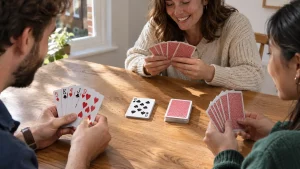
Crazy Eights is one of the easiest card games to enjoy with three people. Its objective is straightforward: get rid of every card in your hand before your opponents.
You need a standard 52-card deck without jokers.
How to play Crazy Eights with three players
The dealer gives five cards to each player. The remaining cards are placed face down in the centre to form the drawing pile.
One card is turned face up to start the discard pile.
The first player must place a card matching either the suit or rank of the card showing.
For example, if the top card is the queen of hearts, the next player can place another queen or any heart.
The number eight has a special purpose. It can be played as a wild card, allowing the player to choose the suit that must be followed next.
If someone cannot play a suitable card, they must draw according to the agreed rules.
The first person to discard all their cards wins.
What makes Crazy Eights interesting?
Although the rules are simple, players must decide when to use their eights.
Playing an eight immediately can help escape a difficult situation. However, keeping it for later might provide an advantage when an opponent is close to winning.
A common mistake is assuming that cards such as twos, queens and aces always have special powers. Those additional effects belong to particular house-rule variations.
For beginners, it is easier to start with only the eights acting as wild cards.
For the traditional rules, see Bicycle Cards’ Crazy Eights guide.
2. Go Fish – Best for Families With Young Children
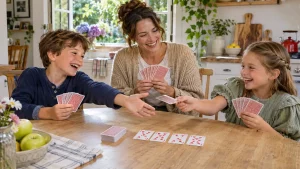
Go Fish is an entertaining card game for three players because it combines memory, observation and a little luck.
The aim is to collect complete sets of four cards of the same rank.
These sets are commonly called books.
How do you play Go Fish with three people?
When three people are playing, each player receives seven cards.
The remaining cards are placed face down in the centre.
The first player chooses an opponent and asks whether they hold a particular rank.
For example:
“Do you have any kings?”
The person asking must already have at least one king in their own hand.
If the opponent has any kings, they must hand over all their cards of that rank.
The person who asked can then continue their turn.
If the opponent has none, they say “Go Fish”, and the asking player draws from the central pile.
Whenever somebody collects all four cards of a rank, they place the completed set face up on the table.
The game finishes when all 13 sets have been collected.
The person with the most books wins.
What is the best strategy for three-player Go Fish?
Instead of choosing opponents randomly, remember which ranks other players requested.
For example, if Player A previously asked for queens, you know they held at least one queen at that moment.
This information can help you decide whom to question later.
Three-player Go Fish adds another interesting decision: you must select which of your two opponents to approach.
That makes remembering previous turns especially useful.
3. Old Maid – Best for Children Learning Card Games
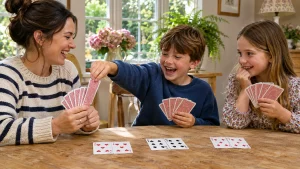
Old Maid is an excellent introduction to playing cards because the rules involve matching pairs rather than complicated scoring.
It also has an unusual mathematical advantage for three players.
A standard deck contains 52 cards. When one queen is removed, 51 cards remain.
That means each of the three players can receive exactly 17 cards.
How do you play Old Maid?
First, remove one queen and shuffle the remaining cards.
Deal all 51 cards equally among the three players.
Everyone examines their hand and places matching pairs aside.
For example, two sevens form a pair, as do two kings.
Players then take turns drawing one unseen card from a neighbouring player’s hand.
If the newly drawn card creates another pair, that pair is discarded.
The process continues until all possible pairs have been removed.
Eventually, only one unmatched queen remains.
The person holding that queen loses the round.
Why is Old Maid suitable for younger players?
Children can practise recognising numbers, remembering cards and taking turns without needing advanced calculations.
The game also encourages interaction because players must choose a card without seeing what they are taking.
For a family-friendly variation, the unmatched queen can simply be called the mystery card, with the final holder completing a funny challenge rather than being labelled the loser.
4. Slapjack – Best for Fast Reactions
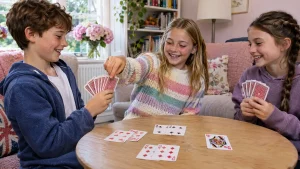
Slapjack is a lively option for three people who prefer physical reactions to lengthy strategic decisions.
Unlike Rummy or Hearts, players do not need to arrange combinations or calculate points throughout the game.
Instead, they compete to react whenever a jack appears.
How do you play Slapjack?
Shuffle a complete 52-card deck and deal every card face down.
Because 52 cannot be divided equally between three people, one player receives 18 cards while the other two receive 17.
Nobody looks at their cards.
Each person keeps their stack face down and takes turns placing the top card into a central face-up pile.
When a jack appears, everyone tries to be the first to slap the pile.
The fastest player collects all the cards in the middle and places them beneath their own stack.
According to traditional rules, slapping a card that is not a jack results in a penalty.
The objective is to collect every card.
How can you make Slapjack more enjoyable?
Place the cards in the centre of a clear table where everyone has an equal chance to reach them.
Keep drinks and fragile objects away from the playing area.
Because a complete game can sometimes last longer than expected, groups may introduce a time limit and count the cards held by each person when time expires.
That is a useful house rule for a short game night.
What Are the Most Entertaining 3 Player Card Games for Friends?
5. Cheat – Best for Bluffing and Laughter

Cheat is particularly entertaining because players are allowed to mislead their opponents.
The game is also commonly called Bullshit in the United States, while Bluff is a name used for closely related variations.
Rather than treating all three names as completely different games, it is more accurate to explain how their rules can differ.
How do you play Cheat with three people?
Use one standard 52-card deck.
Deal all the cards as evenly as possible, giving one player 18 cards and the remaining two players 17 each.
The objective is to discard every card.
Players take turns placing cards face down on a central pile while announcing what they claim to have played.
In one common version, the announced ranks progress in order.
The first player announces aces, the next announces twos, followed by threes, fours and so on.
However, the cards placed face down do not necessarily have to match the announcement.
For example, somebody might announce two sevens while actually placing a seven and a nine.
Either opponent can challenge the claim.
If the player was lying, they must collect the entire pile.
If the announcement was truthful, the person who challenged must collect it.
The first player to get rid of their cards successfully wins.
Why does Cheat work well with exactly three players?
A smaller group makes bluffing more personal.
Each player must decide whether an opponent is telling the truth, but a challenge can also benefit the third person.
Imagine that one opponent has only two cards remaining.
You might challenge an unlikely claim to prevent them from winning. However, if your accusation is incorrect, collecting the pile could leave you far behind.
This creates a simple but entertaining balance between suspicion and risk.
6. Rummy – Best for Players Who Enjoy Strategy
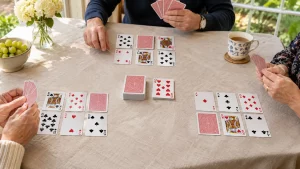
Rummy is a traditional card game in which players create combinations called sets and runs.
It is suitable for three people who want something more thoughtful than a simple matching game.
The game rewards observation, planning and sensible decisions about which cards to keep.
How do you play Rummy with three players?
In basic Rummy, each person receives seven cards from a standard 52-card deck.
The remaining cards form a drawing pile, with one card turned face up to begin the discard pile.
Players try to create two types of combinations.
A set consists of three or four cards of the same rank, such as three queens.
A run contains at least three consecutive cards of the same suit, such as the four, five and six of diamonds.
On each turn, a player draws from the stock or the top of the discard pile.
They may then place valid combinations on the table or add cards to existing combinations when permitted.
The turn ends with a discard.
The objective is to empty your hand before the other players.
What makes three-player Rummy challenging?
Every discarded card potentially helps another player.
For example, throwing away the seven of clubs might seem harmless, but an opponent could be collecting the five, six and eight of clubs.
Watching which cards the other two players collect or discard helps you decide what to keep.
Unlike games based almost entirely on luck, Rummy becomes more interesting as players learn to anticipate one another’s decisions.
Important: Basic Rummy should not be confused with standard Gin Rummy, which is traditionally played by two people.
7. Six-Card Golf – Best for a Relaxed Game Night
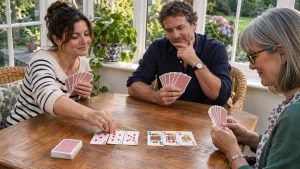
Six-Card Golf is a lesser-known alternative that deserves attention because it works naturally with three players and one standard deck.
The objective is to finish with the lowest total score.
Unlike many other card games, collecting high-ranking cards is not necessarily an advantage.
How do you play Six-Card Golf?
Each player receives six cards arranged face down in two rows of three.
Before the game begins, everyone turns two of their cards face up.
The remaining deck becomes the drawing pile, and a discard pile is started beside it.
On each turn, a player draws from the face-down stock or takes the top card from the discard pile.
They can use that card to replace one of the six cards in their layout.
The replacement is placed face up, while the removed card goes onto the discard pile.
If a player draws from the face-down stock and does not want the card, they may discard it instead.
A round finishes when somebody has turned all six cards in their layout face up.
Everyone then reveals their remaining hidden cards and calculates the score.
In a common six-card version, two equal-ranking cards in the same vertical column score zero.
Other cards contribute points according to the scoring rules agreed before the game.
The group can play nine rounds, called holes, with the lowest overall score winning.
What makes Golf different from Rummy?
In Rummy, players build combinations in their hands.
In Golf, each player gradually modifies a small arrangement of cards on the table, often without knowing every card’s value.
That mixture of hidden information and visible progress creates interesting decisions.
For instance, would you replace a known high-value card or gamble on changing one of your face-down cards?
There is no universally correct answer because the decision depends on the remaining deck and your opponents’ visible layouts.
Note: Six-Card Golf and Nine-Card Golf are different variations. The nine-card version is sometimes called Crazy Nines.
8. Thirty-One – Best for Short Competitive Rounds

Thirty-One, also called Scat or Ride the Bus in some regions, is a quick card game in which players aim to collect cards worth as close to 31 points as possible.
It works particularly well with three people because each player has only three cards to manage.
How do you play Thirty-One?
Deal three cards to each player.
The remaining cards form the drawing pile, and one card starts the discard pile.
The objective is to maximise the value of cards belonging to a single suit.
Aces count as 11 points.
Kings, queens and jacks count as ten points each.
Numbered cards count according to their printed value.
For example, an ace of hearts, king of hearts and ten of hearts make 31 points.
On a normal turn, a player draws one card and discards one card.
When somebody believes their hand is strong enough, they can knock instead of drawing at the beginning of their turn.
The other players receive one final turn before everyone reveals their cards.
The person with the lowest hand normally loses a life or point.
In a traditional elimination format, players begin with a fixed number of lives, and the last surviving player wins.
Why is Thirty-One good for a small group?
Every decision is relatively simple, but the game still introduces uncertainty.
Keeping an ace worth 11 points might seem sensible. However, an ace of the wrong suit may be less useful than a lower card that completes a stronger combination.
Because there are only three cards in each hand, players can quickly understand the consequences of changing their cards.
Which 3 Player Card Games Require More Strategy?
9. Hearts – Best for Tactical Decision-Making
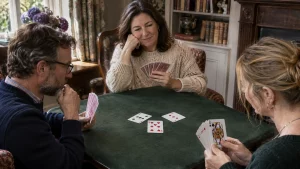
Hearts is a trick-taking game with an unusual objective.
Instead of trying to collect valuable cards, players generally attempt to avoid cards that carry penalty points.
Although Hearts is commonly associated with four players, it can be adapted for three.
How do you play Hearts with three people?
One recognised variation removes the two of diamonds from a standard deck.
This leaves 51 cards, which can be divided into three equal hands of 17 cards.
The objective is to finish with the lowest penalty score.
Each heart captured in a trick counts as one penalty point.
The queen of spades counts as 13 penalty points.
A trick begins when one player leads a card.
The next two players must follow that suit if they hold a suitable card.
Otherwise, they may play another suit, subject to the agreed rules.
The highest card of the suit originally led normally wins the trick.
The winner collects the cards and leads the next trick.
Players continue across several deals while tracking their penalty points.
What is different about three-player Hearts?
The number of cards in each hand changes significantly.
With three people holding 17 cards each, there is more information to remember and more opportunities to work out which cards opponents might still possess.
Passing rules also need adjustment because there is no fourth player sitting opposite.
One practical arrangement is to rotate between passing three cards left, passing three cards right and keeping the next hand unchanged.
Useful strategy: Avoid assuming that winning a trick is always beneficial. Sometimes allowing an opponent to take an ordinary trick protects you from collecting penalty cards later.
10. Oh Hell! – Best for Predicting Tricks

Oh Hell! is an enjoyable game for players who like bidding, observation and calculated risks.
It is also known by several regional names, including Contract Whist and Nomination Whist.
Its central challenge is predicting exactly how many tricks you will win.
How do you play Oh Hell! with three players?
A common three-player format begins by dealing ten cards to each person.
The next card is turned face up to establish the trump suit.
Before playing, everyone announces how many tricks they expect to win.
For example, a player holding several high spades might predict that they will win three tricks.
During play, each person must follow the suit led whenever possible.
A trump card can beat cards from other suits.
However, winning more tricks than predicted is not necessarily successful.
In one straightforward scoring system, a player who meets their bid receives ten points plus the number bid.
A player who misses the target receives zero.
The number of cards dealt can decrease in later rounds, eventually reaching one card each, before increasing again.
Different groups use different scoring and round sequences.
Why is Oh Hell! interesting with three players?
Winning is not simply about having the strongest cards.
A player who predicts two tricks and wins three has failed their target, despite taking more tricks.
This encourages players to control when they win rather than always playing their strongest available card.
That makes Oh Hell! especially rewarding once everyone understands basic trick-taking.
11. Sergeant Major (3-5-8) – Best Game Designed for Three Players

Sergeant Major deserves a prominent place in any guide to three-player card games because its structure is specifically built around three participants.
The game is also associated with the names 3-5-8 and 8-5-3.
Its distinctive feature is that every player has a different target.
How do you play Sergeant Major?
Use a standard 52-card deck.
Deal 16 cards to each player.
The four remaining cards are placed face down as a kitty.
The dealer chooses the trump suit, discards four cards and replaces them with the four cards from the kitty.
The player to the dealer’s left leads the first trick.
Each position has a specific target:
- The dealer must aim to win eight tricks.
- The player to the dealer’s left aims for five tricks.
- The remaining player aims for three tricks.
Players must follow the suit led whenever possible.
The highest trump takes the trick. If no trump is played, the highest card of the suit led wins.
When a hand ends, players compare the number of tricks they actually won with their targets.
For example, if the dealer wins ten tricks, they have exceeded their target by two.
If another player wins only three tricks against a target of five, they are two tricks below their requirement.
Traditional Sergeant Major also includes card exchanges between players in later deals, depending on previous results.
For the complete exchange and scoring procedure, see Pagat’s Sergeant Major rules.
Why is Sergeant Major particularly suitable for exactly three people?
Unlike games adapted from four-player formats, its targets naturally create three different roles.
Furthermore, the dealer changes after each hand, so players experience different objectives as the game progresses.
This variety makes Sergeant Major a strong choice for a regular group of three friends.
12. Three-Handed Cribbage – Best for Players Who Enjoy Scoring
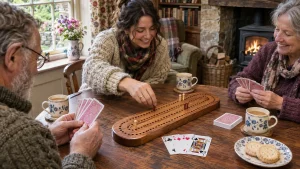
Cribbage is a traditional British card game that combines arithmetic, probability and tactical decision-making.
Although it is frequently played by two people, it also has established three-player rules.
Players use an ordinary deck of 52 cards and usually track their scores on a cribbage board.
How do you play Cribbage with three people?
The dealer gives five cards to each player and places one additional card into a separate area called the crib.
Each player then selects one card from their hand and discards it into the crib.
This leaves each person with four cards.
The crib also contains four cards and belongs to the dealer for that round.
A starter card is revealed from the remaining deck.
Players then take turns playing cards while calculating a running total that must not exceed 31.
Points are awarded for various combinations.
For example, making a total of 15 scores two points.
Pairs, runs and certain other combinations also earn points.
After the playing phase, players score the combinations in their hands using the starter card.
The dealer also scores the crib.
The objective is normally to become the first player to reach 121 points.
What makes three-handed Cribbage different?
The extra player changes both the initial deal and the decisions made when discarding cards.
Each person must contribute one card to the dealer’s crib.
That creates an interesting dilemma: you want to keep a strong hand without giving the dealer a particularly useful card.
It is also important that everyone receives an opportunity to act as dealer across successive rounds.
Which Advanced Card Games Work Best With Exactly Three People?
13. Skat – Best for Experienced Card Players
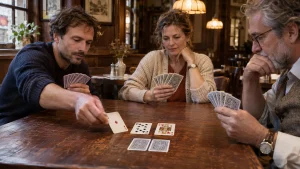
Skat is a traditional German trick-taking game known for its bidding and strategic depth.
It is particularly notable because it was developed around three active players.
How do you play Skat?
Skat uses a 32-card deck.
You can prepare this using a normal 52-card pack by removing the twos, threes, fours, fives and sixes from every suit.
The remaining cards range from seven through ace.
Each player receives ten cards.
Two cards are placed face down in the centre, forming the skat.
The game begins with an auction.
The successful bidder becomes the declarer and plays alone against the other two players, who work together for that hand.
Depending on the contract, the declarer may use the two cards in the skat and select the trump arrangement.
In ordinary suit and grand games, the deck contains 120 card points.
The declarer generally needs at least 61 card points to succeed.
However, Skat also includes other contracts and a more complicated system for calculating game values.
Why does Skat offer more strategy than Crazy Eights?
Skat requires players to think about bidding, card values and the likely distribution of opponents’ cards.
A player may have several strong cards but still need to consider whether their hand can support a successful contract.
The two opposing players also benefit from cooperating and remembering which suits have already been played.
For beginners, the best approach is to learn a basic trump contract before exploring the more advanced scoring options.
14. Ninety-Nine – Best for Hidden Bidding and Advanced Strategy

Ninety-Nine is a particularly interesting three-player game created by the card-game designer David Parlett.
It differs from another game with the same name in which players add card values without exceeding 99.
Parlett’s Ninety-Nine is a trick-taking game involving secret bids.
How do you play Ninety-Nine?
Prepare a 36-card deck by removing the twos, threes, fours and fives from an ordinary pack.
Each of the three players receives 12 cards.
Before the playing phase, everyone chooses three cards to set aside face down.
These cards form a secret bid.
The suits of the selected cards represent different values:
| Suit | Trick Value |
|---|---|
| Clubs ♣ | 3 |
| Hearts ♥ | 2 |
| Spades ♠ | 1 |
| Diamonds ♦ | 0 |
The total value of the three selected suits determines how many tricks the player intends to win.
For example, choosing a heart, spade and diamond means bidding three tricks.
The remaining nine cards are then used to play nine tricks.
Players attempt to win exactly the number of tricks represented by their hidden bid.
Scoring rewards successful contracts, with additional options for premium declarations in the full game.
What makes Ninety-Nine unusual?
The cards used to form a bid cannot also be used during play.
This creates an important strategic decision.
A player may want to bid a high number of tricks but have to set aside cards that could otherwise help them win.
Success therefore depends on finding the right balance between the strength of the playing hand and a realistic prediction.
Ninety-Nine is best suited to groups already comfortable with following suits and understanding trick-taking games.
How Can Three People Play With One Standard Deck of 52 Cards?
One practical question is how to divide 52 cards between three people.
The calculation is simple:
52 ÷ 3 = 17 cards each, with one card remaining.
However, different games handle this problem in different ways.
Some leave unused cards in a drawing pile.
Others give one player an additional card or remove a specific card before dealing.
| Card Distribution Method | Example | How It Works |
|---|---|---|
| Small hands with drawing pile | Crazy Eights | Five cards each; remaining cards form the stock |
| Unequal initial hands | Cheat | Two players receive 17 cards; one receives 18 |
| Remove one card | Hearts | Remove the 2♦, leaving 17 cards each |
| Reserve cards | Sergeant Major | Deal 16 each; leave four as a kitty |
| Use a reduced deck | Skat | Remove cards below seven to create a 32-card deck |
This explains why some games are much easier to adapt than others.
The key is to follow the dealing structure of the chosen game, rather than removing random cards or assuming that every player must receive the same number.
For example, Crazy Eights does not require all cards to be distributed because players draw from a central pile throughout the game.
By contrast, three-player Hearts can use a specifically reduced 51-card deck so that everyone starts with 17 cards.
Understanding these differences can prevent confusion before the first round begins.
What Is the Difference Between Luck-Based and Strategy-Based Card Games?
Not every card game requires the same type of thinking.
Some depend heavily on which cards players receive, while others offer more opportunities to influence the result through decisions.
| Game | Main Skill | Why It Matters |
|---|---|---|
| Go Fish | Memory | Remembering previously requested ranks |
| Slapjack | Reaction speed | Responding quickly when a jack appears |
| Crazy Eights | Hand management | Deciding when to play wild cards |
| Cheat | Bluffing | Judging opponents’ claims and reactions |
| Rummy | Planning | Building sets and runs while managing discards |
| Hearts | Card counting | Avoiding unwanted penalty cards |
| Oh Hell! | Prediction | Winning exactly the number of tricks bid |
| Skat | Bidding and strategy | Choosing a realistic contract |
These distinctions can help a group avoid selecting a game that does not suit everyone’s preferences.
For example, a family with young children may enjoy Slapjack because little calculation is required.
Three adults who regularly play together might prefer Hearts or Sergeant Major because experience gradually changes how they approach each round.
Neither type is automatically better. The most enjoyable choice depends on what the group wants from the session.
How Can You Organise a Fun Three-Player Card Game Night?
A good card game night does not require an elaborate setup.
One ordinary deck, a comfortable table and enough space for everyone to see the cards are usually sufficient.
However, choosing the right sequence of games can make the evening more enjoyable.
Start With an Easy Game
Begin with Crazy Eights or Go Fish.
These games introduce turn-taking and basic card recognition without requiring everyone to understand complicated rules immediately.
A short opening game also gives players an opportunity to become comfortable with one another’s playing styles.
Introduce a More Competitive Game
Once everyone is ready, switch to Cheat or Thirty-One.
Both create opportunities for unexpected results.
Cheat encourages conversation, bluffing and friendly accusations, while Thirty-One introduces decisions about when to keep cards and when to end a round.
Finish With a Strategic Challenge
For an experienced group, finish with Rummy, Hearts or Sergeant Major.
These games tend to reward greater concentration and are suitable when everyone wants a more serious contest.
If you are organising a small celebration, our guide to cheap things to do for your birthday offers additional low-cost entertainment ideas.
For friends who prefer screen-based entertainment, there are also online games to play with friends.
What Common Mistakes Should Three Players Avoid?
Starting Without Agreeing on the Rules
Many traditional card games have regional variations.
For instance, Crazy Eights can include additional special cards, while Golf has several scoring systems.
Players should agree on the chosen version before the first deal.
Confusing Similar Game Names
Cheat, Bluff and Bullshit are closely related names, but different groups may use different procedures.
Likewise, Skat and Scat are not the same game.
Skat is a German trick-taking game, while Scat is another name for the draw-and-discard game Thirty-One.
Using the Wrong Number of Cards
The correct dealing arrangement depends on the game.
Go Fish typically uses seven cards per person when three people play, while Crazy Eights uses five.
Rummy, Golf and Sergeant Major all have their own requirements.
Using the wrong deal can change how the game works.
Choosing a Game That Is Too Difficult
Skat and Ninety-Nine are rewarding, but beginners may find their bidding systems difficult.
It is often better to develop familiarity with simpler games before moving to more advanced options.
Forgetting to Set a Finishing Point
Some games finish naturally when a player runs out of cards.
Others can continue over many deals.
Before starting, agree whether you are playing to a target score, a certain number of rounds or a time limit.
Conclusion: Which 3 Player Card Game Should You Try First?
Three people can enjoy a surprisingly wide range of card games without purchasing specialist equipment or searching for a fourth player.
For beginners, Crazy Eights and Go Fish provide an accessible introduction. Families with younger children may prefer Old Maid or Slapjack, while friends looking for laughter and friendly competition can try Cheat.
Players who enjoy planning and calculation should consider Rummy, Hearts or Thirty-One.
For a group that regularly meets to play cards, Sergeant Major, Skat and Ninety-Nine offer deeper challenges that can remain interesting as everyone becomes more experienced.
The most important consideration is selecting a game that suits all three players.
Start with a familiar option, agree on the rules and gradually explore different styles.
With one deck of cards and the right game, three people are more than enough for an enjoyable evening.
Frequently Asked Questions About 3 Player Card Games
What Is the Easiest Card Game for Three Players?
Crazy Eights is one of the easiest choices because players only need to match cards by suit or rank and use eights as wild cards. Go Fish and Old Maid are also suitable for beginners, particularly children.
Can You Play Card Games With Three People and One Deck?
Yes. All 14 games covered in this guide can be played using cards taken from one standard 52-card deck. Some require removing cards to create smaller packs, while three-handed Cribbage also benefits from having a scoring board.
What Card Games Are Designed Specifically for Three Players?
Sergeant Major, Skat and Ninety-Nine are particularly suitable for exactly three participants. Their playing structures use different trick targets, temporary partnerships or specialised bidding systems.
Can Three People Play Gin Rummy?
Standard Gin Rummy is designed for two players. Three people should consider basic Rummy or a recognised multiplayer Rummy variation instead.
If only two people are available, explore our guide to 2 player card games.
Can Three People Play Hearts?
Yes. One established version removes the two of diamonds from a standard deck, leaving 51 cards. Each participant receives 17 cards, and the game follows the usual objective of avoiding penalty points.
Are Cheat and Bullshit the Same Card Game?
Cheat and Bullshit are common names for the same broad style of bluffing card game. Some variations use different rules for announcing ranks and challenging opponents, so players should agree on the rules before beginning.
What Is the Best Three-Player Card Game for Adults?
Rummy, Hearts, Sergeant Major and Skat are strong options for adults who enjoy strategy. Cheat is especially entertaining for a more relaxed gathering, while Thirty-One is suitable for shorter sessions.
Which Card Game Is Best for Three Children?
Go Fish, Old Maid, Crazy Eights and Slapjack are accessible choices. They involve recognising cards, remembering simple instructions and taking turns without needing advanced strategy.
Can Three People Play Cards Without Keeping Score?
Yes. Crazy Eights, Old Maid and Cheat can be played as individual rounds in which the winner or loser is determined without maintaining an ongoing score.
What Is the Best Quick Card Game for Three People?
Slapjack, Crazy Eights and Thirty-One are good choices when there is limited time. The actual duration depends on the players, number of rounds and chosen rules.
Leave feedback about this