







Quick Snapshot
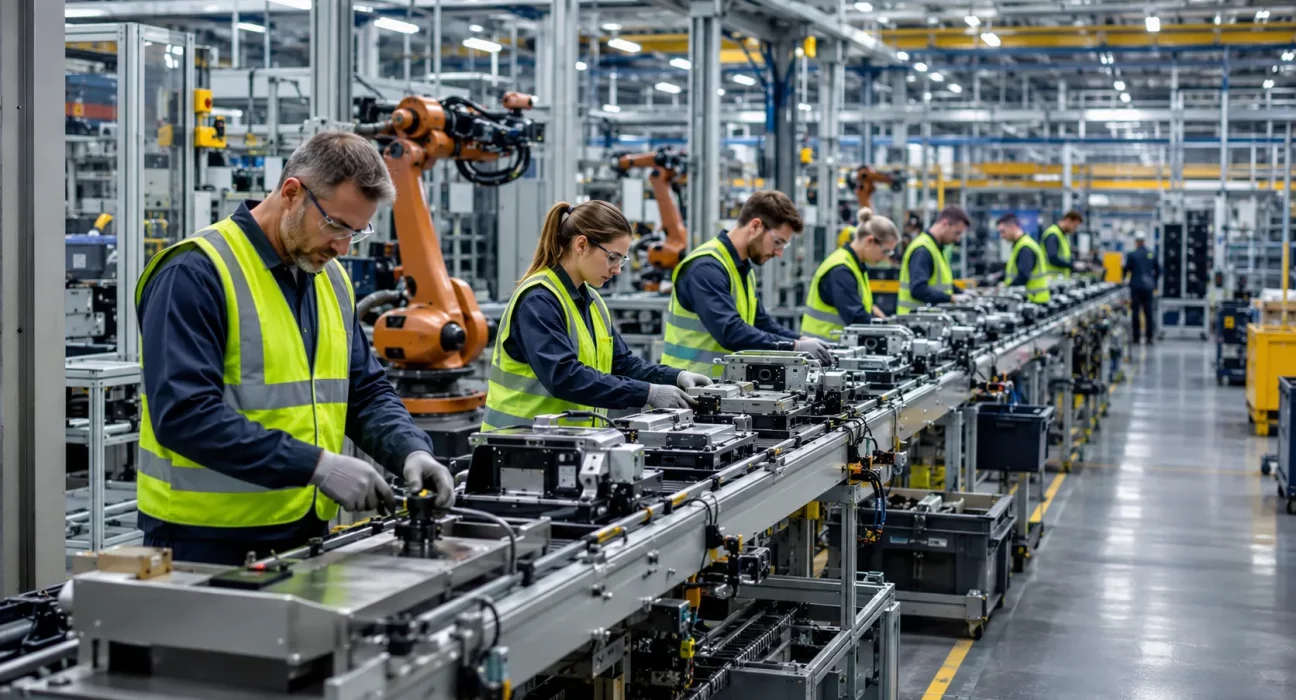
In flow production, the series of workers working on products is called an
assembly line or production line. Each worker or workstation completes a specific task before the product moves to the next stage.
Main Term
Assembly Line
Also Known As
Production Line
Used In
Flow production and mass manufacturing
Key Takeaways
1. An assembly line is a structured sequence of workers, machines, or workstations used to make products efficiently.
2. Each worker performs a specific task, helping the product move smoothly through the manufacturing process.
3. This method helps businesses increase output, reduce production time, and maintain consistent quality.
4. Assembly lines are widely used in automotive, electronics, food, pharmaceutical, and consumer goods manufacturing.
Assembly Line at a Glance
British manufacturing has long been a cornerstone of economic output from the textile mills of the Industrial Revolution to the precision automotive plants of the West Midlands today. In an era where operational efficiency can determine whether a business thrives or contracts, understanding the fundamental structures of flow production is not merely academic; it is a commercial imperative.
So, what do we call the series of workers working on products in flow production?
The answer is an assembly line also commonly referred to as a production line. This is a sequential arrangement of workers and workstations through which a product passes, with each worker or team performing a specific, repetitive task that adds value at each stage of the manufacturing process. The end result is a completed product that has moved systematically from raw material or component input through to finished output.
This guide covers everything operations managers and manufacturing students need to know: the precise definition and context of the assembly line within flow production, the key roles workers perform, the business advantages of an optimised line, challenges organisations face, and what the future holds for the human workforce alongside increasing automation in UK manufacturing.
What Exactly Is an Assembly Line in the Context of Flow Production?
Flow production sometimes called continuous or mass production is a manufacturing method in which products move continuously through a series of sequential operations. Unlike batch production, where groups of identical items are made together before switching, flow production is designed for high-volume, standardised output with minimal interruption to the production process.
The assembly line is the physical and organisational embodiment of flow production. It was popularised by Henry Ford in the early twentieth century but has since been refined by methodologies such as Toyota’s Production System (TPS) and Lean Manufacturing concepts that the Institute for Manufacturing (IfM) at the University of Cambridge cites as foundational to modern operations management.
How the Assembly Line Works in Practice?
In a typical assembly line:
- A product (or its sub-components) moves along a conveyor, track, or structured workflow path.
- Each workstation carries out one defined operation fitting a component, applying a finish, conducting a check.
- Workers or automated systems at each station are trained and tooled specifically for their designated task.
- The pace of the line is controlled by a cycle time the time allotted for each operation before the product moves to the next station.
A British Example: Jaguar Land Rover (JLR) at Solihull
One of the most prominent examples of assembly line production in the United Kingdom is the Jaguar Land Rover facility in Solihull, West Midlands. Producing vehicles such as the Range Rover and Defender, JLR’s production line sees hundreds of workers performing specialist roles across body assembly, powertrain installation, interior fitting, and final quality inspection. The line integrates human skill with robotic automation a model that Make UK, the manufacturers’ organisation, highlights as a blueprint for competitive British industrial output.
Similarly, the Mini plant at Cowley, Oxford, operated by BMW Group, demonstrates how a well-structured production line can manufacture highly customisable products at scale, with thousands of possible configurations managed through sophisticated line sequencing.
What Are the Key Roles Within the Series of Workers on a Production Line?
The workers on an assembly line are not interchangeable. Each role is defined, trained, and optimised for a specific function within the production sequence. Understanding these roles is essential for operations managers seeking to structure their workforce effectively.
Line Operators (Production Operatives)
Line operators are the foundational workforce of any assembly line. They perform the core, repetitive manufacturing tasks at each workstation fitting components, operating machinery, assembling sub-units, or applying finishes. Their performance directly governs throughput.
- Trained for one or more specific workstation tasks
- Expected to maintain consistent quality and pace to cycle time
- In advanced facilities, cross-trained to provide line flexibility (a Lean practice)
Quality Control Inspectors
Quality assurance is integral to flow production rather than an afterthought. Quality control (QC) inspectors are stationed at critical checkpoints along the line to identify defects before they progress further downstream a principle aligned with the Jidoka concept from the Toyota Production System, which the IfM recognises as one of the pillars of Lean manufacturing.
- Conduct visual and instrumental checks at defined inspection gates
- Authorised to halt the line if a critical defect is identified
- Record non-conformances and feed data back to continuous improvement teams
Team Leaders and Shift Supervisors
Team leaders occupy a critical middle layer between the shop floor and management. Their responsibilities include:
- Monitoring line pace and identifying bottlenecks in real time
- Conducting short-interval control (reviewing output every hour or half-shift)
- Managing workforce welfare, attendance, and task rotation
- Facilitating daily briefings and toolbox talks
Maintenance Technicians
Flow production is acutely sensitive to equipment downtime. A single machine failure can halt an entire line. Maintenance technicians operating under Total Productive Maintenance (TPM) frameworks are responsible for:
- Scheduled preventive maintenance during planned downtime windows
- Rapid response to unplanned breakdowns (corrective maintenance)
- Supporting operators with autonomous maintenance tasks (first-line checks)
Continuous Improvement (CI) Specialists
Many modern UK manufacturers, particularly those aligned with Lean or Six Sigma methodologies, embed CI specialists (often called Kaizen leads or process engineers) directly onto the production floor. Their role is to:
- Conduct time-and-motion studies to identify waste (Muda)
- Lead structured improvement events (Kaizen workshops)
- Implement changes to workstation ergonomics, tooling, or sequencing
Materials Handlers and Logistics Operatives
The assembly line cannot function without a reliable supply of components arriving at the right station, at the right time, in the right quantity. The Chartered Institute of Procurement & Supply (CIPS) emphasises that internal supply chain efficiency is as critical as external procurement. Materials handlers are responsible for:
- Operating kanban replenishment systems to supply workstations
- Managing lineside inventory to avoid both shortages and overcrowding
- Co-ordinating with warehouse teams and inbound logistics
What Are the Advantages of an Optimised Production Line?
An efficiently run assembly line delivers a range of measurable business benefits. These are not incidental they are the strategic rationale for investing in flow production infrastructure.
High Output and Economies of Scale
Flow production is designed for volume. Once the line is running at capacity, the unit cost of production falls because fixed costs (plant, equipment, management overhead) are spread across a greater number of units. This is the principle of economies of scale, and it is particularly relevant for UK manufacturers competing against lower-cost international producers.
Consistent and Standardised Quality
Because each task is performed by a trained individual or machine following a defined standard, the output quality is highly consistent. Variation the enemy of quality is minimised. This standardisation also simplifies ISO 9001 quality management system compliance, which many UK manufacturers are certified to.
Reduced Waste Through Lean Principles
Lean manufacturing, as articulated by the IfM and widely adopted across UK industry through Make UK’s Productivity and Skills programmes, targets the elimination of seven forms of waste (Transport, Inventory, Motion, Waiting, Overproduction, Over-processing, and Defects commonly known as TIMWOOD). An optimised production line is structured specifically to minimise each of these.
- Waiting is reduced by balancing the line so no workstation is idle
- Motion is reduced by ergonomic workstation design
- Defects are caught early through in-line quality checks rather than at the end
Faster Training and Workforce Scalability
Because each role on an assembly line is narrowly defined, new workers can be trained relatively quickly to perform a specific task. This allows organisations to scale their workforce during periods of high demand without the lengthy lead times required for multi-skilled training programmes.
Improved Health, Safety, and Ergonomics
Modern flow production facilities increasingly apply ergonomic principles to workstation design adjustable-height benches, torque-controlled tooling, and task rotation schedules. This reduces the incidence of musculoskeletal disorders and improves workforce retention, both of which are priorities flagged by Make UK’s annual health and safety surveys.
What Challenges Do Organisations Face in Managing a Production Line?
No manufacturing methodology is without its difficulties. Understanding the inherent challenges of the assembly line is as important as appreciating its advantages.
Line Balancing Difficulties
Line balancing the process of distributing work evenly across all workstations so that no single station becomes a bottleneck is technically demanding. An imbalanced line creates idle time at some stations and overloading at others, reducing overall efficiency and increasing the risk of quality failures.
Worker Monotony and Retention
The repetitive nature of assembly line work has long been associated with reduced job satisfaction. High turnover on the production floor is costly recruitment, induction, and training expenses accumulate rapidly. Forward-thinking UK manufacturers address this through:
- Job rotation schemes
- Involvement in continuous improvement activities
- Clear progression pathways into team leader or technician roles
Inflexibility in Product Changeovers
Traditional assembly lines are configured for a specific product or product family. Switching to a new product a changeover can involve significant downtime and re-tooling costs. Single Minute Exchange of Die (SMED) techniques, part of the Lean toolkit, are used to reduce changeover time, but the challenge remains significant for organisations with diverse product portfolios.
Supply Chain Vulnerability
An assembly line is only as reliable as the supply of components feeding it. As evidenced during global supply chain disruptions, a shortage of even one sub-component can halt an entire line. This has prompted many UK manufacturers, in line with CIPS guidance, to review their supply chain resilience strategies diversifying suppliers and increasing strategic buffer stocks for critical components.
How Does Flow Production Compare to Other Manufacturing Methods?
To fully appreciate the assembly line, it is useful to situate flow production within the broader landscape of manufacturing methods.
Manufacturing Methods Comparison
Flow production offers the lowest unit cost at high volumes but the least flexibility. Job production offers the highest flexibility but at the greatest unit cost. Most large UK manufacturers operate a hybrid approach, incorporating elements of cell manufacturing and flow production to balance efficiency with customisation a model increasingly referred to as mass customisation.
What Does the Future Hold for Workers on UK Production Lines?
The conversation around automation, robotics, and artificial intelligence in manufacturing is not hypothetical it is already reshaping production lines across the United Kingdom. However, the narrative that automation will simply replace human workers is an oversimplification.
The Rise of Collaborative Robotics (Cobots)
Collaborative robots (cobots) are designed to work alongside human operators rather than replace them. They handle tasks that are physically demanding, hazardous, or require extreme precision freeing human workers to perform roles requiring judgement, dexterity, and interpersonal communication. The IfM’s research into advanced manufacturing highlights cobots as a key enabler of human-centred manufacturing systems.
Reskilling and Upskilling Imperatives
Make UK and the government’s UK Industrial Strategy have consistently emphasised that the primary challenge is not job elimination but job transformation. Workers who previously performed purely manual assembly tasks are increasingly being trained in:
- Data monitoring and analytics (reading OEE dashboards)
- Cobot operation and basic programming
- Predictive maintenance using IoT sensor data
The Human Element Remains Irreplaceable
Despite significant advances in automation, assembly lines in complex manufacturing environments particularly aerospace, specialist automotive, and medical device production continue to rely on human workers for:
- Adaptive problem-solving when unexpected faults arise
- Fine motor tasks that remain beyond the economic reach of automation
- Quality judgement in ambiguous situations
- Team leadership, communication, and culture
The future of the UK production line is not a choice between humans and machines it is the intelligent integration of both.
Conclusion
The series of workers working on products in flow production is called an assembly line or production line a structured, sequential arrangement of people, workstations, and processes through which a product passes from its earliest stage to its completed form.
Key takeaways from this guide:
- The assembly line is the operational backbone of flow production, enabling high-volume, standardised output at low unit cost.
- Workers on the line fulfil distinct roles from line operators and QC inspectors to maintenance technicians and CI specialists each essential to the system’s performance.
- An optimised production line delivers measurable benefits: reduced waste, consistent quality, economies of scale, and a safer working environment.
- Challenges such as line balancing, worker retention, and supply chain vulnerability must be actively managed.
- The future of UK manufacturing lies not in replacing human workers with automation, but in redefining and elevating what human workers do supported by evidence-based frameworks from institutions such as the IfM, Make UK, and CIPS.
For UK organisations seeking competitive advantage, investing in both the physical infrastructure of the production line and the skills and wellbeing of the people working on it is not an either/or proposition. It is the strategic foundation of sustainable manufacturing excellence.