







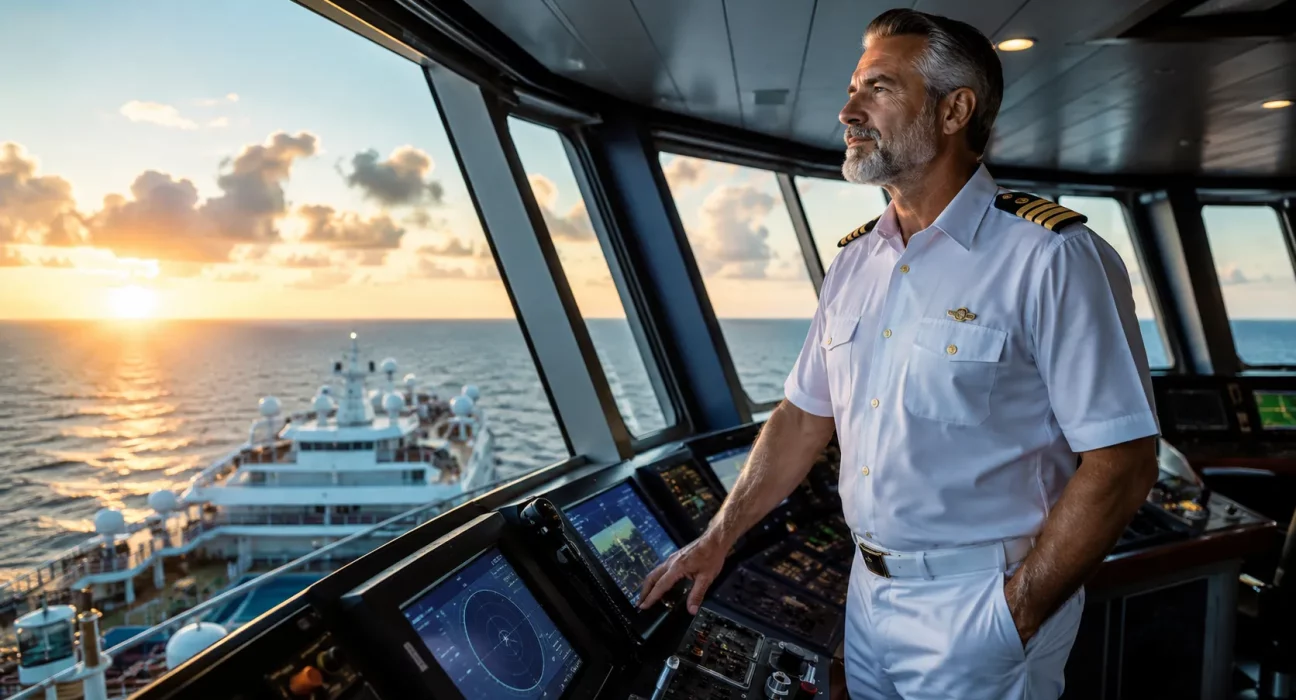
When people ask how much a cruise ship captain earns, they are often imagining one of the most prestigious jobs in maritime life: commanding a vast floating city carrying thousands of passengers across international waters.
The answer is impressive, but not as straightforward as many online salary snippets suggest.
In 2026, a cruise ship captain typically earns between £110,000 and £220,000 per year, with senior captains on major international cruise lines potentially exceeding that range when performance incentives, contractual arrangements, and executive benefits are factored in. Some specialist command roles, particularly within expedition cruising or ultra-luxury operations, may command even higher packages.
Yet many salary comparison websites report dramatically lower figures, creating understandable confusion.
That discrepancy exists because not every “ship captain” salary refers to the same profession. A local ferry master, harbour sightseeing operator, and the commanding officer of a 6,000-passenger international cruise ship are grouped together surprisingly often, despite representing entirely different levels of responsibility .
For UK readers considering a maritime leadership career or simply curious about one of the most demanding executive roles at sea—this guide explains what cruise ship captains really earn, what influences their pay, and whether the financial rewards justify the long journey to command.
How Much Does a Cruise Ship Captain Earn in 2026?
A realistic salary estimate for a cruise ship captain depends heavily on the type of vessel being commanded.
A captain overseeing a smaller passenger vessel or regional cruise operation will earn significantly less than a captain in charge of a modern mega-ship operated by a major global cruise company.
Broadly, salary expectations in 2026 look like this:
These figures reflect broader maritime compensation benchmarks, cruise industry hiring patterns, and senior command pay expectations.
To put this into perspective, a captain commanding a vessel carrying over 5,000 passengers is effectively operating a mobile international hospitality business, transport network, and emergency command centre simultaneously.
That level of responsibility explains why compensation reaches executive territory.
Why Do Cruise Ship Captain Salary Figures Online Vary So Much?
One of the biggest frustrations for readers researching this topic is encountering wildly inconsistent numbers.
One website may suggest a ship captain earns under £60,000, while another implies annual compensation comfortably exceeds £200,000.
Both can technically be true.
The issue lies in how salary platforms categorise maritime roles.
Many job databases combine vastly different positions under broad labels such as “captain”, “vessel master”, or “ship commander”. That means earnings for local sightseeing boats, ferries, tug operators, commercial passenger craft, and deep-sea command roles may be blended into a single average.
That creates misleading comparisons.
A cruise ship captain commanding a major international liner is not simply a boat operator. This individual is typically a Master Mariner with decades of sea-going experience, advanced certification, operational command authority, and legal responsibility for thousands of lives.
Without separating those distinctions, salary figures lose practical meaning.
What Actually Determines a Cruise Ship Captain’s Salary?
Salary in this profession is shaped by several major commercial and operational factors.
The employer is one of the most obvious.
Major global cruise operators generally pay more than smaller regional passenger businesses because expectations, vessel complexity, passenger volumes, and commercial risk are substantially higher.
Luxury operators can also offer stronger compensation because guest expectations are elevated, itineraries may be more specialised, and leadership standards are exceptionally high.
Experience matters just as much.
Cruise command is not an entry-level leadership role. A captain has usually spent decades progressing through officer ranks, building sea time, technical competence, crisis leadership capability, and organisational trust.
Ship size also changes the financial picture.
Commanding a boutique expedition vessel is fundamentally different from commanding one of the world’s largest passenger ships. Larger vessels involve far greater staffing, more complex logistics, higher regulatory oversight, larger passenger populations, and more significant operational consequences if something goes wrong.
Route complexity can also affect compensation.
A conventional Mediterranean itinerary presents a different risk profile compared with remote polar expeditions or technically demanding long-haul operations.
Which Cruise Lines Tend to Pay the Highest Salaries?
Exact compensation packages are rarely made public, which is typical for senior leadership roles.
However, certain market segments consistently offer stronger remuneration.
Ultra-luxury cruise operators are often among the most competitive because service standards are exceptionally demanding, passenger expectations are elevated, and voyages may involve more exclusive itineraries.
Expedition cruise companies can also pay well, particularly when routes involve specialised navigation conditions, remote regions, or heightened operational complexity.
Mega-ship operators represent another high-paying segment simply because command responsibility scales dramatically.
When a captain oversees thousands of guests, thousands of crew members, strict environmental compliance obligations, and highly visible commercial operations, compensation reflects that scale.
Rather than focusing purely on brand names, it is more accurate to understand that salary tends to rise with operational complexity, vessel scale, and commercial prestige.
Do Cruise Ship Captains Earn Bonuses as Well as Base Salary?
Yes, in many cases they do.
A cruise captain’s package can extend beyond basic salary, particularly within larger or commercially sophisticated cruise operations.
Modern cruise businesses are highly data-driven organisations, and senior leadership compensation may reflect that reality.
Performance-based incentives can sometimes be linked to fuel efficiency, operational reliability, environmental compliance, or broader business outcomes.
Passenger satisfaction may also influence leadership incentives indirectly, especially in organisations where executive performance is evaluated against operational excellence and customer outcomes.
That does not mean every captain receives the same type of bonus structure.
Compensation models vary significantly between employers.
Some operators favour straightforward salary packages, while others blend fixed compensation with incentives tied to performance metrics.
Are Cruise Ship Captains Paid While They Are Off Duty?
This is one of the most common questions and the answer depends entirely on contract structure.
Many major cruise companies operate on an annualised salary model.
Under this arrangement, compensation is spread across the year, even though the captain works in scheduled rotational blocks. That means income continues while the captain is at home between assignments.
For example, a captain earning £180,000 annually might receive a consistent monthly salary, regardless of whether they are actively onboard in a particular month.
Smaller operators sometimes work differently.
Certain expedition businesses or specialist operators may rely on day-rate or contract-based arrangements instead. In these cases, pay may only apply while actively assigned.
This distinction matters because two apparently similar annual salary figures may represent very different employment realities.
What Benefits Come with a Cruise Ship Captain’s Compensation Package?
Salary alone does not tell the full story.
A frequently overlooked financial benefit of senior ship command is the limited day-to-day personal spending required while living and working at sea.
Accommodation is typically provided, meals are included, utilities are effectively covered, and transport arrangements may be handled by the employer.
Private officer quarters are standard, and captains generally enjoy considerably more comfortable accommodation than junior crew members.
Many cruise employers also cover practical employment costs such as healthcare assistance, travel arrangements to and from assignments, professional uniforms, and access to selected onboard facilities.
From a financial planning perspective, this matters.
Someone earning a six-figure salary while facing minimal living expenses for extended periods may retain more disposable income than a similarly paid professional based entirely ashore.
What Does a Cruise Ship Captain Actually Do?
Popular culture often reduces the role to steering the vessel and greeting passengers at formal dinners.
The reality is much broader.
The captain serves as the highest-ranking decision-maker on the vessel, carrying full operational and legal responsibility throughout the voyage.
This includes operational leadership, navigation oversight, safety management, legal accountability, emergency command, environmental compliance, crew leadership, and coordination with international port authorities.
The captain is responsible not only for safe passage, but for maintaining a functioning operational ecosystem involving hospitality, logistics, engineering, passenger welfare, and international regulation.
In an emergency, decision-making pressure can be immense.
Few professions combine transport leadership, executive management, crisis command, and public accountability at this scale.
That is a major reason compensation remains high.
How Long Does It Take to Become a Cruise Ship Captain?
This is not a quick route to a high salary.
Becoming a cruise ship captain usually takes between 15 and 25 years.
Progression generally follows a structured hierarchy.
A maritime cadet begins with formal training, sea-time development, and junior officer responsibilities. Over time, promotion may progress through third officer, second officer, chief officer, staff captain, and eventually full command.
Promotion is not automatic.
Advancement depends on competence, examination performance, leadership ability, sea-time accumulation, employer opportunity, and organisational trust.
Because cruise ships operate in high-risk international environments, leadership appointments are made cautiously.
A company placing thousands of passengers under a captain’s command must have confidence in both technical capability and judgement.
How Does Someone in the UK Become a Cruise Ship Captain?
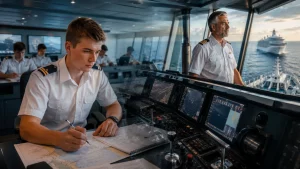
For UK readers, the journey typically begins through the Merchant Navy pathway.
A common starting point is a sponsored cadetship or maritime education programme focused on nautical science or deck officer development.
Training includes academic study, practical sea-going experience, and internationally recognised maritime certification.
Progression usually involves STCW qualifications, officer competency certification, and eventually advanced command credentials such as Master-level certification.
The UK has a long maritime heritage, and several established routes exist for aspiring deck officers.
However, it remains a profession requiring patience, discipline, technical competence, and long-term commitment.
This is not a shortcut career.
Is Being a Cruise Ship Captain Financially Worth It?
Purely from a compensation perspective, the profession can be highly rewarding.
A senior captain may earn an income comparable to high-level corporate professionals, particularly when reduced living expenses and structured leave arrangements are considered.
But the salary reflects exceptional demands.
Extended time away from family is one of the most significant personal sacrifices.
The psychological weight of responsibility is another.
Unlike many executive roles, mistakes at sea can carry immediate operational, legal, financial, and human consequences.
Sleep disruption, irregular schedules, regulatory pressure, and crisis readiness are all part of the profession.
For individuals motivated by leadership, maritime life, and long-term professional progression, the rewards can be substantial.
For others, the lifestyle may be too demanding regardless of salary.
How Does Cruise Captain Pay Compare with Other High-Responsibility Transport Careers?
Cruise ship captains sit within the upper tier of transport leadership compensation, though comparisons depend heavily on sector.
Cargo ship captains often earn similar figures, particularly in global shipping operations.
Offshore vessel masters may command competitive packages, especially in specialist energy sectors.
Senior airline commanders on international long-haul routes can also command highly competitive earnings, making aviation one of the closest salary comparisons.
Superyacht captains occasionally exceed cruise compensation, though contract structures, guest expectations, and employment conditions vary dramatically.
The key distinction is that cruise captains operate within a uniquely hybrid leadership environment that combines transport, hospitality, public safety, and executive operational management.
Are There Common Misconceptions About Cruise Ship Captain Salaries?
Yes, several.
One common myth is that every cruise captain earns over £200,000.
Some certainly do, but many do not.
Another misconception is that command can be reached relatively quickly.
In reality, the pathway usually requires decades.
There is also a persistent belief that captains primarily handle navigation while the rest of the operation runs independently.
That dramatically understates the strategic and operational leadership required.
The most misleading misunderstanding, however, comes from broad salary comparisons that fail to distinguish between entirely different maritime roles.
Context is everything.
Final Thoughts: How Much Does a Cruise Ship Captain Earn?
So, how much does a cruise ship captain earn in 2026?
For senior international cruise command roles, the realistic answer is typically £110,000 to £220,000+, depending on operator, vessel scale, route complexity, and employment structure.
That is undeniably attractive compensation.
But it reflects extraordinary responsibility, long professional development, and a demanding lifestyle few fully appreciate.
For the right professional, it represents one of the most prestigious and financially rewarding careers in maritime leadership.
FAQs
Do cruise ship captains pay UK tax?
Tax treatment depends on residency, employment structure, and maritime tax rules. Professional tax advice is always advisable.
Can cruise ship captains retire early?
Some do, particularly after long maritime careers, though retirement timing depends on employer policy, health, and financial planning.
Is cruise captain pay better than airline pilot salaries?
In some cases yes, though senior airline command roles can be equally or more lucrative.
Are women becoming cruise ship captains?
Yes. Maritime leadership remains male-dominated historically, but the industry continues to diversify.
Do captains receive free travel for family?
Policies vary widely by cruise operator.
Is the job stressful?
Yes, significantly. Few professions require constant decision-making across passenger safety, operational leadership, emergency response, and business performance all at once.
What is the highest-paid role on a cruise ship?
The captain is typically among the highest-paid operational roles onboard.