







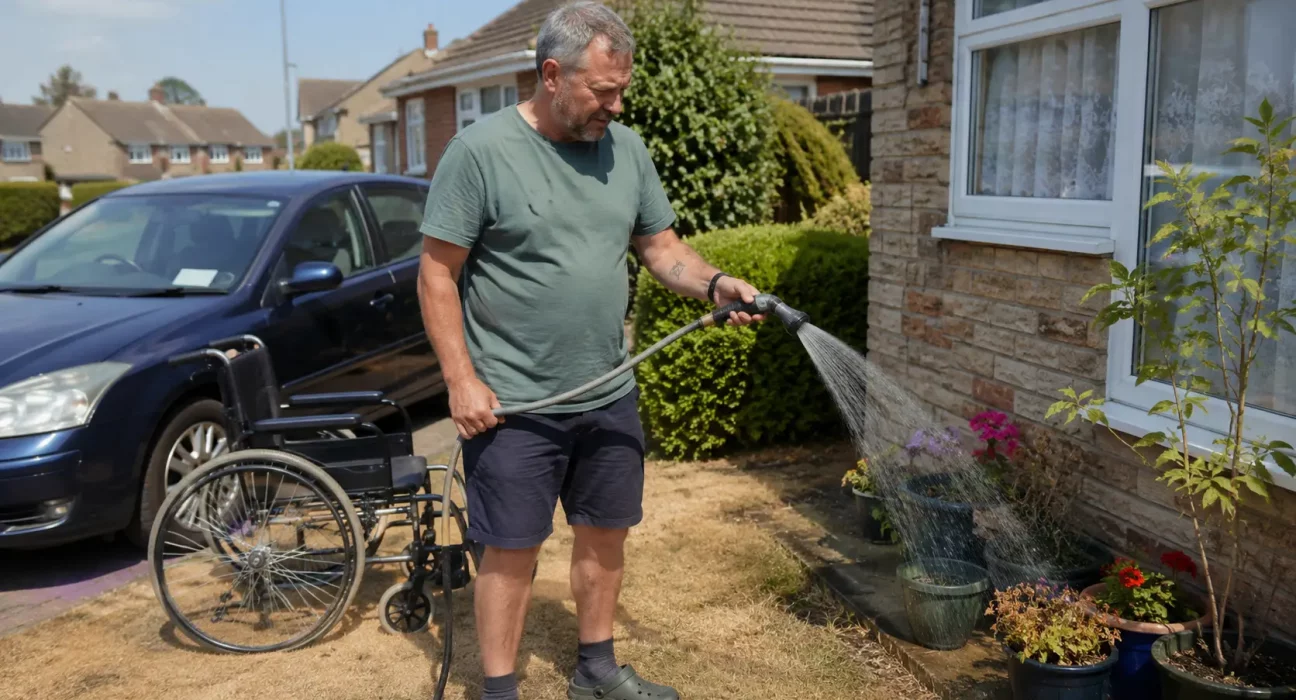
Blue Badge holders are not automatically exempt from every hosepipe ban in the UK. The answer depends on the Temporary Use Ban set by the water company supplying the property.
Some suppliers provide an automatic exemption for Blue Badge holders. Others require a relevant medical or mobility need, Priority Services registration, or proof that alternatives like a bucket or watering can are not reasonably safe.
The key point is simple: a Blue Badge may qualify for an exemption, but the current notice for the address must be checked before using a mains-connected hosepipe.
Key highlights:
- There is no single Blue Badge exemption covering every water supplier.
- Affinity Water’s July 2026 notice automatically exempts Blue Badge holders.
- South East Water uses a needs-based Priority Services test.
- Southern Water links its exemption to medical or mobility needs.
- Thames Water had not imposed a new formal ban when this article was last checked.
- Yorkshire Water currently has no hosepipe restrictions.
- Breaching a valid Temporary Use Ban may result in prosecution and a fine of up to £1,000.
Are Blue Badge Holders Exempt from Hosepipe Bans in the UK?

Blue Badge holders can be exempt from hosepipe bans, but the badge does not create a universal right to use a hosepipe during restrictions.
The position varies because water companies set their own automatic and discretionary exceptions within the legal framework for Temporary Use Bans.
Some suppliers, such as Affinity Water, provide automatic exemptions for Blue Badge holders.
Others, including Anglian Water, apply a needs-based approach, asking whether a disability or health condition prevents safe alternatives like using a watering can.
Blue Badge status, Priority Services registration and WaterSure eligibility are separate. The safest approach is to treat a Blue Badge as potential evidence of eligibility, not automatic permission.
Who Is Exempt from a Hosepipe Ban in the UK?
There is no identical list of exemptions for every hosepipe ban. Suppliers must identify their restrictions, affected areas and exceptions in the applicable notice.
The statutory framework allows water companies facing an actual or anticipated shortage to prohibit specified uses.
The temporary ban legal powers cover activities including watering gardens, cleaning private vehicles and filling domestic pools. The separate defined restricted water uses explain the activities and several health, safety, medical and animal-welfare exceptions.
Common Exception Categories
Although hosepipe bans restrict many outdoor water uses, most water suppliers provide specific exemptions for certain customers and activities.
Depending on the supplier, exceptions may include:
- Blue Badge holders
- Customers with qualifying mobility or medical needs
- Priority Services Register customers unable to make reasonable adjustments
- Certain WaterSure customers
- Water use required for human or animal health and safety
- Approved drip or trickle irrigation systems
- Hosepipes supplied entirely by rainwater or recycled water
- Some commercial activities where hosepipe use is essential
- Recently laid turf or newly planted trees under limited conditions
Recent reporting on hosepipe exemptions has focused partly on benefits claimants. However, receiving benefits does not by itself create a universal exemption.
A WaterSure-related exception applies only where the supplier’s live notice includes that category and any stated conditions are met.
The formal notice, rather than a general news headline, determines who may continue using a hosepipe.
Which Water Companies Automatically Exempt Blue Badge Holders?

Some water companies expressly name Blue Badge holders as automatically exempt, while others use a disability-related or functional-needs test.
Does Affinity Water Automatically Exempt Blue Badge Holders?
Yes. Affinity Water’s Central region restrictions are enforceable from 17 July 2026, and the notice lists Blue Badge holders among those automatically exempt from the 11 restricted activities.
The official statement is unambiguous:
“All Blue Badge holders and Priority Services Register customers are automatically exempt from the 11 activities listed.”
The current automatic exemption notice also says the company may question use of an exception following reports or other evidence of hosepipe use. Exempt customers should therefore keep a valid badge and ensure the activity falls within the current notice.
Yorkshire Water’s Blue Badge Exception
Yorkshire Water excluded Blue Badge holders, Priority Services Register customers and qualifying WaterSure customers from its 2025 restrictions. That historical exemption does not currently need to be relied upon because the company states that no hosepipe ban is in force in Yorkshire as of 15 July 2026.
Supplier comparison – last checked 15 July 2026:
| Supplier or area | Current position | Is a Blue Badge automatically sufficient? | What the customer should do |
| Affinity Water Central region | Ban enforceable from 17 July 2026 | Yes | Retain proof and check the affected postcode |
| South East Water in Kent | Restrictions in force | Not necessarily | Confirm Priority Services and needs-based eligibility |
| Southern Water in Hampshire and the Isle of Wight | Restrictions in force | Linked to mobility or medical needs | Check exemption status and intended use |
| Thames Water | Voluntary water-saving request, not a new formal ban | Not currently applicable | Monitor the live restriction page |
| Yorkshire Water | No current ban | Not currently applicable | Continue using water responsibly |
This comparison shows why a customer should check both the supplier and the date before relying on an exemption.
Do Southern Water and South East Water Apply the Same Exemption Rules?
No. Both recognise disability and mobility needs, but they do not describe eligibility in exactly the same way.
Southern Water
A current ban applies in Hampshire and on the Isle of Wight. Customers on the Priority Services Register with medical or mobility needs—including Blue Badge holders and relevant WaterSure customers—are exempt. The company nevertheless asks exempt customers to reduce or avoid hosepipe use where possible. The current mobility exemption guidance provides the live position.
This wording should not be reduced to “every Blue Badge holder can ignore the ban”. The exemption is presented in connection with medical or mobility needs.
South East Water
South East Water applies a narrower needs-based test in Kent. A customer can be exempt when registered for Priority Services and unable to make a reasonable adjustment, such as using a watering can instead of a hosepipe.
The exemption applies to the eligible person’s domestic property and a registered allotment. Customers should normally receive confirmation and can contact the supplier to check their status. The current disability exemption guidance explains the test and asks exempt customers to postpone unnecessary use where possible.
A Blue Badge may support the customer’s case, but it should not be assumed that the two suppliers use the same eligibility process.
Are Blue Badge Holders Exempt from a Thames Water Hosepipe Ban?

There was no new formal Thames Water hosepipe ban when this article was checked on 15 July 2026. Customers were instead being asked voluntarily not to use hosepipes or sprinklers during heatwaves.
Thames Water’s Current Position
The company says demand can exceed the rate at which water is delivered through parts of its network during hot weather. Its current water-saving request is therefore advisory rather than a legally enforceable Temporary Use Ban.
Its previous ban affecting selected postcode areas began in July 2025 and was lifted on 27 November 2025.
What Would Happen If Thames Water Introduced Another Ban?
A new legal notice would need to identify:
- The affected supply areas or postcodes
- The date enforcement begins
- The activities being prohibited
- Statutory and supplier-granted exceptions
- Any registration or evidence requirements
Blue Badge holders would need to read that new notice. Conditions from an expired 2025 ban should not be assumed to apply to a future restriction.
London’s Multiple Water-Supply Areas
There is no single supplier serving every London property. Some addresses described in news coverage as being in “London” may receive water from Affinity Water rather than Thames Water.
Restrictions follow water-supply boundaries and postcodes, not broad media descriptions. Customers should check the drinking-water supplier shown on their bill before looking for Blue Badge exemption rules.
What Can an Exempt Blue Badge Holder Use a Hosepipe For?
The permitted activity depends on the exemption’s scope. Some notices exempt eligible customers from every listed restriction, while others cover only activities connected with their medical or mobility needs.
An automatic exemption may cover garden watering, vehicle cleaning or maintaining a domestic pond. A needs-based exemption may be limited to watering a garden or allotment where carrying a watering can is unsafe.
Typical activity check:
| Intended activity | Should it be assumed to be covered? | What must be checked? |
| Watering essential garden plants | No | Whether garden watering is included |
| Watering a registered allotment | No | Property and tenancy conditions |
| Washing a private vehicle | No | Whether vehicle cleaning is included |
| Filling a paddling pool or hot tub | No | Recreational-use restrictions |
| Maintaining a fishpond | No | Animal-welfare exception |
| Cleaning an unsafe path | May be separately permitted | Health-and-safety wording |
| Using rainwater from a water butt | Often permitted | The water must not be mains supplied |
The 2010 rules contain specific exceptions for matters such as medical-treatment pools, fishponds and cleaning required for health or safety. These are distinct from a general Blue Badge concession.
Possessing a valid exemption does not necessarily make every type of hosepipe use lawful.
How Are Hosepipe-Ban Rules Enforced in the UK?
Enforcement is normally led by the water company, not the police. Companies commonly begin with education or a warning, but serious or repeated breaches may lead to further action.
Can an Exempt Customer Still Be Reported or Questioned?
Yes, visible hosepipe use may be reported by a neighbour or detected by the supplier. A report does not prove that a breach has occurred, but the company may ask whether an exception applies.
What enforcement may involve?
- Contacting the household for an explanation
- Checking the property’s supply area
- Confirming Blue Badge or Priority Services eligibility
- Checking whether the specific activity was covered
- Issuing advice or a warning
- Investigating repeated or deliberate misuse
- Considering prosecution in serious cases
Affinity Water’s notice expressly reserves the right to question a person’s use of an exception. South East Water also warns people reporting suspected misuse that genuine exemptions exist.
Keeping a copy of the applicable notice or written exemption confirmation can help resolve a query quickly.
Penalties and Proportionate Enforcement
Contravening a valid Temporary Use Ban is an offence. The Water Industry Act framework provides for a fine of up to £1,000 following summary conviction, and current supplier notices repeat that maximum.
An exemption protects only the person and activities falling within its terms. It does not protect unrelated or excessive use.
What Should Blue Badge Holders Do Before Using a Hosepipe?

Blue Badge holders should verify the restriction rather than relying on assumptions, previous bans or social-media posts.
Before using a hosepipe:
- Confirm that a formal Temporary Use Ban applies to the address.
- Identify the property’s drinking-water supplier.
- Open the supplier’s current legal notice or exemption page.
- Check whether Blue Badge status creates an automatic exception.
- Look for conditions involving mobility, medical needs or Priority Services.
- Confirm that the intended activity is covered.
- Register or request an assessment where required.
- Ask for written confirmation if the wording is unclear.
- Retain appropriate evidence without displaying personal information publicly.
- Use no more mains water than reasonably necessary.
Customers using a valid exception should still avoid peak-demand periods and postpone non-essential activities where practical.
Blue Badge holders can therefore be exempt from hosepipe bans, but eligibility depends on the supplier, the current notice and the purpose for which the hosepipe is being used.
Conclusion
Blue Badge holders may be exempt from hosepipe bans, but the rule is not universal across the UK. Eligibility depends on the water supplier, the current Temporary Use Ban notice and the activity involved.
Some companies grant automatic exemptions, while others require Priority Services registration or evidence of mobility or medical need.
Before using a hosepipe, customers should check the latest official guidance, confirm the exemption’s scope and keep evidence while continuing to conserve water.
Frequently Asked Questions
Does a Blue Badge exemption cover everyone living at the same address?
Not necessarily. The exception may apply only to the eligible person and activities undertaken for that person’s needs. Other household members should not use it for unrelated purposes.
Can a carer, relative or gardener use the hosepipe for an exempt person?
Possibly. The activity should be carried out for the eligible resident and remain within the exemption’s scope. Written confirmation is advisable where the notice is unclear.
Must the Blue Badge be displayed while the hosepipe is used?
Usually not unless the supplier specifically requests this. The customer should retain valid evidence but avoid exposing badge details or other personal information publicly.
Is the Priority Services Register the same as a Blue Badge?
No. A Blue Badge is principally a parking concession, while a Priority Services Register records people who may need additional utility support because of disability, health, age or other circumstances.
Are WaterSure customers automatically allowed to use a hosepipe?
Only where the current supplier notice says so. WaterSure status does not create an identical exemption under every Temporary Use Ban.
Can a hosepipe connected to a water butt be used during restrictions?
It is often permitted when the hose is supplied entirely by collected rainwater or recycled water. Customers should ensure the system is not drawing restricted mains water.
Can a Blue Badge holder fill a paddling pool or hot tub?
It should not be assumed. Recreational use may remain prohibited unless the supplier’s notice explicitly covers it or a separate medical exception applies.
Editorial Note:
Hosepipe restrictions and exemptions can be introduced, changed or withdrawn at short notice. This article reflects official information available on 15 July 2026.
Readers should check their drinking-water supplier’s latest notice before using a hosepipe. This is informational, not financial/legal advice, and it should not be treated as a substitute for advice about an individual case.
How We Checked?
The article was checked against current water-company restriction pages, formal notices, government legislation and official guidance.
The review compared automatic and needs-based exceptions, Blue Badge and Priority Services wording, affected supply areas, restricted activities, enforcement provisions and expired bans. News coverage was used to understand current public discussion but was not treated as a substitute for an official notice.
Leave feedback about this