







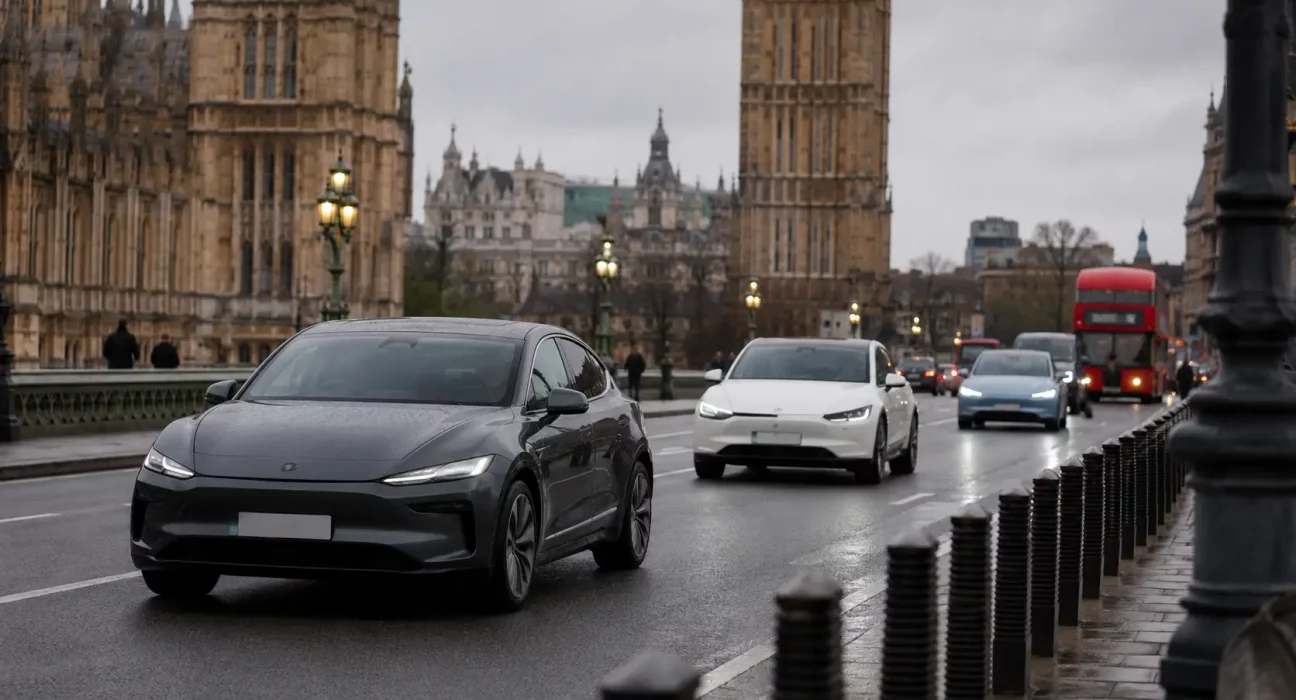
Labour’s EV road tax plans will introduce a mileage-based tax for electric and plug-in hybrid cars from 1 April 2028. The charge, formally known as Electric Vehicle Excise Duty, or eVED, will initially be set at 3p per mile for fully electric cars and 1.5p per mile for plug-in hybrids.
The new charge will apply alongside existing Vehicle Excise Duty rather than replacing it. It is forecast to raise £1.1bn in the 2028–29 financial year and affect around 5.6 million vehicles during that period. However, the figure is an official forecast, not guaranteed revenue.
Key takeaways:
- eVED is scheduled to begin on 1 April 2028.
- Electric cars will initially pay 3p per mile.
- Plug-in hybrids will pay 1.5p per mile.
- The charge will sit alongside existing annual vehicle tax.
- Drivers will estimate their mileage and later reconcile it against an updated reading.
- Newer cars will not require the additional pre-MOT mileage inspections originally proposed.
- Draft legislation has been published, but regulations and operational guidance are still being developed.
What Are Labour’s EV Road Tax Plans, and When Will they Begin?

Electric Vehicle Excise Duty is a national mileage charge designed for cars that can be plugged in to charge. The policy was announced at Budget 2025, followed by a consultation that received 5,133 responses.
A consultation response and draft legislative provisions were published on 13 July 2026.
What the plan covers?
- The intended start date is 1 April 2028.
- Liability begins when an eligible vehicle first renews its existing VED on or after that date.
- The scheme applies across the UK, although implementation must reflect Northern Ireland’s different MOT timetable.
- Mileage reporting and payment will be integrated into the existing vehicle-tax system.
- Detailed regulations, compliance procedures and digital services must still be completed before launch.
The policy therefore amounts to a confirmed government plan supported by draft legislation, rather than a fully operational tax that motorists must pay today. The technical consultation on the draft Finance Bill provisions is due to close on 7 September 2026.
Why Does the Government Expect the EV Road Tax to Raise £1.1bn in 2028–29?
The Government expects the electric vehicle road tax to generate £1.1 billion in its first financial year because millions of vehicles are projected to enter the scheme. Revenue is then forecast to rise as vehicle numbers increase and mileage rates are adjusted over time.
The First-year Revenue Forecast
The £1.1bn headline refers to expected Exchequer revenue during 2028–29. The certified forecast increases in the following two years as more vehicles enter the scheme and the mileage rates rise with inflation.
The official eVED policy details also estimate that approximately 5.6 million vehicles will be affected in the first financial year.
Forecast revenue:
| Financial year | Forecast Exchequer revenue |
| 2028–29 | £1.1bn |
| 2029–30 | £1.435bn |
| 2030–31 | £1.865bn |
These are fiscal projections rather than guaranteed receipts. Actual revenue will depend on vehicle numbers, mileage, payment behaviour, enforcement and future rate changes.
Replacing Part of Declining Fuel Duty
Petrol and diesel drivers contribute fuel duty whenever they buy road fuel. Fully electric vehicle drivers do not pay an equivalent usage-based fuel tax, creating a growing revenue gap as more motorists switch to electric vehicles.
The Government says the new system is intended to replace part of the fuel-duty revenue expected to decline during the transition to electric transport.
Explaining the policy in her 2025 Budget speech, Chancellor Rachel Reeves said the aim was to ensure that:
“Drivers are taxed according to how much they drive and not just by the type of car they own.”
This reflects the Government’s policy rationale, although questions remain about fairness, regional travel needs and the possible effect on electric vehicle demand.
Which Cars and Motorists Will Have to Pay the New EV Mileage Charge?
The new mileage-based charge is expected to apply mainly to UK-registered electric cars and plug-in hybrids. Liability will depend on the vehicle type, registration status and final implementation rules.
Vehicles Expected to Be Included
The scheme is intended to cover:
- Battery-electric cars
- Plug-in hybrid cars
- Hydrogen fuel-cell electric cars at the electric-car rate
- Range-extender electric cars at the plug-in hybrid rate
Electric vans, buses, coaches, motorcycles and heavy goods vehicles are expected to remain outside the scheme initially.
Converted petrol or diesel cars and some special-purpose vehicles, including specified hearses and campervans, may also be excluded at launch.
Who Will Be Responsible for Payment?
The registered keeper will generally be responsible for reporting mileage and paying the charge. For company cars and leased vehicles, this may be the employer or leasing company rather than the driver.
Some motorists who are exempt from ordinary VED may still have to pay the mileage charge. Eligibility should therefore be checked against the final vehicle list and official guidance.
How Will Labour’s Pay-per-Mile EV Road Tax Work in Practice?
The proposed EV mileage charge will be linked to the vehicle licensing process. Registered keepers will estimate their annual mileage, pay the corresponding charge and later reconcile the estimate against an updated odometer reading.
Annual Mileage Estimates and Payment
The yearly process is expected to work as follows:
- The registered keeper provides the vehicle’s current odometer reading.
- The keeper estimates the mileage for the next licensing period.
- The estimated mileage is multiplied by the relevant rate.
- The charge is paid annually or through an available instalment plan.
- A later odometer reading is compared with the original estimate.
- Any difference is settled through an additional payment or mileage credit.
Motorists should be able to revise their estimates if their circumstances change. Monthly payment plans are expected to include the same percentage surcharge currently applied to monthly VED Direct Debit payments.
How Will Underpayments and Mileage Credits Work?
Drivers travelling farther than estimated may need to make a top-up payment. Where a vehicle covers fewer miles than expected, the unused paid mileage will generally be carried forward as credit into the next licensing period.
Cash refunds are expected to be more limited when the scheme launches. Refunds may be available in specified situations, including:
- Vehicle theft
- Irreparable odometer damage
- Certain unexpected financial circumstances
Automatic cash refunds following the sale of a vehicle are not expected to be widely available at launch.
How Will Mileage Be Checked?
Vehicles with valid MOT records can use verified odometer readings from their test history. Owners of newer vehicles that have not yet reached their first MOT will initially report mileage themselves.
The earlier proposal for additional pre-MOT mileage inspections has been dropped. This should reduce inconvenience for private motorists, employers, fleets and leasing companies.
Will the Scheme Track Where People Drive?
The standard system is not expected to require drivers to disclose when or where journeys took place. The charge will be based on total recorded mileage rather than individual routes.
The Government is also developing an option to use a vehicle’s built-in connectivity to submit mileage automatically. This feature is expected to be voluntary rather than compulsory.
How Much Could Drivers Pay Under Labour’s EV Road Tax Plans?

The amount payable will depend on the vehicle’s annual mileage and the rate applied to its category.
Drivers covering more miles will pay more, while plug-in hybrids and range extenders are expected to face a lower rate than fully electric and hydrogen cars.
How Is the Charge Calculated?
The proposed calculation is:
Annual eVED charge = reported mileage × applicable rate
At the expected starting rates:
- A fully electric car travelling 8,000 miles would pay £240
- A plug-in hybrid travelling 8,000 miles would pay £120
Illustrative EV Road-Tax Calculator:
| Annual mileage | Electric or hydrogen car | Plug-in hybrid or range extender |
| 3,000 miles | £90 | £45 |
| 5,000 miles | £150 | £75 |
| 8,000 miles | £240 | £120 |
| 10,000 miles | £300 | £150 |
| 15,000 miles | £450 | £225 |
| 20,000 miles | £600 | £300 |
These figures cover eVED only. Existing Vehicle Excise Duty, insurance, charging, maintenance, depreciation, company-car tax and local road-user charges may also affect total ownership costs.
The starting mileage rates are expected to rise with CPI inflation from 2029/30. No official public calculator had been launched when the article was checked.
Will Pay-per-mile Tax Replace Existing Road Tax for Electric Cars?
No. The planned mileage charge will supplement rather than replace existing Vehicle Excise Duty. Under the current electric vehicle tax rules, electric cars registered from 1 April 2025 pay £10 in their first year and generally move to the £200 standard rate afterwards.
Cars registered between April 2017 and March 2025 generally pay the £200 standard rate, while some older electric cars pay £20. These figures apply for 2026–27 and may change before eVED begins.
Higher-value electric cars may also incur the Expensive Car Supplement. The threshold for qualifying electric vehicles is more than £50,000 under the current rules.
From 2028, an eligible driver may therefore face two separate liabilities: an ownership-based VED bill and a usage-based eVED bill.
What will the EV Mileage Tax Mean for London Businesses and Fleet Operators?
The EV mileage tax could increase whole-life vehicle costs for London businesses, especially those running high-mileage fleets. Employers must treat it separately from leasing, insurance, charging and local road-user costs.
Key Actions for Employers and Fleets:
- Fleet budgets: Add projected eVED liabilities to vehicle costs.
- Mileage scenarios: Model low, expected and high annual mileage.
- Data management: Improve odometer recording and evidence retention.
- Cost responsibility: Decide whether the employer or driver pays.
- Policy reviews: Update company-car and reimbursement rules.
- Leasing terms: Clarify top-ups, disposal and mileage credits.
- Payment systems: Prepare for bulk licensing and reconciliation.
The official assessment describes the overall business impact as negligible, although larger fleets may face software, process and staffing costs.
London operators must also separate eVED from the London congestion charge changes, as the national tax would be based on annual mileage.
Fleet providers may receive centralised management and bulk-payment options, but contracts must still define responsibility clearly.
Could the New EV Tax Affect Electric-Car Sales, and What Happens Next?
The new mileage charge may reduce part of the running-cost advantage associated with electric cars, although the effect will vary by mileage, charging costs, insurance, finance terms and local road charges.
Official estimates suggest eVED and related Budget measures could reduce forecast electric-car sales by around 120,000 between 2025–26 and 2030–31, equal to roughly 2% of expected sales.
However, this estimate covers several connected policies, not the mileage charge alone.
The Government has also introduced purchase grants, charging investment and automotive support. The proposals must still pass through technical consultation and legislation.
Drivers and businesses should monitor final rates, exemptions, enforcement rules and official digital guidance before making long-term cost decisions.
Conclusion
Labour’s EV road tax plans mark a significant shift in how electric motoring will be taxed across the UK. From April 2028, drivers will pay according to mileage as well as existing Vehicle Excise Duty.
The policy is expected to raise £1.1bn in 2028–29, but its impact on households, fleets and EV demand will depend on final rules, future rates and how effectively businesses and motorists prepare before the system takes effect nationally.
Frequently Asked Questions
Will the 3p-per-mile EV rate rise?
Yes. The initial rate is intended to rise with CPI inflation from 2029–30, although the exact future rates will depend on inflation and subsequent policy decisions.
Can eVED be paid monthly?
Monthly, six-monthly and annual payment options are planned. Monthly payments may include a direct-debit surcharge.
Is an official eVED calculator available?
Not yet. Drivers can estimate the charge by multiplying expected mileage by 3p for an electric car or 1.5p for a plug-in hybrid.
What happens when an electric car is sold?
The outgoing keeper may top up an underpayment before transfer. Prepaid mileage credit is expected to remain with the vehicle at launch and may influence the sale price.
Who pays eVED on a leased company car?
Legal responsibility generally sits with the registered keeper. The commercial contract may determine how the charge is recovered from the employer or driver.
Will driving abroad count towards eVED mileage?
The planned system is based on total odometer mileage rather than the location where miles were driven, so overseas mileage is expected to count.
Will electric cars need tracking devices?
No compulsory tracker is planned. Connected-car reporting is being developed as an optional service rather than a standard requirement.
Editorial Note
The accurate revenue wording is “£1.1bn in 2028–29”, not “£1.1bn by 2028–29”. The figure represents forecast receipts for one financial year.
“Road tax” and “pay-per-mile tax” are used because they reflect common search language. The formal terms are Vehicle Excise Duty and Electric Vehicle Excise Duty.
Policy intention, draft legislation and operational rules have been distinguished throughout. Details that remain under development have not been presented as settled law.
Leave feedback about this