







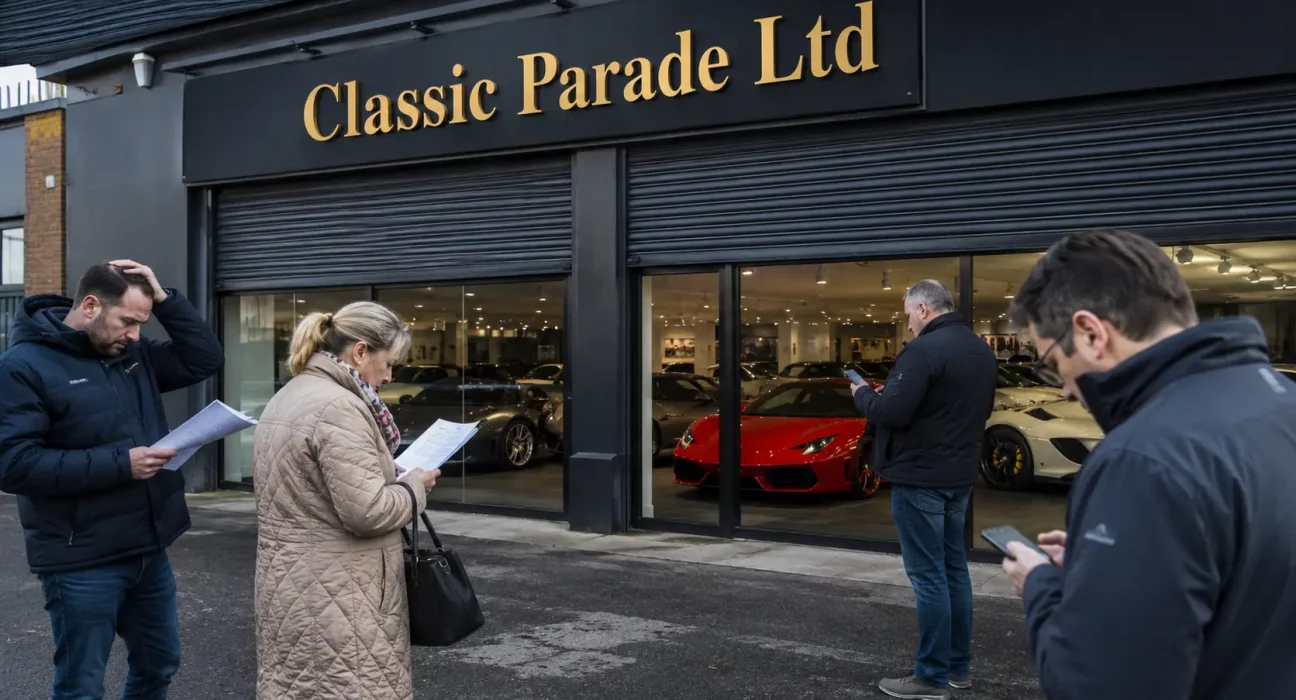
Classic Parade Ltd was wound up by the High Court in London on 14 July 2026 after an investigation found repeated short-notice cancellations, unpaid refunds and unexplained company transactions. The compulsory liquidation followed complaints from customers who had paid upfront for luxury and supercar hire, including bookings connected to weddings and a terminally ill family member.
The Classic Parade Ltd closure does not mean the company has already been dissolved. The Official Receiver has been appointed liquidator and will examine its affairs, assets and creditor claims. Customers may submit evidence of money owed, although recovery will depend on available assets and the statutory payment order.
Classic Parade Ltd had marketed Ferraris, Lamborghinis and other high-end vehicles from a Knightsbridge address. Official records show that the winding-up petition was filed on 23 June 2026.
Key Facts at a Glance:
- Classic Parade Ltd was wound up by the High Court on 14 July 2026.
- The winding-up petition was filed on 23 June 2026, and the official notice was published on 17 July 2026.
- Forty-eight Action Fraud complaints alleged combined customer losses of £220,675.
- Investigators identified at least 14 customers who paid for services that were not delivered.
- Twelve County Court Judgments registered against the company totalled £66,225.
- More than £1.4 million passed through company bank accounts without adequate explanation.
- The Official Receiver, L Burgess, was appointed liquidator.
- The winding-up order is a civil insolvency action and does not represent a criminal conviction.
What Happened In The Classic Parade Ltd Closure?
Classic Parade Ltd was placed into compulsory liquidation after investigators examined complaints involving cancelled luxury-car bookings and refunds that customers said never arrived. The company had presented itself as a Knightsbridge-based provider of Ferraris, Lamborghinis and other supercars.
Although incorporated in March 2023, its website reportedly described the business as celebrating 20 years of service. The official investigation findings on closure said customers frequently paid hire charges and security deposits before bookings were cancelled shortly before the agreed date.
The Official Receiver now controls the liquidation process. The company should therefore be described as wound up or in compulsory liquidation, rather than simply having stopped trading voluntarily.
When Was Classic Parade Ltd Closed and What Is The Timeline?
The legal closure occurred when the High Court made its winding-up order on 14 July 2026. The government announcement followed one week later.
Classic Parade Ltd Closure Timeline
| Event | Date or Detail |
| Company incorporated | 7 March 2023 |
| Registered office | 1 Knightsbridge Green, London, SW1X 7QA |
| Winding-up petition filed | 23 June 2026 |
| High Court winding-up order | 14 July 2026 |
| Official Receiver appointed | 14 July 2026 |
| Insolvency notice published | 17 July 2026 |
| Government investigation findings published | 21 July 2026 |
The timeline separates the court order from the later publication of the insolvency notice and investigation findings.
The formal winding-up order notice identifies the High Court case as No. 004913 of 2026 and confirms that L Burgess was appointed liquidator on 14 July.
Why Did The High Court Wind Up Classic Parade Ltd?
The company was wound up in the public interest following evidence of undelivered services, unpaid refunds, incomplete corporate filings and unexplained financial transactions. Investigators also reported that the director did not attend an interview or provide information needed to establish the full extent of the company’s presence and trading.
Joanna Caswell, Chief Investigator, said: “Classic Parade Ltd presented itself as a prestigious supercar hire business, but our investigation found a very different picture.”
Cancelled Bookings And Unpaid Customer Refunds
Investigators identified at least 14 customers who had paid hire fees and security deposits for services that were not delivered. Reported reasons for cancellations included mechanical faults, engine-management warning lights, business insurance issues and payment security checks.
Customers were allegedly promised refunds, but investigators said those repayments did not arrive. Examples included a Mercedes G63 AMG reserved for a wedding and a luxury vehicle booked as a gift for a terminally ill family member.
What Evidence Did Investigators Present?
The investigation considered Action Fraud complaints, County Court Judgments, banking activity, corporate filing failures and the company’s registered-office arrangements.
Investigators said Classic Parade Ltd had not filed accounts or confirmation statements. They also found no genuine presence at its Knightsbridge address, which was described as a virtual office vacated approximately two years before the investigation.
How Many Customers Were Affected By The Closure?
At least 14 customers were identified directly during the investigation, but that number should not be treated as the complete total. Separately, 48 complaints made to Action Fraud alleged combined losses of £220,675.
These figures describe different evidence groups. The 14 customers were examined as part of the investigation, while the 48 complaints represent reports submitted to Action Fraud. Additional customers or creditors could still come forward during the liquidation.
Investigators said some bookings concerned significant personal occasions, increasing the impact beyond the financial loss alone. Customers had paid for weddings, gifts and other important events before vehicles were reportedly withdrawn shortly before the hire date.
What Complaints And Court Judgements Were Reported?

Customers attempting to recover money obtained 12 County Court Judgments against Classic Parade Ltd between September 2023 and October 2024. Their combined value was £66,225.
Reported customer disputes:
- Customers said confirmed bookings were cancelled shortly before collection.
- Refunds were allegedly offered but not paid.
- Some payments were directed to third-party or personal accounts.
- Customers who posted negative reviews were allegedly threatened with legal action.
- In one case, the director allegedly threatened to post damaging reviews about a customer’s business.
A County Court Judgment establishes a civil debt but does not guarantee recovery. The availability of company assets and the liquidation process will determine whether creditors receive any distribution.
What Did Investigators Find In Classic Parade Ltd’s Accounts?
More than £1.4 million passed through Classic Parade Ltd’s bank accounts, but investigators said the director did not provide information explaining the full purpose of the transactions. Some customers were reportedly instructed to pay an account named Classic Parade Competitions or the director’s personal account instead of Classic Parade Ltd.
The official company officer record lists Andrew Brown as the company’s sole director, appointed on 7 March 2023. It records one current officer and no resignations.
Payments To The Director and A Connected Person
- Bank records showed £166,893 paid to the director personally and £121,847 paid to a person investigators understood to be his partner.
- Investigators said no evidence was supplied to establish that these payments were made for business purposes.
- That finding concerns the absence of supporting explanations and should not be presented as a separate criminal judgement.
Luxury Retail Transactions Under Scrutiny
- The investigation identified £28,154 in apparent personal expenditure at retailers including Harrods, Gucci and Prada.
- The company’s records did not provide evidence demonstrating a business purpose for those transactions.
- One company bank account was also closed in February 2025.
- Investigators said they could not establish the full extent of Classic Parade Ltd’s trading because the requested explanations and records were not provided.
What Has Not Been Established?
- The winding-up order does not establish that the director was convicted of fraud, theft or another criminal offence.
- It is a civil insolvency measure used to place a company into compulsory liquidation.
- The investigation identified conduct concerns, unexplained payments and apparent personal expenditure.
- Those findings must remain clearly separated from any criminal allegation, charge or conviction that has not been officially established.
Why Might Companies House Still Show Classic Parade Ltd as Active?
The public company register may continue to display “Active” while insolvency information is being processed. That label does not override the High Court’s winding-up order or mean the company can continue operating normally.
The same register shows overdue accounts and an overdue confirmation statement. It lists the first accounts, covering the period to 31 March 2024, as due by 7 December 2024, while the first confirmation statement was due by 20 March 2024.
Legal Status Explained
| Term | Meaning |
| Wound up | The court has ordered the company into compulsory liquidation |
| In liquidation | A liquidator is dealing with assets, liabilities and creditor claims |
| Dissolved | The company has been removed from the register |
| Active on the register | The company has not yet been recorded as dissolved, or an update is pending |
The most accurate current description is that Classic Parade Ltd has been wound up and placed into compulsory liquidation.
What Should Affected Customers Do After The Closure?
Customers who are owed money may need to register as creditors with the Official Receiver. They should retain documents establishing the booking, payment, cancellation and amount claimed.
Official enquiries concerning the company’s affairs can be sent to the Public Interest Unit, PO Box 16664, Birmingham, B2 2JQ, or PIU.OR@insolvency.gov.uk. The Official Receiver may request further evidence when reviewing creditor claims and company transactions.
How To Register As A Creditor?
Customers should collect booking confirmations, contracts, receipts, card or bank statements, cancellation messages, refund promises and relevant court documents. Action Fraud reference numbers and correspondence showing where payments were sent may also assist the claim.
The creditor should provide accurate figures and distinguish the original booking cost, security deposit, court award and any amount already recovered.
Will Customers Receive All Their Money Back?
Full repayment is not guaranteed. Returns depend on recoverable assets, liquidation expenses, legally preferred claims and the amount owed to all creditors.
Customers who paid by card may also ask their provider whether chargeback or statutory credit protection is available. Eligibility depends on the payment method, transaction value, date and individual circumstances, so prompt contact with the payment provider may be important.
What Does The Closure Mean For UK Luxury Car Hire Customers?

The case highlights the risks associated with large advance payments for high-value vehicle hire. A prestigious address, luxury business website or access to expensive vehicle imagery does not independently establish that a business has the vehicles, finances or systems needed to fulfil bookings.
Checks Before Paying
- Confirm that the payment account matches the contracting company.
- Review the company’s filing status and overdue-record warnings.
- Read cancellation, deposit and refund conditions before booking.
- Use a payment method that may provide additional consumer protection.
- Keep written confirmation of the vehicle, date, price and refund terms.
- Question requests to transfer money to a personal or unrelated account.
- Retain all messages and receipts until the booking is completed.
These checks cannot remove every risk, but they can provide stronger evidence if a booking fails or a payment dispute arises.
Conclusion
The Classic Parade Ltd closure followed a High Court winding-up order made on 14 July 2026 after investigators found a pattern of cancelled supercar bookings and unpaid refunds. The case involved 48 Action Fraud complaints alleging losses of £220,675, 12 County Court Judgments worth £66,225 and more than £1.4 million passing through company accounts without a complete explanation.
The Official Receiver is now responsible for examining the company’s records, assets and liabilities. Customers can submit creditor claims, although repayment will depend on what funds or assets can be recovered.
FAQs
Was Classic Parade Ltd Closed Voluntarily?
No, Classic Parade Ltd was placed into compulsory liquidation by a High Court winding-up order. It was not recorded as a voluntary closure initiated by the director.
Who Was the Director of Classic Parade Ltd?
Andrew Brown is listed as the company’s director and was appointed on 7 March 2023. The public officer record shows one current officer and no recorded resignations.
Was Anyone Convicted of Fraud?
The winding-up order does not establish a criminal fraud conviction. Any criminal charge or conviction would require a separate investigation and court process.
What Is the Classic Parade Ltd Company Number?
Classic Parade Ltd is registered under company number 14713503. This number can be used to distinguish its official company and insolvency records from similarly named businesses.
Can Customers Request a Card Chargeback?
A chargeback may be possible depending on the payment method, transaction date and card provider’s rules. Customers should contact their bank or card issuer promptly and provide supporting evidence.
Who Is Handling the Liquidation?
L Burgess was named as the Official Receiver and liquidator from 14 July 2026. The Official Receiver is responsible for dealing with the company’s affairs and assessing creditor claims.
Could Former Customers Be Contacted by Investigators?
Yes, the Official Receiver may contact customers for evidence about bookings, payments or promised refunds. Keeping complete records can help customers substantiate the amount they are owed.
Note:
The customer-loss figures, financial transactions and conduct concerns in this article are attributed to official investigation findings and insolvency records. The winding-up order is a civil insolvency action and should not be described as a criminal conviction or formal dissolution unless a later official record establishes that status.
Leave feedback about this