






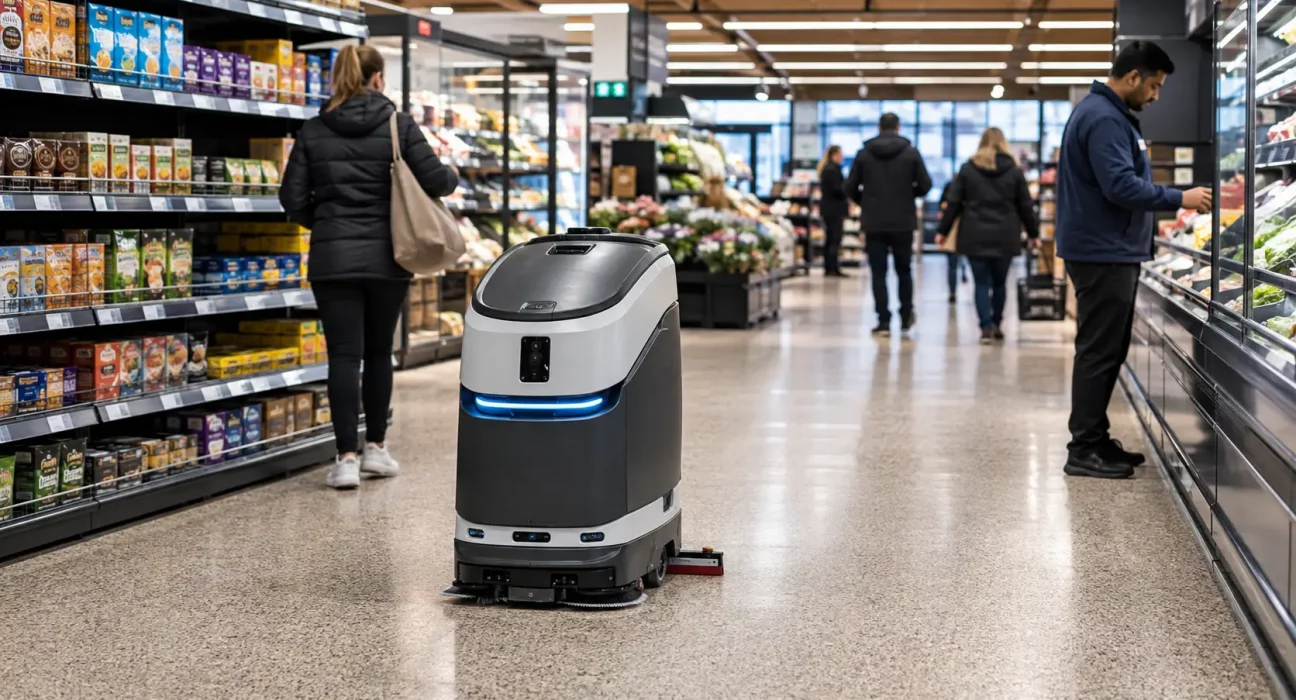
Tesco has completed the initial phase of its ICE cleaning robot rollout across 600 Express stores in the UK. The autonomous machines carry out routine floor cleaning while Tesco employees continue handling customer service, stock management and wider store operations.
The programme was announced on 9 June 2026, before the completion milestone was reported on 31 July.
Tesco and Industrial Cleaning Equipment, known as ICE, describe the machines as “co-bots” that work alongside employees rather than replace them.However, neither company has published detailed figures showing labour hours saved, cleaning-score improvements, costs or customer feedback.
How Did Tesco’s Cleaning Robot Rollout Reach 600 Stores?
The programme developed over several stages rather than through a single nationwide launch. The initial announcement set the target, while the July update confirmed that the first deployment phase had been completed.
Rollout Timeline
- On 9 June 2026, ICE announced autonomous cleaning robots for 600 Tesco Express stores.
- The companies presented Tesco with an Innovation and Partnership Award to recognise the collaboration.
- Equipment installation was accompanied by colleague training and ongoing service support.
- On 31 July 2026, the programme was reported to have completed its initial phase.
- Representatives later visited 32 Express stores in Scotland to gather feedback from employees using the machines.
The project involved store colleagues, shift leaders, managers, engineers and suppliers, indicating that implementation required more than delivering equipment to individual shops.
This chronology also prevents the June announcement from being presented as a new event after the rollout had already reached its first completion milestone.
What Do Tesco’s ICE Cleaning Robots Do Inside Express Stores?
The machines perform a defined operational task: cleaning floors in participating Tesco Express stores. The official rollout programme details describe them as autonomous “co-bots” supported by data tracking, reporting, training and continuing service provision.
Routine Cleaning Responsibilities
The robots take over regular floor-cleaning activity that would otherwise require employee or cleaning-team time.
They are not presented as general-purpose robots capable of serving customers, filling shelves, operating checkouts or making independent store-management decisions.Automating a repetitive task could allow colleagues to focus on customers, product availability, stock handling and daily shopfloor work.
That remains the programme’s stated objective rather than a quantified outcome, because published sources do not show how many working hours have been redirected.
ICE says it brings more than 10 years of experience in autonomous equipment and is supplying the machinery, comprehensive training and continuing service support across all 600 locations.
How Does Cleaning Data Support Store Teams?
The robots also generate tracking information and performance reports intended to show whether cleaning routines have been completed consistently. This could give store managers a clearer record of scheduled activity than a process relying only on manual confirmation.
The available information does not disclose the exact data collected, the reporting interface, retention periods, intervention rates or store-level performance thresholds.It would therefore be inaccurate to describe the system as generative artificial intelligence or assume that its reports independently prove higher hygiene standards.
ICE chief executive Mark Bresnihan said the programme showed how “data-driven automation can work hand-in-hand with retail teams to improve cleaning standards”.
The statement confirms the intended operational model, although independently measured improvements have not been released.
Why Is Tesco Introducing Autonomous Cleaners Into Express Stores?
Tesco Express shops are compact convenience stores where customers, colleagues, stock cages and deliveries may share limited floor space. Cleaning must be completed regularly without unnecessarily disrupting shopping or other store activities.
Autonomous machines may help standardise repetitive floor care, provide evidence that scheduled routines have occurred and reduce the amount of colleague time spent operating conventional cleaning equipment. A centrally supported system may also simplify training, maintenance and performance monitoring across hundreds of sites.
The business case remains incomplete publicly. Tesco and ICE have not disclosed the total investment, cost per store, maintenance expenditure, expected payback period or recorded labour savings. Claims that the rollout has already reduced costs or improved productivity would therefore go beyond the available evidence.
The programme is better understood as an attempt to automate a narrow operational process while retaining people for duties requiring judgement, flexibility and direct customer interaction.
How Much Of Tesco’s Express Estate Does The Rollout Cover?
The 600-store deployment represents a sizeable but partial share of Tesco’s convenience network. Tesco reported 2,074 Express stores in November 2024 and said it planned to add more than 150 over the following three years.
Estimated Estate Coverage
| Calculation | Result |
| Stores in robot rollout | 600 |
| Published Express count | 2,074 |
| Calculated share | 28.9% |
| Rounded description | About three in ten |
Based on the 2,074-store figure, the rollout covers approximately 29% of the estate. Because Tesco has continued announcing store expansion, the proportion of its current 2026 network may be slightly lower; the calculation should not be treated as a live store count.
Tesco has not published a complete list of the 600 participating locations or explained how stores were selected for the first phase.
Are Tesco’s Cleaning Robots Designed To Replace Store Colleagues?
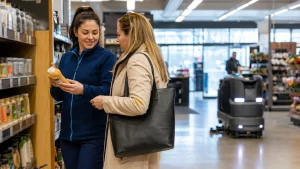
Tesco and ICE present the robots as assistants for employees rather than replacements. Their stated role is to perform routine floor cleaning so colleagues can devote more time to serving customers and managing other shopfloor responsibilities.
The Co-Bot Model
“Co-bot” is a shortened form of collaborative robot. In this rollout, it describes a machine assigned a limited task while employees remain responsible for wider store operations, customer needs and situations requiring human judgement.
The term does not mean the machines can operate without any human involvement. Store teams still require training, while technical servicing, route adjustments, fault resolution and unexpected obstacles may require intervention.
What Workforce Evidence Has Been Published?
The available sources do not identify job reductions connected with the rollout.
They also provide no before-and-after staffing figures, changes to contractor arrangements, reductions in labour budgets or measured increases in customer-facing time.
This means there is insufficient evidence to conclude either that the programme will eliminate jobs or that it will have no longer-term workforce effect. The strongest verified statement is that Tesco and ICE currently describe the machines as tools designed to support employees.
Measures That Would Show Workforce Impact
A meaningful evaluation would require Tesco or ICE to publish:
- Staff hours spent on floor cleaning before and after deployment.
- Time redirected to customers, stock or store availability.
- Employee feedback on workload and usability.
- Frequency of human intervention.
- Training time and continuing support requirements.
- Changes to cleaning contracts or staffing budgets.
- Robot downtime and conventional equipment still required.
Without these measures, the workforce impact remains an operational objective rather than a demonstrated result.
Why Did Tesco And ICE Visit 32 Scottish Express Stores?
Representatives visited 32 Tesco Express stores across Scotland to mark the completion milestone and collect feedback from colleagues using the technology.The visits gave project teams an opportunity to examine how the machines performed in real shops rather than relying only on rollout plans or supplier specifications.
Employee feedback could identify navigation difficulties, training gaps, recurring faults or differences between store layouts.Express stores may present changing conditions, including customers moving through aisles, delivery cages, promotional displays and stock awaiting replenishment.Feedback may influence machine routes, maintenance arrangements, colleague guidance and decisions about further deployment.
However, the visits were described as a feedback exercise, not an independent audit or a published performance study.No detailed findings from the 32 stores have been released. Consequently, there is no verified breakdown of employee satisfaction, cleaning consistency, customer reaction or technical problems identified during the Scottish visits.
How Does The Rollout Fit Tesco And ICE’s Wider Retail Partnership?
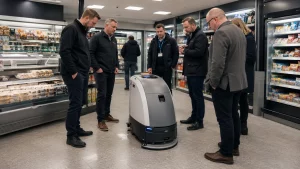
The 600-store programme extends an established commercial relationship rather than creating an entirely new supplier arrangement. ICE had already provided cleaning equipment services within Tesco’s convenience estate before autonomous machines were introduced.
The 2024 Nationwide Cleaning Contract
In March 2024, ICE announced an expanded contract to service and supply cleaning equipment across approximately 2,000 Tesco Express stores. The agreement doubled its previous footprint, as the company had earlier serviced roughly half of the estate.
The national cleaning contract details show that the renewed arrangement followed an existing three-year partnership. Tesco facilities manager Matthew Standley said: “This agreement ensures consistent service and supply across all our stores.”
Tesco subsequently reported 2,074 locations in its official Express estate figures. An existing maintenance and training network may have reduced the practical difficulty of deploying new equipment across 600 stores, although neither company has published implementation-cost comparisons.
How Is This Different From Tesco’s Other Robot Trials?
The ICE machines clean floors. They should not be confused with shelf-scanning robots, which move through aisles to identify product availability, pricing or stock gaps.Other UK retailers had experimented with cleaning automation before Tesco’s rollout.
Asda trialled autonomous floor-cleaning machines at three stores in 2020, while Morrisons later introduced cobotic cleaning at logistics locations. Those projects differ in setting and scale from a rollout across 600 convenience shops.
Tesco and ICE’s defensible distinction is therefore the reported scale within the UK convenience sector, not the invention or first-ever UK use of robotic floor cleaning.
What Remains Unknown About The Rollout, And What Happens Next?

The completed first phase establishes deployment scale but does not yet establish financial, operational or workforce success. Several material details remain unpublished.
Information Still Required
- The programme’s total cost and average investment per store.
- The exact robot model or mix of models used.
- Average daily operating hours and floor area covered.
- Cleaning completion and quality results.
- Human intervention and machine-failure rates.
- Maintenance and repair costs.
- Staff hours released for other work.
- Customer, accessibility and safety feedback.
- Criteria used to select participating stores.
- Plans for a second phase or other Tesco formats.
The next significant update would be evidence showing whether the robots have delivered consistent cleaning, reliable operation and meaningful time savings.Confirmation of expansion into more Express stores, superstores or other formats would also indicate Tesco’s level of confidence in the programme.
Until an official announcement is made, further deployment remains possible rather than confirmed.
Conclusion
The Tesco ICE cleaning robot rollout has moved from a June announcement to a completed initial deployment across 600 Express stores.
Its scale makes it an important development in UK convenience-store automation, particularly because the machines combine routine floor cleaning with performance tracking and central support.
The programme is intended to assist colleagues rather than replace them, but deployment numbers alone cannot demonstrate success.
Tesco’s next challenge is to show whether the robots improve cleaning consistency, operate safely around customers, reduce repetitive workload and provide benefits that justify their cost.
Published performance evidence—and any decision to expand beyond the first 600 stores—will offer the clearest measure of the rollout’s long-term value.
FAQs
Who Supplies Tesco’s Autonomous Cleaning Robots?
Industrial Cleaning Equipment supplies the machines and provides colleague training and continuing service support. The company was already responsible for cleaning equipment across Tesco’s Express estate before this rollout.
What Does “Co-Bot” Mean In A Tesco Store?
A co-bot is a collaborative robot intended to work alongside people on a specific task. In this case, the task is routine floor cleaning rather than customer service or complete store operation.
Can The Robots Operate While Customers Are Shopping?
The machines are designed for shopfloor use, but published information does not provide operating schedules for all 600 locations. Individual stores may manage cleaning times according to layout, customer traffic and local requirements.
What Happens When A Robot Encounters An Obstacle?
The rollout announcements do not explain the exact obstacle-avoidance process or frequency of human intervention. Store colleagues may still need to assist when routes are blocked or conditions change unexpectedly.
Who Trains Tesco Employees To Use The Robots?
ICE says it provides comprehensive staff training alongside the machinery. It also supplies continuing service support across all participating locations.
Has Tesco Confirmed The Exact Robot Model Used?
The public rollout information does not identify one model as standard across every store. It is therefore unclear whether all 600 locations use identical machines or configurations.
Are The Robots Used During Opening Hours Or Overnight?
The companies have not published a universal operating timetable for participating stores. The schedule may vary according to opening hours, shopfloor traffic and store-level cleaning plans.
Note
The 600-store figure covers the completed first phase, not every Tesco Express location. Claims about the rollout’s scale come from Tesco and ICE and have not been independently verified across the whole UK market. The estimated estate share is approximate, while costs, savings, performance results and any second phase remain undisclosed.
Leave feedback about this