








The Andy Burnham London housing market debate is fundamentally about whether the new Prime Minister can reform property taxes and increase housing supply without creating further uncertainty in an already weak capital market.
London prices were falling before Burnham entered Downing Street, while costly transactions, limited affordable supply and outdated Council Tax valuations were already restricting movement.
Burnham has supported major property-tax reform and promised more council homes, but neither a national proportional property tax nor the abolition of Stamp Duty has been confirmed. The eventual impact will depend on the tax rate, regional protections, implementation timetable and funding available for housebuilding.
Key Takeaways
- London house prices fell for a ninth consecutive month on an annual basis in May 2026.
- A 0.48% property levy is a campaign proposal, not confirmed government policy.
- London-focused alternatives would use lower initial rates and retain local tax powers.
- Burnham’s council housing pledge requires additional funding and delivery capacity.
These distinctions are essential when assessing what Burnham could realistically change.
What Is Driving the Andy Burnham London Housing Market Story?

Andy Burnham became Prime Minister on 20 July 2026, becoming the seventh person to hold the office since 2016. His arrival has renewed debate about property taxation, housing devolution and council housebuilding at a time when London’s market needs both reform and stability.
Why the Story Matters
- London transactions have fallen in seven of the past ten years.
- Sales increased by only 1% last year despite four interest-rate cuts.
- Council Tax still relies on property values from 1991.
- Stamp Duty creates a large upfront cost when households move.
- London’s higher property values amplify the effect of value-based taxation.
Burnham has discussed land or proportional property taxation for years, but the market’s immediate concern is uncertainty. Announcing a future Stamp Duty abolition long before implementation, for example, could encourage buyers to delay purchases and weaken transactions in the intervening period.
Why Is London’s Housing Market Under Pressure Before Andy Burnham Reforms?
London’s average house price was provisionally £545,000 in May 2026, down 3.7% from £566,000 a year earlier. This was the ninth consecutive annual decline and a steeper fall than April’s 2.3% decrease. Across the UK, average prices instead rose 2.7% to £271,000.
Inner London recorded a 5.9% annual decline, compared with only 0.3% in Outer London. The difference shows why claims about a single “London market” can be misleading.
Selected Borough Price Changes
| London Area | May 2026 Average | Annual Change |
| Westminster | £836,000 | -22.8% |
| Tower Hamlets | £444,000 | -14.5% |
| Hammersmith and Fulham | £729,000 | -10.9% |
| Kensington and Chelsea | £1.256 million | -10.7% |
| London overall | £545,000 | -3.7% |
Westminster’s average fell from approximately £1.084 million, wiping nearly £248,000 from the annual figure. However, these estimates are provisional and can be volatile where the number or mix of completed sales changes materially.
Higher mortgage costs, tax changes, weaker international demand and political uncertainty may all be contributing. The decline began before Burnham took office, so it cannot reasonably be attributed to his premiership.
Could Burnham Replace Council Tax and Stamp Duty?

The National 0.48% Property Levy
The most widely discussed model would abolish Council Tax and Stamp Duty on owner-occupied purchases and replace them with an annual levy equal to 0.48% of current property value. Empty homes, second homes and homes owned by non-UK residents could face a 0.96% rate under that campaign proposal.
At 0.48%, a £1.5 million London property would generate a £7,200 annual bill. One external estimate suggests the flat model could collectively increase London’s property-tax burden by approximately £7.5 billion, although this is not a Treasury forecast.
How Does the London Alternative Differ?
A London-focused proposal would charge 0.39% on homes worth up to £800,000, with gradual increases between £800,000 and £1 million and further increases above £1 million. Liability would move from occupiers to owners, meaning renters would no longer directly receive Council Tax bills.
The model would also preserve tax-setting powers at local, regional and national levels. Its authors estimate it could raise an additional £912 million annually for London housing and potentially double social housing delivery, but these remain modelled outcomes rather than government commitments.
Confirmed Policy Versus Political Direction
The official prime minister role record confirms Burnham’s appointment, but there is no confirmed 0.48% government rate, abolition date, valuation method or national property-tax bill.
A separate measure is already scheduled from April 2028: owners of homes worth at least £2 million will pay a High Value Council Tax Surcharge ranging from £2,500 to £7,500. Fewer than 1% of English properties are expected to fall within its scope, and the measure is forecast to raise about £430 million annually.
How Could a New Property Levy Affect London Homeowners?
A value-based levy would shift taxation away from moving home and towards continued ownership. That could improve mobility but create higher recurring costs for some London households.
Illustrative Annual Property Bills
| Property Value | Bill at 0.48% | Bill at 0.39% |
| £400,000 | £1,920 | £1,560 |
| £600,000 | £2,880 | £2,340 |
| £800,000 | £3,840 | £3,120 |
| £1 million | £4,800 | At least £3,900 |
| £1.5 million | £7,200 | Progressive rate applies |
For an average £600,000 London home, the flat model would produce a £2,880 bill—about £812 above the referenced average Band D charge. The 0.39% alternative would produce £2,340, approximately £272 more.
These figures do not account for abolished Stamp Duty, transitional relief, deferral or local variations. They also illustrate the central fairness problem: a long-term owner may have substantial housing wealth but insufficient income for a sharply higher annual payment.
The issue is particularly sensitive in areas such as Hackney, where referenced market data show the average semi-detached price rising from £570,470 in 2012 to £1,181,319. Such homes may be valuable without being conventional mansions.
Can Burnham’s Housebuilding Pledge Increase London Housing Supply?
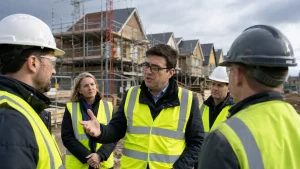
Burnham used his first Downing Street speech to say:
“And we will build more council homes.”
He has also promised the biggest council housebuilding programme since the post-war period, but delivery will depend on financing, land and institutional capacity.
Main Delivery Barriers
- London land values absorb a large proportion of development costs.
- Construction costs and labour shortages restrict viable projects.
- Councils and housing associations face borrowing constraints.
- Weak private sales reduce cross-subsidy for affordable homes.
- Planning decisions can delay or cancel substantial developments.
Recent examples cited in the industry include the rejection of an 867-home redevelopment in Peckham and Enfield’s withdrawal from the proposed Crews Hill development. Greater Manchester delivered about 3.8 homes per 1,000 residents between 2018 and 2025, showing that Burnham’s regional record does not automatically provide a simple London blueprint.
The existing London affordable housing programme has secured up to £11.7 billion within a national £39 billion, ten-year programme. Nationally, the programme aims to support 300,000 affordable homes by 2036.
This funding is substantial, but Burnham’s post-war comparison requires a much larger delivery shift.
Who Could Gain or Lose From Burnham’s Housing Agenda?
Who Might Benefit From the Proposed Reforms?
First-time buyers could benefit if Stamp Duty were removed and transaction costs fell. A revived Help to Buy-style scheme could also stimulate demand: the previous programme offered equity loans of up to 20% nationally and 40% in London, allowing eligible buyers to proceed with a 5% deposit before the scheme ended in 2023.
Referenced figures show the average London and South-East first-time buyer property rising by more than one-fifth, from £395,612 a decade ago to £478,533. Demand support could therefore help with deposits, although it would not resolve mortgage affordability or housing shortages.
Families seeking larger homes and older owners wishing to downsize could also gain from lower moving taxes. Renters might benefit if new revenue genuinely finances more social housing.
Risks for Homeowners, Pensioners and Landlords
A recurring levy could disadvantage pensioners, long-term residents and other owners whose property values have risen faster than their incomes. Recent buyers may also object if they have already paid Stamp Duty and are then moved quickly onto a new annual charge.
Landlords, second-home owners and overseas owners could face the proposed 0.96% rate. Some costs might be reflected in rents, although the extent would depend on supply, local demand and the final legislation.
The strongest protections would include phased implementation, deferral for income-constrained owners and credits for recent Stamp Duty payments. None has yet been confirmed for a Burnham property-tax reform.
Will Burnham’s Policies Push London House Prices Down Further?

A new annual levy could place downward pressure on expensive properties by increasing ownership costs and reducing investor demand. Prime central London may be particularly sensitive because it is already adjusting to the April 2028 high-value surcharge and has recorded some of the capital’s steepest recent price falls.
However, abolishing Stamp Duty could support prices by making purchases and moves less expensive. A demand scheme resembling Help to Buy could also encourage first-time buyer activity and give developers more confidence to begin stalled projects.
Mortgage rates, employment, wages, available stock, international demand and tax transition dates will remain at least as important as Burnham’s political position. The most credible conclusion is therefore not that his programme will cause a crash or boom, but that poorly timed announcements could temporarily freeze transactions.
London needs policy clarity quickly, yet implementation must be designed carefully enough to avoid a rush, cliff edge or prolonged waiting period.
What Should London Buyers, Sellers and Investors Watch Next?

Which Market Indicators Matter Most?
Readers can use the official London house-price data to monitor price changes, revisions and differences between Inner and Outer London.
Signals to Monitor
- Monthly sales and agreed transaction volumes
- Mortgage approvals and lending rates
- New buyer enquiries and property listings
- Borough-level price revisions
- Private rental inflation
- New-build starts and affordable completions
No single indicator confirms a recovery or downturn, so several measures should move together before conclusions are drawn.
Government Policy Milestones
The most important developments will be a formal Treasury consultation, confirmed property valuations, landlord and second-home rules, deferral arrangements and the treatment of recent Stamp Duty payers.
Buyers should also watch whether Help to Buy is formally reviewed or revived. The former scheme’s 20% national and 40% London equity loans remain relevant context, but no replacement should be assumed until eligibility, price caps and funding are published.
What Would Signal a Genuine Turning Point?
A sustainable improvement would combine stronger transactions, better mortgage affordability, stabilising prices and rising construction starts. Announcing tax abolition alone may lift long-term mobility while weakening short-term activity if buyers wait for a future start date.
For social housing, progress should be measured through funded starts and completions rather than headline ambition. Current analysis suggests redirecting the £39 billion programme, using a £2.5 billion low-cost loan facility and adjusting developer contributions could support about 66,000 low-rent or affordable homes a year—only 1,000 to 3,000 more than otherwise expected and below the post-war level of 100,000 council homes annually.
Conclusion
The Andy Burnham London housing market outlook depends less on one headline tax rate than on detailed policy design. London entered Burnham’s premiership with falling prices, weak transaction growth and severe shortages of genuinely affordable homes.
Replacing Stamp Duty could improve mobility, while a proportional levy could modernise Council Tax. Yet a flat national rate risks placing a disproportionate burden on London owners unless it includes devolution, progressive bands and household protections.
Burnham’s housebuilding pledge faces an equally difficult test. England has 134,000 households in temporary accommodation and 1.3 million on housing waiting lists, while social rent is typically about 50% of market rent. Delivering meaningful change will require additional money, viable land, cheaper finance and faster construction, not promises alone.
Frequently Asked Questions
When Did Andy Burnham Become Prime Minister?
Andy Burnham became Prime Minister on 20 July 2026 after becoming Labour leader. He had returned to Parliament as the MP for Makerfield in June 2026.
Is the 0.48% Property Tax Confirmed?
No, the 0.48% rate comes from a proportional property-tax campaign model. The government has not confirmed that rate, its scope or an implementation date.
Would Renters Pay the Proposed Property Levy?
The London-focused model would make property owners liable instead of occupiers. The final government design, including any effect on rents, remains unknown.
Could Pensioners Defer Higher Property Bills?
Deferral is frequently proposed to protect owners with valuable homes but limited income. No Burnham government deferral scheme has yet been confirmed.
What Happens to Recent Stamp Duty Payers?
Recent buyers could face both historic Stamp Duty and a new annual levy unless transitional protection is introduced. Any credit, exemption or phase-in period would require formal legislation.
Will the Existing Mansion Surcharge Continue?
The existing high-value surcharge is scheduled from April 2028 for properties worth £2 million or more. Charges will initially range from £2,500 to £7,500 annually.
Where Can Londoners Check Reliable Price Figures?
The UK House Price Index provides national, regional and borough-level figures. Readers should check whether figures are provisional and review later revisions before drawing conclusions.
Note: The 0.48% property levy, the £7.5 billion estimate and the London-specific proportional property tax model are proposals or external calculations, not enacted government policy.
London house-price figures for May 2026 are provisional and may be revised. The market decline began before Andy Burnham became Prime Minister on 20 July 2026, so it should not be attributed to policies introduced after that date.
Leave feedback about this