







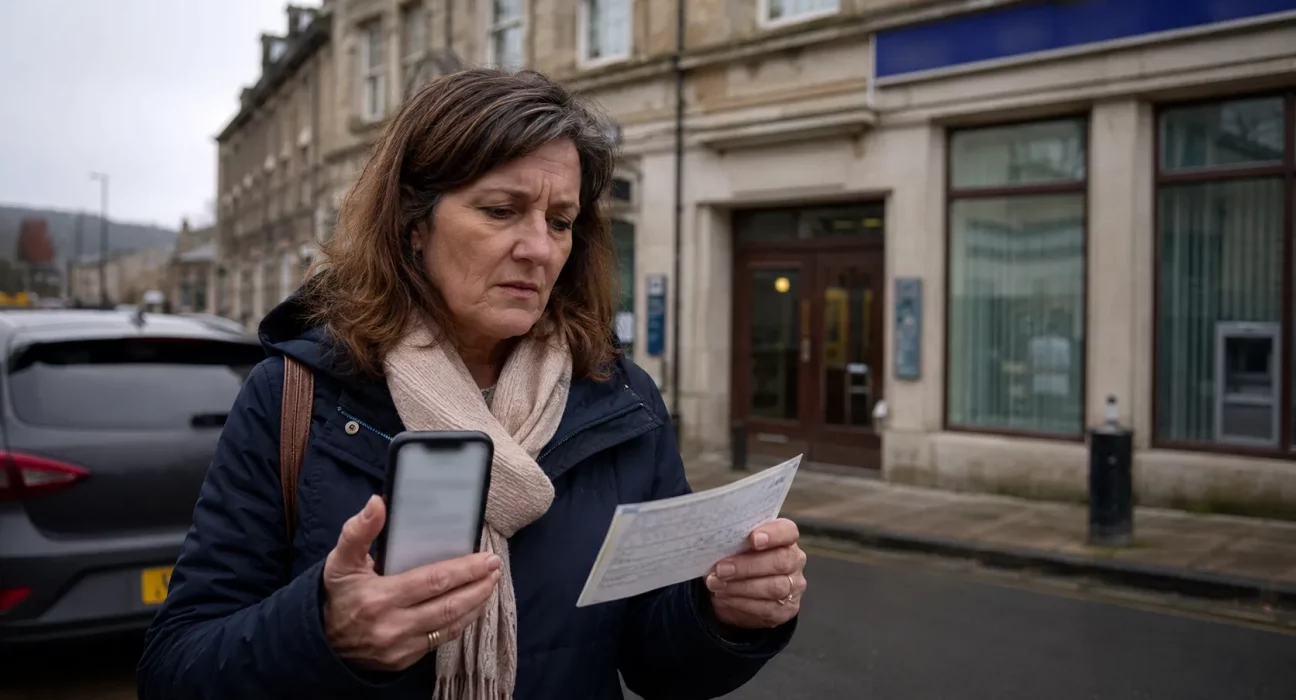
When Annabel Yates received a £900 tax refund cheque from HMRC, she expected a straightforward trip to her bank. What followed exposed a crack running through the entire UK banking infrastructure one that millions of small business owners, rural residents, and everyday taxpayers may be about to fall into.
The Annabel Yates Lloyds cheque deposit saga began when her Lloyds Bank mobile app refused to scan and process her HMRC tax refund cheque a document she describes as not being perforated correctly for the app’s camera recognition system. Unable to use a local Post Office branch as an alternative (Lloyds had ended its Post Office cheque-deposit partnership), and with no nearby Lloyds branch remaining after the bank’s aggressive closure programme, Yates faced a 94-mile round trip simply to deposit a cheque worth £900.
Her story went viral and for good reason. It is not a one-off complaint from a disgruntled customer. It is a window into a systemic failure: the collision of digital-first banking strategy with the physical realities of rural life and an ageing paper-based government payment system. This guide explains precisely what went wrong, and provides clear, step-by-step workarounds for any UK taxpayer, sole trader, or small business owner facing the same problem today.
UK taxpayers who have received HMRC cheques they cannot deposit via mobile app; Lloyds Bank customers in rural or semi-rural areas; sole traders and small business owners handling cheque payments; anyone affected by bank branch closures in the UK.
The Core Issue:
Why the Annabel Yates Lloyds Cheque Deposit Failed?
To understand what happened to Annabel Yates and why the same could happen to any Lloyds customer with an HMRC cheque it is necessary to understand two simultaneous failures in the UK banking system.
1. The End of the Lloyds–Post Office Cheque Agreement
For several years, Lloyds Banking Group participated in the Post Office’s banking services framework, which allowed customers to deposit cheques at Post Office counters as a substitute for branch access. This arrangement was particularly vital for the estimated 8 million people who live in rural areas where Lloyds has closed branches. However, Lloyds terminated its participation in this specific element of the Post Office banking partnership, removing what had been, for many customers, their only practical method of depositing cheques.
“Back in the day, Lloyds’ ethos was to make banking easy. I think this is a reversal of that.”
— Annabel Yates, Lloyds Bank customer
The bank’s official position is that customers can use its mobile app for cheque deposits. For the majority of standard cheques, this works adequately. But HMRC tax refund cheques present a specific and known technical obstacle.
2. HMRC Cheques and Mobile App Incompatibility
HMRC tax refund cheques the kind sent to individuals following a self-assessment overpayment or a PAYE recalculation are printed on continuous stationery. Unlike standard bank-issued cheques, they are typically not perforated along the edges in a way that mobile banking apps are optimised to detect. The Lloyds mobile app (and several other banks’ apps) uses edge-detection and micro-print recognition technology that struggles to correctly frame and process these non-standard documents, resulting in repeated scan failures.
“I think the bank’s theory is everything could be done on an app and that’s just not always the case. It’s very backwards thinking.”
— Annabel Yates
The consequence is a Catch-22: the digital alternative does not work for the specific cheque type, but the analogue alternative the Post Office has been removed. And the branch network has been reduced to the point that physical access is, for many people, a significant logistical undertaking.
She also expressed concern about posting a cheque of that value, stating she “did not want a cheque in the post… when you are not sure it would actually reach its destination.”
— Annabel Yates
How to Deposit an HMRC Cheque When Lloyds App Fails: Step-by-Step Workarounds
If you are in the same position as Annabel Yates holding an HMRC tax refund cheque with no nearby Lloyds branch — there are three practical routes available to you. Attempt them in the following order.
Option A: Optimise Your Lloyds Mobile App Scan
Before concluding that the app will not work, attempt the following adjustments. Many HMRC cheque scan failures are caused by environmental factors rather than an outright incompatibility.
1. Use a plain, high-contrast background
Place the cheque on a dark, solid-coloured surface a navy or black desk mat is ideal. The app’s edge-detection algorithm struggles on white or patterned backgrounds that blend with the cheque edges.
2. Control your lighting carefully
Use natural daylight rather than overhead artificial lighting. Avoid direct sunlight, which creates glare on the cheque surface. If indoors, position near a window with diffused light and disable your phone’s camera flash entirely.
3. Align all four corners within the on-screen frame
Hold the phone directly above the cheque not at an angle. The camera must be parallel to the cheque surface. Wait for the app’s auto-capture to trigger rather than tapping manually. If the document is longer than standard, the app may need you to capture it in one pass rather than two sections.
4. Flatten the cheque before scanning
HMRC cheques from continuous stationery may have fold lines from the envelope. Gently press the cheque flat under a heavy book for ten minutes before attempting the scan. Any curl or ridge creates shadow lines that the app interprets as a scan failure.
5. Update the Lloyds app and ensure camera permissions are enabled
Open your phone’s Settings, navigate to the Lloyds app, and confirm that camera access is set to “Always” or “While Using.” Then check the App Store or Google Play for any pending updates. Older app versions have known cheque-capture bugs that have been patched in recent releases.
Option B: Use the Official Lloyds Freepost Cheque Deposit Service
If the mobile app scan fails entirely and you do not wish to make a lengthy journey to a branch, Lloyds Bank operates a Freepost cheque deposit by post service. This is the most practical alternative for most customers affected by the same issue as Annabel Yates.
How to use the Lloyds Freepost cheque deposit service:
- Write your full name, Lloyds Bank account number, and sort codeclearly on the back of the HMRC cheque.
- Include a brief covering note with your name, account number, sort code, and a contact phone number.
- Place the cheque and covering note in a sturdy envelope do not fold the cheque if possible.
- Address the envelope as follows (no stamp required this is a Freepost address):
LLOYDS BANK CHEQUE DEPOSITS
Important: While Lloyds’ Freepost service does not cost postage, it is advisable to use a tracked or recorded mail service at your own cost if the cheque value is significant. Annabel Yates herself noted her concern about sending a cheque in the post without confidence it would arrive safely. For sums over £500, Royal Mail Special Delivery (with built-in compensation cover) is strongly recommended.
Option C: Request a BACS Bank Transfer Directly from HMRC
The most elegant long-term solution and one that bypasses the cheque problem entirely is to instruct HMRC to issue future refunds directly to your bank account via BACS electronic transfer, rather than sending a paper cheque.
For UK taxpayers already on Self Assessment, or those with an active HMRC Personal Tax Account, this can be arranged through the following steps:
- Log in to your HMRC Personal Tax Accountat uk/personal-tax-account using your Government Gateway credentials.
- Navigate to “Manage your tax”and then “Tax refund” or “Bank account details.”
- Enter your UK bank account number and sort code. HMRC will use this for all future refund payments via BACS.
- If you have already received a cheque and wish to return it in exchange for a bank transfer, contact HMRC directly on 0300 200 3300and request that the cheque be cancelled and reissued as an electronic payment. This can take four to six weeks to process.
- For Self Assessment taxpayers, bank account details can also be updated within the relevant tax return submission via HMRC online services.
This third option is strongly recommended for any sole trader, freelancer, or small business owner who receives regular HMRC payments or refunds. Eliminating paper cheques from the equation removes the dependency on both bank branches and mobile app scanning compatibility altogether.
The Broader Impact:
What the Annabel Yates Lloyds Cheque Deposit Row Means for UK Businesses?

The Annabel Yates case is not simply a consumer inconvenience story. Business owners, entrepreneurs, sole traders and SME operators it highlights a structural risk that is growing quietly in the background of UK commerce.
Rural and Semi-Rural Businesses Are Being Left Behind
Since 2015, over 5,000 UK bank branches have closed across the country, according to consumer finance research published by Which? and the Access to Cash Review. Lloyds Banking Group has been among the most aggressive in reducing its physical footprint, with closures disproportionately affecting smaller towns and rural communities. For a sole trader operating in, say, rural Wales, the Scottish Highlands, or parts of the South West, the nearest Lloyds branch may now be a 30-40-minute drive away or further.
Annabel Yates urged Lloyds to “reconsider their policy” to avoid “disenfranchising the rural population.”
— Annabel Yates
For business owners receiving supplier cheques, client payments, or government refunds by post, the inability to deposit those cheques quickly and conveniently has direct cash flow implications. A cheque stuck in a postal queue waiting for a Freepost processing centre to handle it or requiring a day off work to drive to a distant branch is not a minor inconvenience. It is a cash flow delay that can affect payroll, supplier payments, and operating costs.
The Digital Assumption Problem
Banks including Lloyds have made a strategic assumption that the transition to digital banking is universal, linear, and near-complete. This assumption fails on at least three counts:
- Technology adoption is uneven.An estimated 2.4 million UK adults do not use the internet at all, and millions more use it only for limited purposes. For older customers or those with disabilities, mobile app banking is not a functional substitute for branch access.
- App functionality has specific limits.As the HMRC cheque scanning failure illustrates, mobile apps cannot process all document types reliably. Continuous-stationery government cheques are a known edge case that the industry has not resolved.
- Third-party payment flows have not caught up.Government bodies, local authorities, insurance companies, and some larger businesses still issue payments by cheque. Until that changes and it is changing slowly the demand for physical cheque deposit infrastructure will remain.
The Post Office Gap
The partial withdrawal of major banks from full Post Office banking services including cheque deposits removes what had been the industry’s main concession to physical access. Post Offices remain open in many communities where bank branches have closed, and the Post Office branch banking services framework [Post Office – Banking Services] still supports cash deposits and withdrawals for many banks. However, the cheque-deposit element is not universally maintained across all participating banks, and customers are advised to confirm precisely which services their specific bank offers via Post Office counters before making the journey.
What SMEs Should Be Doing Now?
For small and medium-sized enterprises, this situation is a prompt to review payment receipt practices proactively, rather than waiting to be caught in the same bind as Annabel Yates. The following steps are recommended:
- Contact all key payment sources including HMRC, local councils, and regular clients and request that all payments be made by bank transfer rather than cheque.
- Register for the HMRC Business Tax Account to manage VAT refunds, corporation tax repayments, and other government payments directly to your nominated bank account.
- Check which banking services your nearest Post Office offers for your specific bank, and establish the postal Freepost address for cheque deposits as a backup.
- Speak to your accountant or bookkeeper about whether any current suppliers or clients are still paying by cheque, and begin a managed transition to electronic invoicing.
Conclusion: A Practical Problem That Demands a Practical Response
The Annabel Yates Lloyds cheque deposit dispute has done something valuable: it has made visible a problem that has been accumulating quietly for years. As UK banks accelerate branch closures and push customers towards digital-only service models, the gaps in that model the cases where the app does not work, the Post Office partnership has ended, and the nearest branch is an hour away are becoming impossible to ignore.
Yates’ situation is neither unique nor extreme. It is, in fact, representative of what millions of UK banking customers will encounter more frequently as the physical banking infrastructure continues to contract. The workarounds described in this guide optimising the mobile scan, using the Lloyds Freepost service, and switching HMRC to direct bank transfer are practical steps that any affected customer can take today.
But the responsibility does not lie solely with consumers to adapt. Banks, including Lloyds, must acknowledge that a digital-first strategy is not the same as a digital-only strategy, and that the communities and customers being left behind are not a rounding error they are a significant proportion of the UK’s banking population.
“Back in the day, Lloyds’ ethos was to make banking easy. I think this is a reversal of that.”
— Annabel Yates
Until the infrastructure catches up with the ambition, the practical guide above represents the best available path forward for those caught between a cheque and a closed branch door.
Key Takeaways
- The Annabel Yates case: Lloyds Bank customer forced into a 94-mile round trip to deposit an £900 HMRC cheque after mobile app failure and Post Office service withdrawal.
- Why HMRC cheques fail on apps: Non-perforated continuous stationery confuses mobile banking edge-detection technology.
- Option 1: Fix the scan: Use a dark background, natural daylight, and a flattened cheque for best mobile scanning results.
- Option 2: Post it free: Use Lloyds’ official Freepost cheque deposit service; add tracking for high-value items.
- Option 3: Eliminate cheques: Update bank details on your HMRC Personal Tax Account to receive all future refunds by BACS transfer.
- Wider lesson for businesses: Proactively transition all incoming payment flows to electronic transfer to eliminate dependency on cheque infrastructure.
FAQs
Why won’t Lloyds Bank’s mobile app scan my HMRC cheque?
HMRC issues tax refund cheques on continuous stationery, which is not perforated along the edges in the standard way. Lloyds Bank’s mobile cheque imaging system uses edge-detection technology that is calibrated for conventional bank-issued cheques. The non-standard formatting of HMRC documents can cause the app to fail to recognise the cheque correctly, resulting in a rejection error. This is a known compatibility issue, not a fault with your phone or your account.
Can I still deposit a Lloyds cheque at the Post Office?
Lloyds Bank has ended its participation in the Post Office cheque deposit service. As of the time of writing, Lloyds customers cannot deposit cheques at Post Office counters. Cash deposits and withdrawals may still be available via Post Office for Lloyds customers, but cheques must be handled via the mobile app, a Lloyds branch, or the bank’s Freepost postal service. Always confirm the latest position directly with Lloyds or your local Post Office, as partnership terms can change.
Is the Lloyds Freepost cheque deposit service safe for large amounts?
The Freepost service does not cost postage, but it offers no tracking or compensation for lost items. As Annabel Yates noted, posting a high-value cheque involves risk. For cheques over £500, it is advisable to send the item via Royal Mail Special Delivery, which provides tracking and compensation cover of up to £750 or more depending on the service selected. The additional cost is generally worth the security for significant sums.
How long does it take for HMRC to cancel a cheque and reissue by bank transfer?
HMRC typically takes four to six weeks to cancel an existing cheque payment and reissue the refund electronically via BACS once a bank transfer request has been processed. During this period, the original cheque will be cancelled and should not be presented for payment. Contact HMRC on 0300 200 3300 to initiate the process. Note that processing times may be longer during peak periods such as following the Self Assessment filing deadline in January.
Can sole traders and small business owners set up direct bank transfers with HMRC for all future payments?
Yes. Businesses registered for Self Assessment, VAT, or Corporation Tax can add and manage bank account details via the HMRC Business Tax Account at gov.uk/log-in-register-hmrc-online-services. Once bank details are registered, HMRC will issue refunds and repayments electronically. This is strongly recommended for any sole trader or SME currently receiving HMRC payments by cheque.
What can I do if I have no Lloyds branch near me and the app refuses my HMRC cheque?
Your practical options are: (1) retry the mobile app scan using the optimisation steps outlined in this guide — improved lighting and background conditions resolve a significant proportion of failures; (2) use the Lloyds Freepost postal deposit service with tracked postage for security; (3) contact HMRC to request the cheque be cancelled and reissued as a BACS bank transfer. If the cheque is time-sensitive, option one or two is the fastest available route. You may also wish to file a formal complaint with Lloyds and escalate to the Financial Ombudsman Service if you feel the bank’s policies have caused you material detriment.
What is the Financial Ombudsman Service, and can it help in cases like Annabel Yates’?
The Financial Ombudsman Service (FOS) is the independent statutory body that resolves disputes between UK financial firms and their customers. If a Lloyds customer has exhausted the bank’s internal complaints process and remains dissatisfied for example, because they have suffered financial loss or significant inconvenience due to the bank’s cheque policies they can escalate to the FOS for free. The Ombudsman has the power to require banks to pay compensation. More information is available at financial-ombudsman.org.uk.
Are other UK banks facing the same cheque deposit problem?
The HMRC non-perforated cheque issue is not unique to Lloyds it affects mobile cheque imaging systems used by several UK high street banks. However, the scale of the problem is amplified in Lloyds’ case because of the simultaneous withdrawal from the Post Office cheque service and the significant reduction in the Lloyds branch network. Customers of other banks are encouraged to verify whether their bank’s Post Office arrangement includes cheque deposits, and to set up direct bank transfer with HMRC as a preventative measure regardless of which bank they use.