







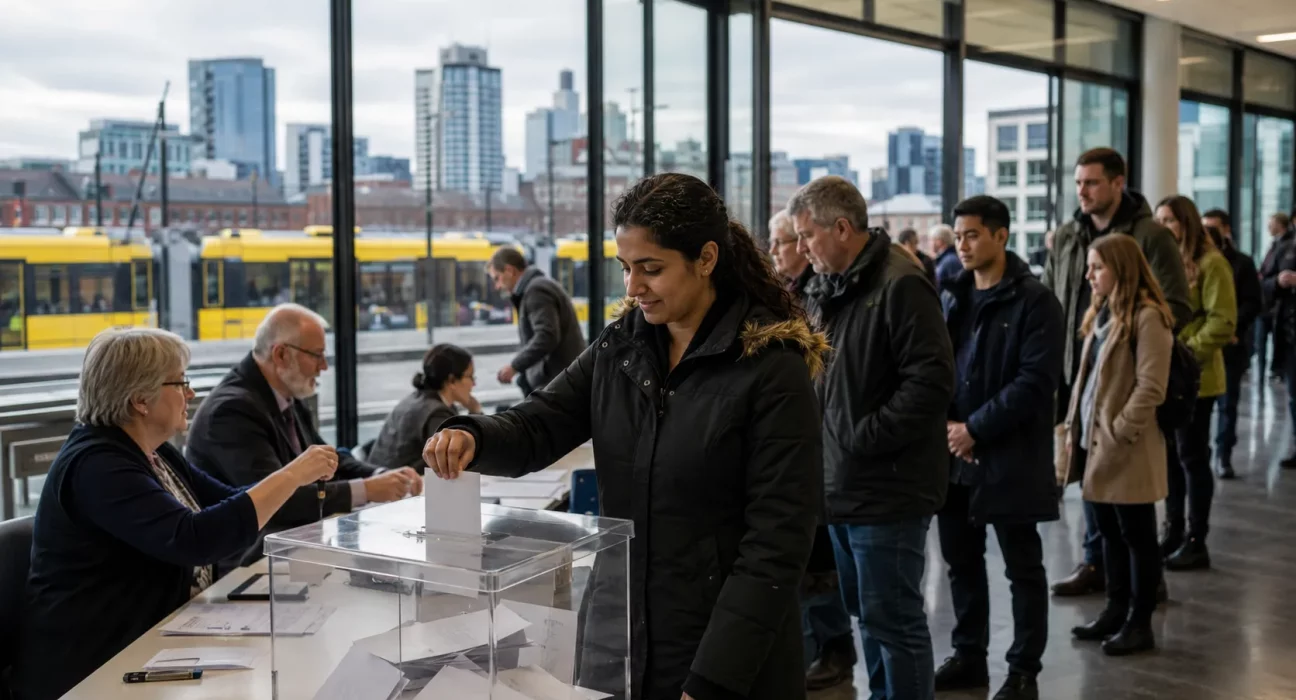
Why Is Manchester’s Voting System Changing Again Just Two Years After the Last Reform?
Political systems rarely attract widespread public attention until they change. Yet in Greater Manchester, a seemingly technical adjustment to the way mayoral elections are conducted could have consequences that extend far beyond ballot papers and vote counting.
The return of the Supplementary Vote (SV) system for combined authority mayoral elections marks another significant shift in England’s evolving devolution landscape. Only two years after the Elections Act 2022 replaced SV with First Past the Post (FPTP), the government has moved to restore the previous system through the Combined Authorities (Mayoral Elections) (Amendment) Order 2026.
On the surface, the change appears straightforward. Voters will once again have the opportunity to indicate a first and second preference rather than selecting only one candidate. Yet reducing the debate to voting mechanics misses the broader significance of what is happening.
The timing of the reform is particularly noteworthy. Greater Manchester stands at a potentially transformative moment in its political development. For nearly a decade, the region’s mayoralty has been synonymous with one individual: Andy Burnham. His electoral dominance has often overshadowed debates about the voting system itself because he consistently secured overwhelming levels of support regardless of how votes were counted.
That may no longer be the case.
If Burnham ultimately returns to Westminster, Greater Manchester could face its first genuinely competitive mayoral contest since the office was created. In that context, the return of SV becomes more than an administrative adjustment. It becomes a structural change that could influence how candidates campaign, how coalitions are built and how executive power is ultimately secured.
For businesses, investors and policymakers, this matters far more than many initially realise.
Is the Return of SV Really About Voter Choice—or About Political Stability?
Officially, the government’s rationale is clear. Ministers argue that directly elected executive positions require broader democratic mandates than traditional legislative elections. Unlike MPs, who form part of a larger parliamentary system, metro mayors exercise substantial executive authority over transport, housing, skills, planning and economic development.
The argument is straightforward: if a mayor is responsible for shaping a region’s strategic direction, that individual should command support extending beyond a simple plurality.
Supporters of SV argue that it helps achieve this objective. By allowing voters to express a second preference, the system encourages candidates to appeal beyond their core supporters and seek broader acceptance across the electorate.
Critics remain unconvinced.
Opponents argue that the return of SV risks introducing unnecessary complexity while creating the perception that election rules are being altered for political convenience. Some Conservative figures have suggested that reverting to the previous system undermines the clarity and simplicity that FPTP provides.
Yet beneath these competing arguments lies a more important question.
Is this really a debate about electoral theory, or is it a debate about political stability during a period of increasing fragmentation?
Across the UK, traditional party loyalties have weakened. Smaller parties are attracting greater support, independent candidates are becoming more visible and voters appear increasingly willing to move between political camps. In such an environment, the risk of highly fragmented election results becomes more pronounced.
The return of SV can therefore be viewed not simply as a voting reform but as an attempt to ensure that executive leaders possess a broader base of legitimacy before assuming control of major regional institutions.
Why Did the Voting System Barely Matter During the Burnham Era?
One of the most overlooked aspects of the current debate is that the voting system has historically made little practical difference to the outcome of Greater Manchester mayoral elections.
The reason is simple: Andy Burnham consistently achieved decisive victories.
The figures tell a compelling story.
In both elections conducted under SV, Burnham exceeded the 50 per cent threshold comfortably. As a result, second preferences were never required to determine the winner.
This is an important point because it challenges one of the more common assumptions surrounding the debate.
Many discussions imply that changing the voting system would have fundamentally altered previous election outcomes. The evidence suggests otherwise. Burnham’s victories were driven by personal popularity, regional recognition and broad cross-party appeal rather than by any specific electoral mechanism.
In practical terms, Greater Manchester has spent much of the last decade operating under what might be described as the “Burnham effect”. Political competition existed, but the outcome was rarely in serious doubt.
The real test of SV will therefore emerge not during the Burnham era but potentially after it.
Could the Next Greater Manchester Election Be the First Time the Voting System Truly Matters?
This is where the discussion becomes significantly more interesting.
The next mayoral election could take place in a political environment that looks very different from the one that produced Burnham’s landslide victories.
Without a dominant incumbent, several dynamics become more important.
Labour would almost certainly remain a strong contender, but a successor candidate may struggle to replicate Burnham’s unique personal brand. Meanwhile, the Liberal Democrats continue to strengthen their position in parts of England, the Green Party is attracting growing support among younger and environmentally focused voters, and Reform UK has demonstrated an ability to disrupt traditional voting patterns.
Under such circumstances, vote fragmentation becomes increasingly likely.
Imagine a scenario in which five credible candidates each secure meaningful levels of support. Under FPTP, a candidate could potentially win with little more than one-third of the vote.
Under SV, however, candidates must think differently.
They need not only first-preference support but also second-preference credibility.
That distinction changes campaign incentives in important ways.
Candidates are encouraged to broaden their appeal, moderate extreme positions and engage constructively with voters who may not initially support them.
Whether one views this as an advantage or disadvantage depends largely on one’s perspective, but it undoubtedly changes the strategic landscape.
Why Should Manchester Businesses Care About a Change to Election Rules?
For many business leaders, electoral reform can seem distant from everyday commercial concerns.
That would be a mistake.
The Mayor of Greater Manchester is no longer merely a political figurehead. The role now sits at the centre of regional economic strategy.
The mayor has an impact on choices related to transportation infrastructure, housing development, skills financing, investment promotion, and long-term planning through the Greater Manchester Combined Authority.
The Bee Network alone represents one of the most ambitious transport integration projects outside London. Decisions regarding expansion, funding priorities and service delivery have direct implications for employers, developers and investors.
Similarly, mayoral influence over housing and planning can affect land values, commercial development opportunities and infrastructure investment decisions across the city-region.
From a business perspective, the key issue is not whether SV is inherently better than FPTP.
The key issue is whether the electoral system contributes to policy predictability.
Major investors typically favour environments characterised by stability, continuity and clear strategic direction. The ability of elected leaders to command broad support can strengthen confidence that long-term projects will survive political transitions.
For this reason, electoral systems are not merely political arrangements. They are institutional frameworks that shape investment risk.
Could the Return of SV Influence Investment Confidence Across Greater Manchester?

Investors rarely make decisions based solely on electoral systems.
However, they do pay close attention to governance quality.
Regions perceived as politically stable often enjoy advantages when competing for capital, talent and infrastructure funding.
The argument advanced by supporters of SV is that broader mandates create stronger executive legitimacy. A mayor elected with support extending beyond a narrow plurality may find it easier to build consensus around major projects and negotiate effectively with central government.
Critics argue that such claims are difficult to prove conclusively.
Nevertheless, perception matters.
If businesses believe that electoral structures encourage moderation and continuity, those structures can indirectly influence confidence and investment behaviour.
In a city-region responsible for tens of billions of pounds in economic activity, even marginal improvements in confidence can carry significant consequences.
Conclusion
At first glance, the return of the Supplementary Vote system appears to be a technical electoral adjustment.
In reality, it reflects a much larger conversation about leadership, legitimacy and governance.
The evidence suggests that SV would not have altered the outcome of Greater Manchester’s previous mayoral elections. Andy Burnham’s electoral dominance ensured that voting mechanics played only a limited role in determining results.
The future may be different.
As Greater Manchester potentially approaches its first post-Burnham political era, electoral structures could become significantly more consequential. The challenge facing voters is not simply deciding how ballots should be counted. It is determining what kind of mandate should be required for those entrusted with shaping the region’s economic and political future.
For businesses, investors and residents alike, that question extends far beyond election day.
FAQs
Why does the return of SV matter more now than it did during Andy Burnham’s previous victories?
Andy Burnham consistently won with large majorities, so the voting system had little effect on the outcome. A more competitive future election could make second-preference votes much more influential.
Could a candidate still win the mayoralty without being the most popular first-choice option?
Yes. If no candidate wins an outright majority, second-preference votes can help another candidate overtake the first-round leader.
How might the return of SV influence campaign strategies in Greater Manchester?
Candidates will need to appeal to a broader range of voters rather than focusing only on their core supporters. Winning second-preference votes could become just as important as securing first-choice backing.
What risks does SV aim to reduce in a fragmented political landscape?
SV helps prevent candidates from winning with a relatively small share of the vote when support is split among several parties. It encourages winners to have broader public support.
Why should business leaders pay attention to changes in mayoral election rules?
The Mayor influences transport, planning, housing and economic development policies. A voting system that promotes broader mandates may contribute to greater policy stability and investor confidence.