







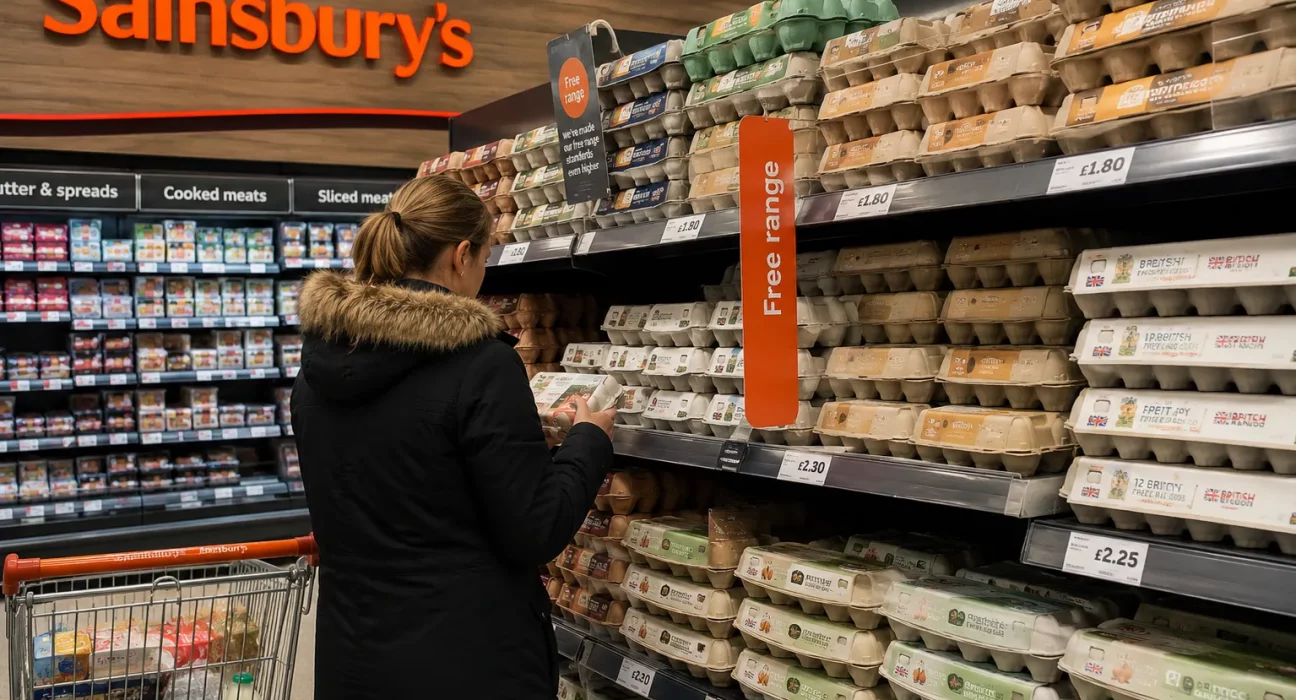
Sainsbury’s is gradually replacing brown-shelled eggs with white-shelled eggs across its own-brand range, with plans to complete the transition by 2028. The supermarket says its assessment found that white eggs have a 12.7% lower carbon footprint than its brown eggs, making the change part of its wider strategy to reduce environmental impacts throughout food production.
For shoppers, the difference may appear minor. White eggs contain essentially the same nutrients as brown eggs, and Sainsbury’s says customers can expect the same quality, taste and price.
But behind the colour change is a more significant development involving poultry genetics, resource efficiency, animal welfare and agricultural supply chains.
An examination of the latest UK egg production figures, published by the Department for Environment, Food & Rural Affairs (Defra) in July 2026, also reveals a changing British egg market.
This updated analysis explains why Sainsbury’s is making the transition, what the 12.7% carbon reduction really means, how UK egg production is changing and what consumers should know before buying white eggs.
Quick Facts: Sainsbury’s Brown to White Eggs Switch
| Key Question | Confirmed Information |
|---|---|
| What is changing? | Sainsbury’s own-brand brown eggs are gradually being replaced with white eggs. |
| When will the switch be completed? | Targeted for 2028. |
| Reported carbon-footprint difference | 12.7% lower for white eggs. |
| Will egg nutrition change? | No meaningful difference attributable to shell colour. |
| Will the price increase because of the switch? | Sainsbury’s says prices will remain comparable. |
| Where will the eggs come from? | British producers. |
| Farming standards | Free-range and RSPCA Assured. |
| Are branded brown eggs disappearing? | Not necessarily; branded options may remain. |
| Latest analysis | October 2026. |
Key finding: The switch is intended to improve the environmental efficiency of egg production, rather than change the nutritional characteristics of the eggs consumers buy.
Why Is Sainsbury’s Changing From Brown to White Eggs?
Sainsbury’s is moving towards white eggs because the laying hens used for white-egg production can have environmental and productivity advantages over the breeds traditionally used for brown eggs.
The supermarket says its life-cycle assessment identified a 12.7% lower carbon footprint for its white eggs compared with its brown eggs. Sainsbury’s also states that the findings have been independently verified.
This environmental advantage is connected to the characteristics of the laying hens rather than the appearance of the eggshell itself.
How Do White-Egg-Laying Hens Improve Production Efficiency?
Different laying-hen strains can vary in body size, feed requirements, laying performance and productive lifespan.
Sainsbury’s identifies two principal advantages of the hens producing its white eggs: they can remain productive for longer and use resources more efficiently.
Feed is particularly important because producing and transporting poultry feed contributes to the environmental impact of egg farming.
When a flock can produce the same quantity of marketable eggs using fewer resources, the emissions associated with each egg may be reduced.
Longer productive laying periods can also improve resource efficiency by spreading the inputs associated with rearing replacement hens across more eggs.
However, the precise environmental outcome depends on farm management, flock health, feed composition and production conditions.
White shells alone do not guarantee a lower-carbon product. The supermarket’s reported environmental advantage relates to the particular production systems assessed.
Why Is Sainsbury’s Making the Change Now?
Environmental reporting increasingly requires major retailers to examine emissions beyond their shops, warehouses and delivery vehicles.
Agricultural products can generate emissions before they reach a supermarket, including those associated with animal feed, farm operations, processing and transportation.
Sainsbury’s transition shows how retailers may address these emissions by working with suppliers to alter production practices.
Rather than requiring households to change their diets, the supermarket is attempting to improve the environmental performance of a familiar grocery product.
This approach reflects the broader importance of eco-friendly strategies to help businesses future-proof their supply chains, where changes to sourcing, resource use and production methods can support longer-term environmental improvements.
How Do White Eggs Reduce Carbon Emissions by 12.7%?
The 12.7% figure comes from Sainsbury’s comparative life-cycle assessment.
It is important to understand exactly what the number represents.
The assessment indicates that white eggs in the supermarket’s evaluated supply arrangement have a carbon footprint 12.7% lower than the comparable brown eggs.
It does not mean the entire company has reduced its carbon emissions by 12.7%, nor does it establish that all projected savings have already been achieved.
Original Analysis: Carbon-Footprint Index Comparison
To make the reported difference easier to understand, London Business Mag has calculated a simple relative carbon-footprint index.
Brown eggs are assigned a baseline value of 100. White eggs are then calculated using the supermarket’s reported percentage difference.
| Measurement | Brown eggs | White eggs |
|---|---|---|
| Relative carbon-footprint index | 100.0 | 87.3 |
| Difference from brown-egg baseline | — | −12.7 |
| Percentage reduction | — | 12.7% |
Calculation:
100 × (1 − 0.127) = 87.3
The resulting index suggests that every 100 units of carbon footprint associated with the assessed brown-egg production would correspond to 87.3 units for the assessed white-egg alternative.
This is an original calculation illustrating Sainsbury’s published finding. It is not a new life-cycle assessment, and the index does not represent kilograms or tonnes of CO₂-equivalent.
What Would the Carbon Savings Look Like During the Transition?
The environmental benefit will depend partly on how much of Sainsbury’s own-brand range has actually been converted.
A simplified scenario model can illustrate the potential effect at different stages of the transition.
| Hypothetical share converted to white eggs | Modelled reduction in the original brown-egg footprint |
|---|---|
| 25% | 3.18% |
| 50% | 6.35% |
| 75% | 9.53% |
| 100% | 12.70% |
The calculations assume an unchanged total quantity of eggs, an equal original emissions baseline per unit and a consistent 12.7% difference for every converted unit.
For example, a 50% conversion would produce:
50% × 12.7% = 6.35%
Important: These are hypothetical scenarios, not reported progress figures or verified emissions savings achieved by Sainsbury’s.
Real savings would also depend on supplier-specific production methods, sales volumes and changes in the overall supply mix.
The model demonstrates why the proportion converted matters when interpreting the supermarket’s environmental claim.
When Will Sainsbury’s Complete the Brown-to-White Egg Transition?
Sainsbury’s plans to complete the switch across its own-brand egg range by 2028.
The company has explained that it is introducing white eggs gradually while working closely with British farmers and suppliers.
This phased approach allows producers to manage changes in laying flocks and production arrangements rather than attempting to replace the entire supply immediately.
What Progress Has Been Confirmed in 2026?
As of 12 October 2026, Sainsbury’s has publicly described the transition and its 2028 objective. However, the information reviewed for this article does not establish an exact percentage of the own-brand range already converted.
Therefore, claims that the supermarket has completed a particular proportion of the switch would require additional evidence.
Several useful indicators remain worth tracking as the transition progresses: the number of own-brand lines converted, the volume of white eggs supplied, independently quantified emissions savings and changes in supplier production efficiency.
Until further figures are released, the 2028 date should be treated as a planned completion target rather than evidence that the full transition has already happened.
What Do the Latest UK Egg Statistics Reveal About the Market in 2026?
The latest available Defra quarterly egg statistics, published on 30 July 2026, offer important context for assessing the scale of the British egg industry.
The figures cover UK egg production, farm-gate prices and packing-station activity.
Although they do not distinguish white eggs from brown eggs, they show how the industry is developing while major supermarkets make changes to their egg ranges.
UK Egg Production: Q2 2025 Compared With Q2 2026
| UK egg market indicator | Q2 2025 | Q2 2026 | Change |
|---|---|---|---|
| Total eggs produced for human consumption | 263.1 million dozen | 272.0 million dozen | +3.4% |
| Shell eggs produced | 240.1 million dozen | 240.3 million dozen | +0.1% |
| Eggs for processing | 23.0 million dozen | 31.7 million dozen | +37.8% |
| Average farm-gate price | 148.5p/dozen | 153.1p/dozen | +3.1% |
| Free-range packing-station intake | 184.0 million dozen | 202.5 million dozen | +10.1% |
Source: Defra quarterly UK egg statistics, Q2 2026. Percentage changes are calculated from published rounded figures.
The data reveals several developments worth examining.
Insight 1: The UK Produced Around 3.26 Billion Eggs in Three Months
Defra recorded 272 million dozen eggs produced for human consumption during Q2 2026.
Converting this into individual eggs gives:
272 million × 12 = 3.264 billion eggs
This represents approximately 101 million more eggs than the corresponding total in Q2 2025, using the rounded quarterly production figures.
However, the increase did not come equally from all types of production.
Shell-egg production remained almost unchanged, while eggs destined for processing increased substantially.
That distinction matters because supermarkets sell shell eggs directly to consumers, while processed eggs are used in other food-manufacturing activities.
Insight 2: Free-Range Packing-Station Intake Increased by 222 Million Eggs
Defra reported free-range packing-station intake of 184 million dozen in Q2 2025 and 202.5 million dozen in Q2 2026.
The difference is 18.5 million dozen.
Converted into individual eggs:
18.5 million × 12 = 222 million additional free-range eggs
This calculation indicates the scale of year-on-year growth in free-range egg intake recorded by UK packing stations.
It does not show that Sainsbury’s caused the increase, nor does it identify how many of these eggs had white shells.
Insight 3: Free-Range Eggs Represented Over 75% of Packing-Station Intake
Using Defra’s packing-station figures, the free-range share can be calculated as follows.
| Quarter | Free-range intake | Total packing-station intake | Calculated free-range share |
|---|---|---|---|
| Q2 2025 | 184.0 million dozen | 261.1 million dozen | 70.5% |
| Q2 2026 | 202.5 million dozen | 268.1 million dozen | 75.5% |
The free-range share increased by approximately 5.1 percentage points over the year, calculated before rounding.
This is particularly relevant because Sainsbury’s has committed to maintaining free-range production throughout its switch to white eggs.
The figures show a domestic production market in which free-range eggs already account for a substantial majority of packing-station intake.
Editorial interpretation: Sainsbury’s transition is taking place within an expanding free-range segment, but the available national statistics do not establish whether its switch has changed the overall balance of shell colours in the UK market.
Will Sainsbury’s White Eggs Be Cheaper Than Brown Eggs?
Sainsbury’s has said customers should expect the same pricing for its white eggs as for the brown eggs they replace.
The company has not positioned the switch as an opportunity to introduce a premium-priced product.
However, this does not guarantee that supermarket egg prices will remain unchanged throughout 2026 and beyond.
Retail prices are influenced by several factors, including agricultural costs, labour, energy, packaging, transport and commercial pricing decisions.
What Do the Latest Egg Price Figures Show?
Defra reported an average UK farm-gate egg price of 153.1 pence per dozen in Q2 2026, compared with 148.5 pence in Q2 2025.
The increase was approximately 3.1%.
| Price comparison | Q2 2025 | Q2 2026 |
|---|---|---|
| Average farm-gate price per dozen | £1.485 | £1.531 |
| Change per dozen | — | +4.6p |
| Annual percentage change | — | +3.1% |
Farm-gate prices represent payments to producers rather than the final price paid by consumers.
The increase therefore should not be interpreted as a specific change to the price of Sainsbury’s eggs.
A more useful question for shoppers is whether the white-egg transition itself introduces an additional premium.
Sainsbury’s says it does not.
For a broader explanation of supermarket price comparisons and loyalty discounts, readers can explore our analysis of Tesco and Sainsbury’s shoppers paying more.
Are White Eggs as Nutritious as Brown Eggs?
Yes. White eggs and brown eggs have broadly equivalent nutritional characteristics when comparing eggs of similar size and production conditions.
The shell colour is primarily determined by the genetics of the laying hen and does not independently establish the egg’s nutritional value.
Both types provide protein, fats, vitamins and minerals.
Does Eggshell Colour Affect Protein or Vitamin Content?
There is no sound basis for assuming that brown eggs contain more protein or vitamins simply because their shells are darker.
The nutritional characteristics of eggs can be influenced by the hen’s feed, egg size and other production factors.
For example, specially formulated diets may alter the amounts of certain nutrients present in eggs.
However, those differences cannot be established from shell colour alone.
Do White Eggs Taste Different?
Sainsbury’s says its white eggs offer the same taste and quality as its brown eggs.
Differences in perceived flavour are more likely to be influenced by freshness, preparation, storage and individual preferences than by eggshell pigmentation.
The same applies to most ordinary cooking uses, including boiling, frying, scrambling and baking.
Will White Eggs Be Smaller?
Not necessarily.
Shell colour and egg size are separate characteristics.
White eggs can be graded and sold in the same established UK size categories as brown eggs.
Consumers should check the size shown on the packaging rather than assuming a white egg will be smaller or lighter.
Are White Eggs Better for Hen Welfare?
Sainsbury’s says white-egg-laying hens are generally more docile and less prone to behaviours such as feather pecking.
The company believes these characteristics can support better welfare outcomes when accompanied by appropriate farming practices.
However, it would be misleading to suggest that white eggs automatically prove better animal welfare.
A hen’s welfare depends on housing, health, nutrition, flock management, environmental enrichment and the quality of care provided by farmers.
Will Sainsbury’s White Eggs Still Be Free-Range?
Yes. Sainsbury’s says its own-brand eggs will continue to be:
- 100% British
- 100% free-range
- 100% RSPCA Assured
The supermarket states that its own-brand eggs have been free-range since 2009.
These commitments are separate from shell colour and remain important for customers who consider welfare standards when buying eggs.
How Can Consumers Identify Free-Range Eggs?
Eggs sold through UK supermarkets carry producer codes that identify the production method.
| First number stamped on an egg | Production method |
|---|---|
| 0 | Organic |
| 1 | Free-range |
| 2 | Barn |
| 3 | Caged |
The country code and remaining producer identification provide further traceability information.
For example, an egg beginning with 1UK is identified as free-range and produced in the United Kingdom.
This gives shoppers a more reliable indicator of the declared production method than the shell’s colour.
Why Did White Eggs Become Less Common in UK Supermarkets?
White eggs were historically familiar to British consumers.
Over time, brown eggs became more strongly associated with traditional farming and premium product perceptions.
Sainsbury’s notes that white eggs were the norm in the UK until the 1980s.
Shoppers increasingly favoured brown-shelled eggs, and supermarkets stocked products that reflected those preferences.
However, the perception that brown eggs are naturally healthier or superior is not supported by shell colour itself.
Why Are White Eggs Returning?
The increasing attention given to agricultural efficiency and supply-chain emissions has encouraged retailers to reconsider established product choices.
In Sainsbury’s case, the company has identified a measurable environmental advantage through the production systems supplying white eggs.
This represents a change in the commercial factors influencing which eggs supermarkets choose to stock.
Consumer familiarity remains important, but environmental performance is becoming another consideration.
What Does the Transition Mean for British Egg Farmers?
Sainsbury’s has said it worked with suppliers for approximately three years to plan the transition.
Changing egg production involves more than delivering a different product to supermarket shelves.
Farmers need to consider laying-flock replacement cycles, housing arrangements, feed requirements, animal health and the long-term economics of production.
The supermarket has identified The Lakes Free Range Egg Co. as a partner involved in the transition.
Its chief executive, David Brass, has publicly supported the move, highlighting the potential advantages associated with productivity, sustainability and flock management.
Could Farmers Produce More Eggs With Fewer Resources?
In principle, improvements in feed conversion and productive lifespan can reduce the resources required for a given number of eggs.
However, the financial benefit will depend on the farm.
A producer changing laying strains may encounter adjustment costs or new management requirements.
Any improvement in productivity should therefore be assessed alongside the full costs of production, flock health and welfare outcomes.
It is also important that supply contracts provide sufficient certainty for farmers making long-term investments.
For more context on pressures affecting agricultural inputs and food distribution, see our coverage of UK food supply chain risks and resilience.
How Does the Egg Switch Support Sainsbury’s Net-Zero Strategy?
Sainsbury’s has two distinct long-term climate ambitions that should not be confused.
The supermarket is working towards net-zero greenhouse gas emissions in its own operations by 2035 and across its wider value chain by 2050.
Own operations include activities such as running stores, managing refrigeration and operating parts of the logistics network.
Value-chain emissions include emissions associated with products and their suppliers.
Agricultural production therefore forms an important part of the retailer’s wider environmental strategy.
Which Net-Zero Target Applies to Egg Farming?
Egg production is primarily relevant to supply-chain, or Scope 3, emissions.
Consequently, the transition supports Sainsbury’s wider value-chain decarbonisation strategy rather than directly representing a 12.7% reduction in its operational emissions.
This distinction matters when evaluating environmental announcements.
A retailer can improve the footprint of a particular product without producing an equivalent percentage reduction in total corporate emissions.
The actual corporate impact depends on the product’s contribution to the organisation’s emissions inventory, changes in purchasing volumes and other factors.
What Information Is Still Missing About the 12.7% Carbon Claim?
Sainsbury’s says its comparison was supported by a life-cycle assessment and independently verified.
Nevertheless, a more detailed public explanation of the results would help consumers and researchers understand the scale of the environmental benefit.
Three questions are especially relevant.
First, what is the absolute carbon footprint per egg?
The 12.7% figure establishes a relative difference. An absolute figure in kilograms of CO₂-equivalent per dozen eggs would help readers understand the scale of emissions associated with production.
Second, how much of the range has actually switched?
A progress figure would help distinguish projected environmental improvements from changes already delivered.
Third, what is the annual quantity of emissions avoided?
This would require information about production volumes, emissions baselines and the extent of the conversion.
These questions do not invalidate the supermarket’s assessment. They identify where more transparent reporting could improve public understanding.
Original Editorial Assessment
Based on the published information, the strongest conclusion is that Sainsbury’s has identified an independently verified relative footprint advantage for the white eggs it assessed.
The current evidence reviewed for this article is insufficient to calculate the total annual tonnes of greenhouse gas emissions avoided by the initiative.
A credible assessment should preserve that distinction rather than presenting potential savings as already completed results.
Are Brown Eggs Going to Disappear From Sainsbury’s Completely?
Not necessarily.
Sainsbury’s transition concerns its own-brand range.
The supermarket has indicated that customers may continue to find brown eggs among branded products.
This means shoppers who prefer brown eggs may still have options depending on local stock and availability.
The company’s objective is to change its own-brand supply arrangements by 2028, not to prohibit the sale of brown-shelled eggs throughout the United Kingdom.
Conclusion: Is Sainsbury’s Brown-to-White Egg Switch Worthwhile?
Sainsbury’s decision to transition from brown to white own-brand eggs offers an example of how supermarkets can address environmental impacts within existing food supply chains.
The company reports a 12.7% lower carbon footprint for its assessed white eggs and plans to complete the switch by 2028.
For customers, the supermarket says nutrition, taste, quality, pricing and welfare assurances will remain comparable.
The latest Defra statistics also show that free-range eggs account for a growing share of UK packing-station intake, reaching approximately 75.5% in Q2 2026.
However, the precise emissions savings delivered by Sainsbury’s will depend on the scale and implementation of the transition.
The most useful future disclosures would include conversion progress, product-level absolute emissions figures and the total environmental savings achieved.
Until those are available, the evidence supports a potentially beneficial production change, but not an independently calculated claim about Sainsbury’s total emissions savings.
For shoppers, the takeaway is simple: the colour of an eggshell does not determine its nutritional quality, and a white egg can meet the same British free-range and welfare standards as a brown egg.
Frequently Asked Questions
Why Is Sainsbury’s Switching From Brown to White Eggs?
Sainsbury’s says white eggs in its assessed production systems have a 12.7% lower carbon footprint than comparable brown eggs. The change is intended to improve production efficiency while maintaining product quality and welfare standards.
When Will Sainsbury’s Complete the White Egg Switch?
The supermarket aims to complete the transition of its own-brand egg range by 2028.
Are White Eggs Healthier Than Brown Eggs?
Neither shell colour is inherently healthier. Nutritional value depends more on factors such as egg size, the hen’s diet and production conditions.
Will Sainsbury’s White Eggs Be Cheaper?
Sainsbury’s says prices will remain comparable to those of its brown eggs. However, wider egg-market conditions may still affect retail prices over time.
Are Sainsbury’s White Eggs Free-Range?
Yes. The company says its own-brand eggs will remain British, free-range and RSPCA Assured throughout the transition.
Does the 12.7% Carbon Reduction Apply to All Sainsbury’s Emissions?
No. It refers to a comparison of the carbon footprints of the eggs assessed, not the retailer’s overall emissions.
Are White Eggs Smaller Than Brown Eggs?
Not automatically. White and brown eggs can be sold in the same UK size categories, and shell colour does not determine egg size.
Will Brown Eggs Still Be Available in UK Supermarkets?
Yes. Sainsbury’s plans concern its own-brand egg range, while branded brown eggs may still be available. Other retailers can also continue selling brown eggs.
Has Sainsbury’s Already Finished Changing Its Eggs in 2026?
No publicly confirmed completion figure was established in the sources reviewed for this update. The company’s stated aim remains a full own-brand transition by 2028.
Research Methodology and Editorial Note
Last reviewed: 12 October 2026
This article was updated using Sainsbury’s published explanation of its white-egg transition, its sustainability commitments, Defra’s Q2 2026 egg statistics and government guidance on egg identification and marketing standards.
London Business Mag’s original calculations include the relative carbon-footprint index, hypothetical conversion scenarios, quarterly UK production changes and growth in free-range packing-station intake.
The underlying national figures were not collected directly by London Business Mag. Editorial calculations have been identified separately from company-reported findings and official statistics.
No supermarket-specific egg sales figures, current conversion percentages or total annual carbon savings have been invented.