







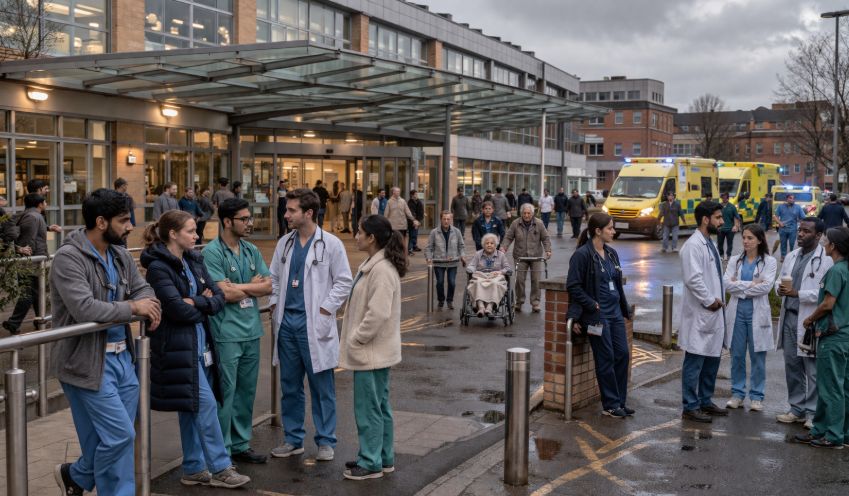
Is the NHS strike going to disrupt your care, delay your appointment, or affect your ability to access urgent treatment?
The NHS England six-day strike represents one of the most serious ongoing challenges facing the UK healthcare system. Building on earlier record-breaking industrial action, the April 2026 walkout continues to test NHS capacity, staffing, and patient access.
The strike began at 7 am on Tuesday, 7 April 2026, and will end at 6:59 am on Monday, 13 April 2026, lasting a full 144 hours.
This guide is based on verified updates from NHS England and the British Medical Association (BMA), ensuring you receive accurate, clear, and actionable information during this period.
When Will the NHS England Six-Day Strike End?
 The NHS England six-day strike runs from 7 April to 13 April 2026, lasting 144 continuous hours.
144-Hour Walkout Details
The strike duration is significant because it spans nearly an entire working week, increasing cumulative pressure on services.
- Start: 7:00 am, Tuesday, 7 April 2026
- End: 6:59 am, Monday, 13 April 2026
- Total duration: 144 hours
This extended timeframe makes it more disruptive than shorter strikes, particularly for planned care and hospital scheduling.
Timing After Easter
The timing of the strike has added complexity. Occurring just after a bank holiday weekend, NHS systems are already under strain due to:
- Increased patient demand over holidays
- Reduced staffing during long weekends
- Backlogs from postponed care
Health leaders have described this overlap as “particularly challenging” because recovery time between peak demand periods is limited.
Why Are Resident Doctors Striking in 2026?
Resident doctors are striking due to disputes over pay, working conditions, and long-term workforce planning.
Breakdown of Pay Negotiations
The British Medical Association (BMA) has rejected the government’s latest offer, stating that changes made at the last minute weakened the proposal.
Doctors argue that:
- Pay has not kept pace with inflation
- Previous commitments on pay restoration have not been fully met
The 3.5% vs. Inflation Dispute
At the centre of the disagreement is the government’s proposed 3.5% pay increase for 2026/27.
From the BMA’s perspective:
- Inflation (measured by RPI) exceeds this increase
- The offer represents a real-terms pay reduction
This disagreement highlights a broader issue around retaining skilled healthcare professionals within the NHS.
Specialty Training Bottlenecks
Another major concern is the removal of a proposal for 1,000 additional specialty training posts.
This has implications such as:
- Slower career progression for doctors
- Fewer specialists entering the system
- Increased long-term workforce shortages
Which NHS Services Are Affected During the Strike?
Emergency services remain operational, but non-urgent care such as routine appointments and elective procedures may be delayed.
Postponed Appointments and Procedures
Patients should expect disruption mainly in planned care.
Hospitals may reschedule:
- Elective surgeries (e.g., joint replacements)
- Routine outpatient appointments
- Follow-up consultations
However, it is important not to assume cancellation. The NHS will contact patients directly if changes are required.
Services Operating as Normal
Despite the strike, several critical services continue to function:
- GP practices remain open
- Pharmacies provide frontline support for minor illnesses
- Mental health services continue
- Maternity services prioritise urgent and time-sensitive care
Service Availability During the 6-Day Strike
How Is the NHS England Six-Day Strike Impacting Patients and the System?
 The strike contributes to appointment delays, increased waiting times, and financial strain on the NHS.
Appointment Cancellations and Backlogs
Since industrial action began in 2022:
- Over 1.7 million appointments have been rescheduled
- The NHS waiting list remains at approximately 7.2 million patients
This backlog affects:
- Elective procedures
- Specialist consultations
- Diagnostic services
A&E Pressure and Waiting Times
Emergency departments remain open, but pressure increases during strike periods.
Reports from previous strikes indicate:
- Waiting times reaching up to 11 hours in some hospitals
- Increased reliance on emergency services due to reduced routine care
Financial Cost of the Strike
The economic impact is significant.
- Each major strike round costs approximately £300 million
- Total costs across multiple strikes now approach several billion pounds
These costs affect:
- NHS budgets
- Resource allocation
- Long-term service improvements
What Do Experts Say About the NHS Strike Dispute?
Experts agree that patient safety remains a priority, but urgent negotiations are needed to resolve the dispute.
NHS Leadership Perspective
NHS leaders emphasise that patients should continue seeking care when needed.
Their guidance highlights:
- Emergency services are safe to use
- Patients should not delay necessary treatment
BMA Perspective
The BMA stresses that:
- Doctors feel undervalued financially
- Pay and working conditions must improve to retain staff
This reflects a deeper structural challenge within the NHS workforce.
What Should Patients Do During the NHS England Six-Day Strike?
Patients should continue attending scheduled care, use NHS 111 for guidance, and reserve emergency services for serious conditions.
Life-Threatening Emergencies
Emergency care remains the highest priority.
Patients should:
- Call 999 immediately
- Go to A&E for critical conditions such as chest pain, stroke symptoms, or severe injuries
Urgent Medical Advice
For non-emergency issues, NHS 111 online is the recommended first step.
This service:
- Provides quick medical guidance
- Helps direct patients to appropriate care
- Reduces unnecessary pressure on hospitals
Attending Existing Appointments
Patients should attend appointments unless they are explicitly contacted by the NHS.
Assuming cancellation without confirmation can:
- Delay care unnecessarily
- Increase system inefficiencies
Are More NHS Strikes Expected in 2026?
 Yes, further strike action is possible if negotiations between doctors and the government remain unresolved.
Ongoing Strike Mandate
The current strike mandate is valid until August 2026, allowing for additional action if required.
Wider NHS Workforce Tensions
The situation extends beyond resident doctors:
- Consultants and SAS doctors may take action
- GP contract disputes are ongoing
Future Outlook
While negotiations may still lead to a resolution, uncertainty remains.
Healthcare leaders continue to call for:
- Renewed discussions
- Long-term workforce planning
- Sustainable funding solutions
How Does the Government Offer Compare to BMA Demands?
The government proposes modest pay increases, while the BMA argues these do not meet inflation or long-term restoration goals.
This gap between expectations and proposals continues to drive industrial action.
What Is a Real-Life Example of the Strike’s Impact on Patients?
Patients often face delays in planned care, which can affect quality of life but are managed by NHS rescheduling systems.
A real-world scenario helps illustrate the impact.
A patient scheduled for elective surgery may experience:
- Postponement of their procedure
- Continued symptoms or discomfort
- Delayed recovery timelines
For example, a patient awaiting knee surgery could face:
- Several weeks of delay
- Reduced mobility during that time
- Dependence on follow-up communication from the NHS
This demonstrates that while disruption occurs, systems are in place to reschedule and prioritise care.
What Are the Facts vs Misinformation About the NHS Strike?
Not all NHS services stop during strikes, and misinformation can lead to unnecessary anxiety or missed care.
Confirmed Facts
- Emergency services remain fully operational
- Many appointments still go ahead
- NHS prioritises life-saving and urgent care
Misinformation Clarified
- “All services are closed” is incorrect
- “You should avoid hospitals entirely” is false
- “Every appointment will be cancelled” is misleading
Understanding these distinctions helps patients make informed decisions.
What Is the Key Takeaway from the NHS England Six-Day Strike?
The NHS England six-day strike causes disruption but does not stop essential healthcare services.
The most important points to remember are:
- Emergency care remains available and safe
- Routine services may be delayed but not cancelled entirely
- Patients should continue to seek care responsibly
While the strike reflects serious challenges within the NHS, the system continues to prioritise patient safety and critical care.
FAQ About NHS England Six-Day Strike
Can I still attend my hospital appointment during the NHS strike?
Yes, unless the NHS contacts you directly to reschedule, you should attend as planned.
What is the safest way to get medical advice during the strike?
Using NHS 111 online is the most efficient and recommended option for non-emergencies.
Are ambulance services affected by the strike?
Ambulance services continue to operate for emergencies, though demand may be higher.
Will waiting times increase during the strike period?
Yes, waiting times may increase, especially for non-urgent care.
Are pharmacies reliable during NHS strikes?
Yes, pharmacies remain open and are a key resource for minor health concerns.
Why is the NHS facing repeated strikes?
The main reasons include pay disputes, workforce shortages, and training concerns.
How can patients stay updated during NHS strikes?
Patients should check official NHS websites and communications for real-time updates.