







Updated: 10 September 2026
The UK Cake Sheds Business Trend has moved beyond being an unusual home-baking success story. In 2026, these small self-service bakeries have become a test case for how British councils regulate a new generation of home-based micro-businesses.
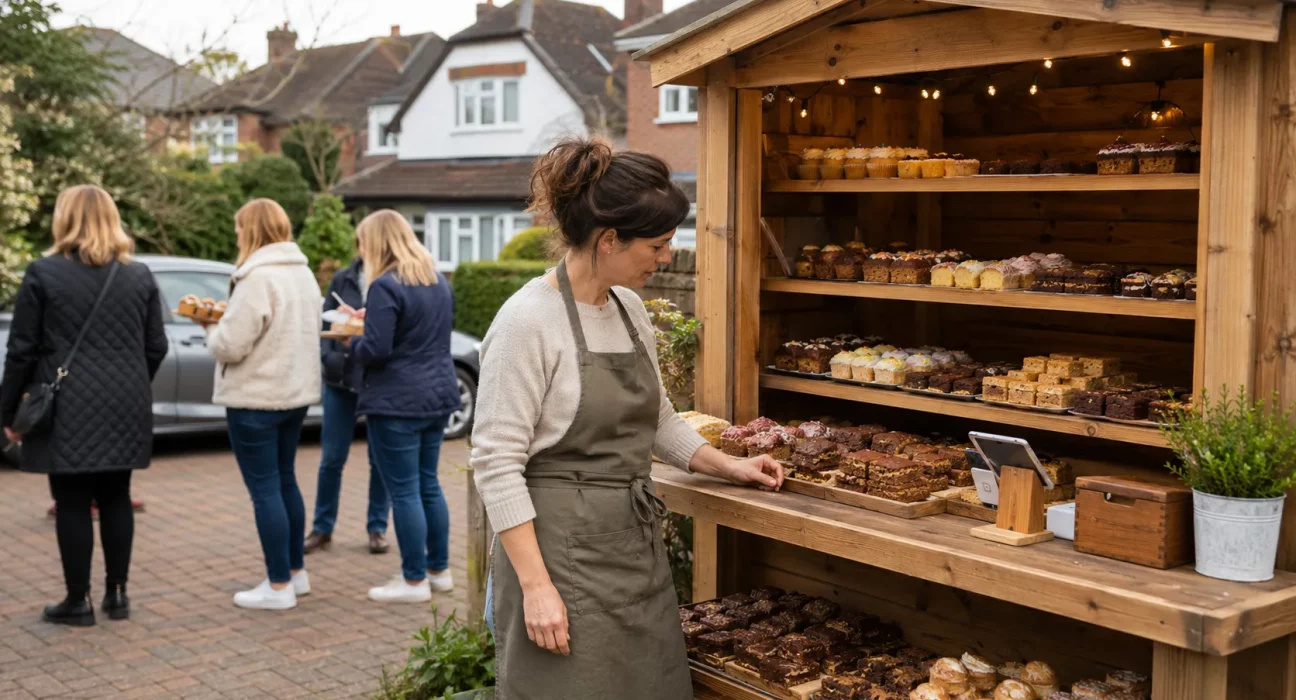
The basic model remains remarkably simple. A baker prepares cakes, brownies, blondies, cookies or other treats at home, places them in a small shed, cupboard or kiosk outside the property, and allows customers to buy them using cash or digital payment.
What has changed is the regulatory environment around them.
London Business Mag reviewed current council guidance, licensing committee decisions, government information and Parliamentary records in September 2026. The research shows there is still no single practical approach being followed across local authorities.
A cake shed that is unlikely to require street-trading consent in one council area could potentially need permission in another. Elsewhere, councils are introducing special low-cost schemes specifically designed for unattended kiosks and honesty boxes.
The debate has also expanded beyond street-trading licences.
Planning permission, food registration, allergen labelling, taxation and even business rates are now relevant questions for operators.
That makes the cake shed story much bigger than a £5 brownie sold from a driveway. It has become an example of what happens when digital payments, social media and home entrepreneurship develop faster than traditional local licensing frameworks.
What Has Changed in the UK Cake Sheds Business Trend in 2026?
The biggest change since the first wave of cake shed stories appeared earlier in 2026 is that the regulatory debate has continued rather than disappeared.
Bassetlaw District Council became the highest-profile example.
Its revised Street Trading Policy came into effect on 24 April 2026 and included cake cupboards and sheds within its regulatory framework. Following a strong public reaction, the council subsequently paused enforcement relating specifically to cake sheds and cupboards operating on residents’ own land.
The issue did not end with that pause.
On 22 July 2026, Bassetlaw’s Licensing Committee considered the policy again. Instead of reaching a final permanent settlement, members directed officers to carry out further public consultation on whether cake sheds should continue to be included in the Street Trading Policy.
That is an important development.
It means the Bassetlaw controversy should no longer simply be described as a council “crackdown”. The position has developed into a broader policy review over how small home-based sellers should be treated.
National politicians have started asking questions too.
On 17 July 2026, the Government responded to a Parliamentary question about discussions with local authorities concerning cake sheds and enforcement. The response emphasised that local authorities make decisions according to their individual needs while the Food Standards Agency provides a framework for food controls.
Then, on 1 September 2026, another Parliamentary question asked the Chancellor whether the HMRC Valuation Office Agency values cake sheds for business rates.
That question matters because it highlights another issue that could become increasingly important as successful cake sheds grow from casual side ventures into established retail operations.
Cake Shed Regulatory Timeline
| Date | Development | Why It Matters |
|---|---|---|
| 24 April 2026 | Bassetlaw’s updated Street Trading Policy took effect | Cake sheds were specifically brought into the local regulatory debate |
| May 2026 | Bassetlaw paused cake-shed enforcement | Operators on their own land could continue temporarily without a licence |
| 3 June 2026 | Bassetlaw Licensing Committee reviewed the rules | The financial and practical impact on small operators was reconsidered |
| 18 June 2026 | Cake sheds were discussed again at council level | The council recognised that activity ranges from modest honesty boxes to more commercial businesses |
| 17 July 2026 | Government answered a Parliamentary question on cake-shed enforcement | Central government confirmed the importance of local decision-making |
| 22 July 2026 | Bassetlaw ordered further public consultation | The long-term licensing position remained under review |
| 1 September 2026 | Parliament raised the question of business rates | The debate expanded beyond street-trading licences |
The timeline demonstrates why operators should not rely on advice published months earlier. Local rules and interpretations are still developing.
Are Cake Sheds Legal in the UK in 2026?
Yes. There is no national law banning cake sheds.
However, describing a cake shed as simply “legal” can be misleading because several separate regulatory systems may apply to the same business.
A baker may need to consider food business registration, hygiene requirements, allergen labelling, street-trading rules, planning restrictions, taxation, insurance conditions and potentially business rates.
The most unpredictable part remains street trading.
Schedule 4 of the Local Government (Miscellaneous Provisions) Act 1982 gives participating councils powers to regulate street trading. One of the central difficulties is that the definition of a street can extend beyond an ordinary public pavement or road.
Some councils therefore consider privately owned land accessible to customers relevant to street-trading rules.
Others take a much more permissive approach to small home businesses.
Our review of current council guidance illustrates just how different the answers can be.
How Are UK Councils Treating Cake Sheds?
London Business Mag checked published guidance and council records rather than assuming that one council’s interpretation applies nationally.
The findings show what could reasonably be described as a cake shed postcode lottery.
| Council | Current Published Position | What It Means for Operators |
|---|---|---|
| Bassetlaw District Council | Cake-shed enforcement was paused and further consultation ordered in July 2026 | Operators need to watch the ongoing policy review |
| Maidstone Borough Council | A pilot operates for small unmanned kiosks and honesty boxes | A dedicated £75 consent route is currently published |
| Wigan Council | A home cake shed is unlikely to need street-trading consent, but cases are assessed individually | Operators are encouraged to contact licensing with details |
| Derby City Council | An open driveway accessible for walk-up cake purchases may legally be considered a street | Walk-up retail can create licensing exposure |
| East Cambridgeshire District Council | Its policy can include private land adjacent to a street | An annual street-trading consent may be required |
These are not minor differences in wording. They can materially affect how a business operates.
What Is Happening in Bassetlaw?
Bassetlaw remains the most important case because the council specifically incorporated cake sheds and cupboards into its Street Trading Policy.
The council initially argued that treating cake sheds differently from burger vans, market stalls and other static trading businesses could allow them to bypass controls relating to matters such as location, planning, waste, insurance and food safety.
However, public opposition led to enforcement being paused.
Council records from June also show discussion of reducing the initial cost for qualifying unmanned residential cake sheds through a council-funded subsidy, illustrating how policymakers were already considering whether the normal framework was disproportionate for very small traders.
The next major development came on 22 July.
Rather than simply confirming the existing approach, councillors requested another consultation specifically addressing the continued inclusion of cake sheds within the policy.
For operators, the important conclusion is simple: Bassetlaw’s cake shed policy remained an evolving issue during summer 2026 rather than a settled national precedent.
What Is Maidstone Doing Differently?
Maidstone provides a particularly interesting contrast.
Its current licensing information states that the council is running a pilot scheme for small unmanned kiosks and honesty boxes.
Applicants can be asked for an application form, site plan, photographs, insurance evidence and food-business registration where food is being sold.
Most importantly, Maidstone currently publishes an unmanned kiosk or honesty box consent fee of £75.
This may represent one possible direction for future regulation.
Instead of forcing a tiny driveway business through exactly the same licensing structure used for traditional traders, councils can create a proportionate category reflecting the relatively unusual operating model.
Does Wigan Require a Cake Shed Licence?
Wigan takes a noticeably different approach.
Its council guidance specifically says that someone running a “cake shed” type business from home is unlikely to need street-trading consent.
However, the authority still recommends contacting it with details of how the business operates, including advertising, so that the circumstances can be considered individually.
Wigan also makes clear that businesses of this type still need food-premises registration.
That distinction is important.
Not needing street-trading consent does not mean a business is exempt from food law or other regulatory requirements.
Why Is Derby Important?
Derby’s guidance demonstrates how the way customers buy products can change the licensing position.
Derby City Council says that if a driveway is open and anybody can walk up to a stall and purchase a cake, the location may legally be considered a street for trading purposes.
Its guidance also creates an important distinction for pre-orders.
Where goods are pre-ordered and paid for before collection or delivery, street-trading consent is not required under the circumstances described by the council. But if customers can purchase additional products at collection, consent may become necessary.
For cake shed owners, this creates a potentially significant difference between:
open walk-up retail
and
pre-ordered, prepaid collection.
The commercial activity may look similar to the baker, but the regulatory treatment can be different.
What Does East Cambridgeshire Say?
East Cambridgeshire District Council has one of the clearest cake-shed-specific statements we found.
The council says its Street Trading Policy requires permission when articles are sold or exposed for sale in a street and explains that this can include private land adjacent to a street.
It therefore warns that people operating cake sheds may need annual street-trading consent and separately reminds them that the operation must be registered as a food business.
When these five council positions are viewed together, one conclusion becomes difficult to avoid:
there is currently no reliable UK-wide yes-or-no answer to the cake shed street-trading question.
Operators need to check the rules applying specifically to their property and council area.
Can a Cake Shed Really Make £1,000 a Week?
The £1,000-a-week figure has become one of the most repeated claims associated with the UK cake shed boom.
It is possible for gross sales to reach that level, but it should not be confused with £1,000 of weekly profit.
Instead of treating headline figures as a typical industry income, London Business Mag modelled what different levels of weekly sales would require.
London Business Mag Cake Shed Revenue Model
| Scenario | Customer Purchases Per Week | Average Sale | Weekly Gross Revenue | Gross Revenue Over 48 Trading Weeks |
|---|---|---|---|---|
| Small local operation | 80 | £4.50 | £360 | £17,280 |
| Growing cake shed | 140 | £5.00 | £700 | £33,600 |
| Busy established operation | 200 | £5.00 | £1,000 | £48,000 |
These are illustrative London Business Mag calculations, not reported average earnings for UK cake sheds.
The table exposes something that headlines often miss.
To generate £1,000 per week at an average transaction value of £5, an operator would need approximately 200 purchases every week.
That can certainly be achievable for a well-known business with repeat customers, a good location and a large social-media audience. It is far less realistic for every new cake shed.
And turnover is only the first number.
Ingredients, packaging, card-processing fees, electricity, equipment, insurance, wastage, cleaning, marketing, commercial waste arrangements where applicable and taxation can all reduce the amount ultimately retained by the owner.
There is also the value of the baker’s time.
A business producing hundreds of cakes, brownies or traybakes every week may have low property overheads compared with a high-street bakery, but it can still involve substantial labour.
That is why revenue, gross profit and personal income should never be treated as interchangeable figures.
Why Does the Cake Shed Business Model Work?
The economics become more interesting when a cake shed is compared with a conventional bakery.
A traditional retail bakery may need commercial premises, deposits, rent, utilities, shop fitting, staffing and a much larger initial investment before the first customer walks through the door.
A home baker already has access to much of the infrastructure required for production.
The shed then functions as an extremely small retail interface.
There may be no cashier. There may be no indoor customer space. Opening hours can be adjusted according to demand, and products can be promoted through local Facebook groups, Instagram, TikTok or existing customer networks.
Digital payments have made the model even easier.
An unattended retail concept that would once have depended entirely on coins and an honesty box can now accept electronic payments without employing somebody to stand beside the products.
The model therefore combines three established ideas home baking, honesty-box retail and social-media marketing—in a format suited to modern consumer behaviour.
What Must a Cake Shed Owner Do Before Selling Food?
Whatever happens to street-trading policies, food law is not optional.
The Food Standards Agency’s registration service states that anyone starting a new food business or taking over an existing one must register with the relevant local authority and should do so at least 28 days before trading or food operations begin.
That requirement can apply to businesses operating from home.
Registration should therefore come before opening the shed, not after sales have already started.
Local authority food-safety officers may subsequently assess the business.
In England, Wales and Northern Ireland, the Food Hygiene Rating Scheme evaluates areas including hygienic food handling, the condition and cleanliness of facilities and food-safety management. Scotland operates a separate food-hygiene information system.
For a home baker, operating on a small scale does not remove the responsibility to supply food safely.
Does Natasha’s Law Apply to Cake Sheds?
It can.
This is particularly important because many cake sheds display products that have already been wrapped, bagged or boxed before customers arrive.
Where food meets the legal definition of prepacked for direct sale (PPDS), the Food Standards Agency says its label needs to show the name of the food and a full ingredients list, with any of the 14 regulated allergens present clearly emphasised.
The exact classification depends on how and where the product is packed and sold, so operators should not simply assume every cake requires identical labelling.
But the self-service nature of many cake sheds makes clear and accurate information particularly important.
There may be no member of staff standing next to the shed to answer a customer’s allergen question.
Good labelling is therefore not merely an administrative exercise. It is a core part of making an unattended food-retail model safe.
Could Planning Permission Affect a Successful Cake Shed?
Yes, although planning permission is not automatically required merely because somebody starts baking from home.
Government planning guidance states that running a business from home will not normally require planning permission where the business use remains incidental to the property’s use as a dwelling.
The position can change where the activity produces a material change of use.
Factors can include increased traffic and parking, regular visitors or deliveries, noise, smells and structural alterations.
This creates an interesting paradox for cake sheds:
the more successful the business becomes, the more important the planning question can become.
A small cupboard selling a limited number of brownies to nearby residents once a week has a very different effect on a street from a destination bakery promoted across social media that attracts a regular stream of cars.
There is therefore no useful universal sales threshold such as “£500 per week means you need planning permission“.
The impact on the residential property and surrounding area is more relevant than turnover alone.
Operators expecting significant customer traffic should consider discussing the proposed activity with their local planning authority.
Could Cake Sheds Have to Pay Business Rates?
This may become one of the next significant questions surrounding the sector.
General government guidance says people running minor businesses from home do not normally pay business rates where only a small part of the home is used, goods or services are not sold to visiting members of the public, no other people are employed at the premises and no non-domestic alterations have been made.
But those conditions are particularly interesting when applied to cake sheds because the entire model can involve members of the public visiting a residential property to buy goods.
GOV.UK also states that a person may have to pay business rates on the portion of a home used for business where the Valuation Office Agency gives that part a rateable value.
The issue reached Parliament on 1 September 2026 when a written question specifically asked whether the HMRC Valuation Office values cake sheds for business rates.
That does not mean every cake shed is about to receive a business-rates bill.
It does demonstrate, however, that the regulatory conversation has expanded.
Cake shed owners should therefore avoid assuming that operating from a residential property automatically makes business rates impossible.
What Tax Does a Cake Shed Owner Need to Consider?
Another common mistake is confusing HMRC’s £1,000 trading allowance with a rule allowing someone to make £1,000 per week tax-free.
They are completely different figures.
HMRC guidance says the trading and miscellaneous income allowance provides up to £1,000 of relief against qualifying trading income.
Where annual gross trading income exceeds £1,000, additional reporting obligations can apply. HMRC also allows eligible taxpayers to choose between using the trading allowance and deducting actual allowable expenses, depending on their circumstances; the same expenses cannot simply be deducted on top of the allowance.
For somebody running a busy cake shed, reliable record keeping therefore matters from the beginning.
Sales through QR codes and card-payment services may create useful digital records, but operators should also keep evidence of cash sales, ingredient purchases, packaging, equipment and other legitimate business expenditure.
A business can feel informal to the customer while still being a taxable commercial operation for its owner.
Is a Cake Shed Still Cheaper Than Opening a Bakery?
Usually, the attraction is not that running one costs nothing.
It is that the fixed-cost structure can be dramatically lighter.
There may be no commercial lease, no staffed counter and no need to fit out a full customer-facing shop.
That can allow a baker to test demand before committing to a larger business.
But 2026 has shown that operators need to budget for more than timber and cake ingredients.
Depending on circumstances and location, costs could involve insurance, food-safe storage, packaging and labelling, payment processing, waste disposal, security, planning advice and licensing.
The regulatory position therefore needs to be investigated before building an elaborate shed or creating a large customer following.
What Can Councils Learn From Maidstone’s £75 Approach?
The most important policy question may no longer be whether cake sheds should face any regulation.
It may be what proportionate regulation looks like.
The contrast between councils provides a useful experiment.
Maidstone’s current £75 unmanned kiosk and honesty-box consent demonstrates that a council can recognise unattended micro-retail as something different from a traditional full-scale street-trading operation.
Wigan demonstrates another approach: begin with an assumption that a home cake shed is unlikely to require consent, then assess unusual cases individually.
Derby provides clearer behavioural guidance by distinguishing ordinary walk-up selling from goods that have already been pre-ordered and paid for.
Bassetlaw, meanwhile, is using further consultation to reconsider how cake sheds should sit inside its wider policy.
Those examples suggest there is room between two extremes.
Councils do not necessarily have to choose between leaving commercial activity completely unregulated and treating a tiny residential honesty box exactly like a conventional street trader.
Could Pre-Order Collection Become the Safer Business Model?
One under-discussed consequence of the licensing debate is that some bakers may change how they sell, rather than abandon their businesses.
Derby’s published guidance is particularly relevant here.
A model where customers order and pay online before collecting a prepared package can have a different street-trading position from allowing anybody to walk onto a driveway and choose additional products.
For some home bakers, the future cake shed may therefore operate less like a miniature shop and more like an automated collection point.
Customers could see the week’s products online, reserve them, pay electronically and collect them from a secure cupboard during a specified period.
That would preserve much of the convenience that makes cake sheds attractive while potentially reducing spontaneous customer traffic and some licensing concerns.
It could also make production easier to forecast, reducing unsold stock and food waste.
Whether this model changes the legal position will still depend on the relevant council, but it demonstrates how regulation can influence business innovation.
Why Are Cake Sheds Different From Traditional Honesty Boxes?
Britain has a long history of roadside eggs, vegetables, plants and flowers being sold through honesty boxes.
Cake sheds look similar, but there can be an important commercial distinction.
Surplus eggs or garden produce may arise naturally from domestic activity. A cake business deliberately purchasing ingredients, manufacturing products, advertising them and replenishing a retail display is more clearly organised commercial activity.
Bassetlaw has explicitly distinguished sales of items such as eggs, vegetables and cut flowers that may represent surplus domestic produce from commercial cake-shed activity.
That helps explain why councils that have tolerated traditional honesty boxes for decades can still reach different conclusions about modern cake sheds.
The shed itself is not necessarily the issue.
It is the nature and scale of the trading activity taking place through it.
What Does the Trend Reveal About Britain’s Small-Business Economy?
Cake sheds matter because they represent a much broader change in the economics of starting a business.
Digital technology has reduced the minimum infrastructure needed to become a retailer.
A home baker can now advertise to thousands of local people without buying newspaper advertising.
Customers can discover opening times through social media rather than shop signage.
Payments can be collected without a cash register.
A residential property can function simultaneously as a production site, administrative office, marketing studio and collection point.
The cake shed is simply the most visible physical expression of this change.
Similar questions will increasingly arise around other home-based micro-retail businesses.
Existing regulatory frameworks were often designed around a relatively clear distinction between a home and a commercial premises.
Technology is making that distinction less obvious.
What Should Someone Check Before Opening a Cake Shed?
The most important lesson from the 2026 regulatory debate is to check the business model before investing heavily in it.
A prospective operator should establish whether the food business has been properly registered, how products will be labelled, whether the council regards the proposed location as street trading, whether customer activity could trigger planning concerns, what their home or business insurer requires, how commercial waste will be handled where applicable and what records HMRC will require.
The order matters.
Checking these questions after a social-media post has already brought hundreds of customers to a residential street is much harder than designing a compliant operation from the beginning.
Operators should also describe their intended setup precisely when contacting a council.
There can be a material difference between saying:
“I run a cake business from home”
and explaining:
“Customers will walk onto my driveway without pre-ordering, select packaged products from an unattended shed and pay through a QR code between 9am and 5pm on Saturdays.”
The second description gives licensing and planning officers the information needed to assess the actual activity.
Will Cake Sheds Continue Growing?
There is little reason to think the underlying business idea will disappear simply because councils are paying more attention to it.
The model solves genuine commercial problems.
It gives bakers a way to sell directly without immediately taking on the fixed costs of a retail shop. It gives consumers convenient access to local products. And it allows entrepreneurs to test demand before deciding whether to expand.
What is likely to change is the level of professionalism expected from operators.
The next generation of successful cake sheds may look less like informal garden honesty boxes and more like highly organised micro-retail businesses, complete with digital payments, compliant food labels, scheduled stock releases, professional insurance and clear arrangements with local authorities.
Some may eventually move into conventional shops.
Others may deliberately remain small.
And some councils may create dedicated regulatory categories similar to Maidstone’s honesty-box route.
The business model is therefore unlikely to disappear.
It is more likely to mature.
What Is the Real Future of the UK Cake Sheds Business Trend?
The most important finding from London Business Mag’s September 2026 review is that there is no single national cake shed story.
Bassetlaw is consulting.
Maidstone has introduced an honesty-box pilot.
Wigan says home cake sheds are unlikely to require street-trading consent but assesses them case by case.
Derby warns that unrestricted walk-up sales from an open driveway may qualify as street trading.
East Cambridgeshire says its policy can extend to private land adjacent to a street.
And Parliament has now raised questions concerning both local-authority enforcement and business rates.
That is much more significant than a temporary social-media craze.
The UK Cake Sheds Business Trend has exposed a regulatory grey area created by the rapid growth of home-based, digitally enabled micro-retail.
The businesses themselves are simple.
The legal environment around them is not.
For entrepreneurs, the strongest strategy is therefore not to assume cake sheds are either completely unrestricted or automatically overregulated. It is to understand the exact rules applying to their own location and design the operation accordingly.
For policymakers, the challenge is different.
Councils need to protect food safety, residential amenity and fair trading without creating compliance costs so disproportionate that a small weekend enterprise becomes economically impossible.
Maidstone, Wigan, Derby, East Cambridgeshire and Bassetlaw are already demonstrating different ways of answering that question.
The result of those experiments could eventually matter to far more businesses than Britain’s home bakers.
Cake sheds may simply be the first highly visible example of a much larger challenge: how should old regulatory systems respond when a home can become a shopfront with little more than a shed, a smartphone and a QR code?
FAQs
Are Cake Sheds Legal in the UK?
Yes, cake sheds can operate legally, but there is no single licence covering every business. Food-safety rules apply, while street-trading, planning and other requirements depend on the location and individual circumstances.
Do Cake Sheds Need a Street-trading Licence?
Not everywhere. Wigan says a home cake shed is unlikely to require consent but considers businesses individually. Derby warns that walk-up trading on an accessible driveway may qualify as street trading, while East Cambridgeshire says private land adjacent to a street can fall within its policy. Operators should therefore check directly with their own council.
What Happened to the Bassetlaw Cake Shed Licence Rules?
Bassetlaw paused enforcement relating specifically to cake sheds and cupboards on residents’ own land. On 22 July 2026, its Licensing Committee then directed officers to conduct further public consultation on whether cake sheds should continue to be included within the Street Trading Policy.
How Much is a Cake Shed Licence?
There is no national cake shed licence fee. Costs depend on the local authority and regulatory route. Maidstone, for example, currently lists a £75 consent for an unmanned kiosk or honesty box.
Can a Cake Shed Make £1,000 Per Week?
It is possible to generate £1,000 in weekly gross sales, but that should not be presented as typical profit. At an average £5 transaction, £1,000 of weekly revenue would require around 200 purchases. Ingredient, packaging, energy, payment, insurance, waste and other costs then need to be deducted.
Do I Need to Register a Cake Shed as a Food Business?
A person starting a food business must register with their local authority. The Food Standards Agency says registration should take place at least 28 days before trading or food operations begin.
Does Natasha’s Law Apply to Cakes Sold From a Shed?
It can. Where cakes or other products qualify as prepacked for direct sale, labels need the food name and full ingredients list, with regulated allergens emphasised.
Does a Cake Shed Need Planning Permission?
Not automatically. Planning permission may become necessary if running the business creates a material change in the use of the property. Customer traffic, parking, deliveries, noise and other effects can influence that assessment.
Could a Cake Shed Have to Pay Business Rates?
Potentially, depending on how part of the property is used and whether it receives a rateable value. Government guidance states that minor home business use does not normally attract business rates in certain circumstances, but businesses selling to visiting members of the public require closer consideration.
What is the £1,000 HMRC Rule for Cake Shed Owners?
The £1,000 figure refers to HMRC’s trading allowance for qualifying trading income; it is not a £1,000-per-week tax exemption. Operators whose gross trading income exceeds the relevant threshold should check their reporting and Self Assessment responsibilities.
Are Cake Sheds Likely to Disappear Because of Regulation?
There is no evidence of a national move to ban cake sheds. Current developments instead show councils experimenting with different approaches, ranging from case-by-case exemptions to specific low-cost honesty-box consent schemes and formal policy consultations.