








Last updated: 12 October 2026
The 6135 job code is one of the most important occupation classifications for care workers and home carers in the United Kingdom. However, substantial changes to UK immigration rules have altered who can obtain sponsorship, how much employers must pay and whether applicants can bring their families.
From 22 July 2025, the UK government closed new overseas Skilled Worker sponsorship applications for care workers under occupation code 6135. Certain workers already in the UK can still qualify for sponsorship under transitional arrangements, but meeting the occupation and salary requirements alone is no longer sufficient.
In 2026, eligible applicants under the Health and Care Worker route generally need a salary of at least £25,000 annually and £12.82 per hour, with the applicable going rate adjusted for contracted working hours.
This guide examines the latest rules, explains the difference between occupation codes 6135 and 6136, and presents independently calculated salary comparisons alongside published UK care workforce statistics.
What Is the 6135 Job Code in the UK?

Occupation code 6135 is part of the Standard Occupational Classification (SOC) 2020 system. It identifies care workers and home carers who provide direct assistance to people requiring support with their everyday lives.
These professionals commonly work in residential care homes, domiciliary care organisations, supported living services and community care settings.
Their responsibilities can include supporting people with washing, dressing, mobility, meals, medication routines, emotional wellbeing and maintaining accurate care records.
The exact responsibilities depend on the employer, the care setting and the individual’s assessed needs.
Importantly, SOC codes describe occupations rather than guaranteeing visa eligibility. Someone can work legally in a care worker position without requiring immigration sponsorship.
What Is the Difference Between 6135 and 6136 Job Codes?
Care workers and senior care workers are classified separately because the nature and level of their responsibilities can differ.
| Job code | Occupation | Main responsibilities |
|---|---|---|
| 6135 | Care workers and home carers | Providing direct personal and practical care |
| 6136 | Senior care workers | Senior care responsibilities, supervision and coordination |
| 6145 | Former SOC 2010 care worker code | Historical classification corresponding to 6135 |
| 6146 | Former SOC 2010 senior care worker code | Historical classification corresponding to 6136 |
A senior care worker may supervise other employees, coordinate daily care arrangements, support less experienced colleagues and undertake additional senior-level responsibilities.
However, an employer cannot simply change someone’s title to ‘senior care worker’ to qualify for different immigration treatment.
The occupation code must accurately reflect the genuine duties being performed.
Is the 6135 Job Code Still Eligible for a UK Visa in 2026?
Yes, but eligibility is now significantly restricted.
Since 22 July 2025, employers have been unable to sponsor applicants seeking new entry clearance from overseas under occupation codes 6135 or 6136.
This does not mean every care worker already living in the UK has lost access to sponsorship.
Under the Home Office’s current guidance, an applicant must already be in the UK and satisfy at least one of two conditions:
- They have been legally working for the proposed sponsoring employer as a care worker or senior care worker for at least three months before the Certificate of Sponsorship is assigned.
- They were last granted qualifying Skilled Worker permission in an eligible care occupation and have maintained the required continuous permission.
The three-month transitional pathway currently requires applications to be made no later than 22 July 2028.
Who Can Apply Under the 6135 Job Code?

| Applicant situation | General eligibility position in 2026 |
|---|---|
| Applicant currently overseas seeking a new 6135 sponsored job | Not eligible for new entry clearance sponsorship |
| Graduate visa holder legally working in care for the proposed sponsor for three months | May qualify under transitional arrangements |
| Existing sponsored care worker extending their visa | May qualify, subject to relevant conditions |
| Existing sponsored care worker changing employers | May qualify with continuous permission and valid new sponsorship |
| UK resident who has not yet completed three months’ qualifying employment | Does not yet satisfy the three-month pathway |
| British citizen working in the care sector | Skilled Worker sponsorship not required |
| Person holding indefinite leave to remain | Skilled Worker sponsorship not required |
Original eligibility insight: A licensed care employer cannot guarantee that every overseas national working in the UK can switch into occupation code 6135.
The applicant’s existing permission must allow the employment they have undertaken, and the relevant immigration route must permit switching.
This is particularly important for applicants whose current immigration permission restricts their working hours or the type of work they may undertake.
What Is the Minimum Salary for the 6135 Job Code in 2026?
The salary requirements for occupation code 6135 depend on the applicable Skilled Worker arrangements.
The Home Office currently identifies different thresholds for eligible Health and Care Worker visa cases and certain standard Skilled Worker cases.
| Visa category | Annual salary threshold | Hourly rate |
|---|---|---|
| Eligible Health and Care Worker visa | £25,000 | £12.82 |
| Standard Skilled Worker visa where Health and Care eligibility does not apply | £33,400 | £17.13 |
Both the annual and hourly requirements must be satisfied, alongside the relevant occupation’s going-rate rules.
The government bases published going rates on a 37.5-hour working week, with adjustments for other contracted working patterns.
Original Analysis: Does Working More Hours Increase the Required Salary?
Yes. Employers and applicants sometimes concentrate on the advertised annual salary without considering the number of contracted hours.
To demonstrate the difference, London Business Mag calculated illustrative minimum salaries using the £25,000 annual benchmark, the £12.82 hourly requirement and the 37.5-hour going-rate methodology.
| Weekly contracted hours | Illustrative annual salary required | Effective hourly salary |
|---|---|---|
| 30 hours | £25,000 | £16.03 |
| 35 hours | £25,000 | £13.74 |
| 37.5 hours | £25,000 | £12.82 |
| 40 hours | £26,667 | £12.82 |
| 45 hours | £30,000 | £12.82 |
Research method: Calculations use the higher of the £25,000 annual threshold and the going rate pro-rated from a 37.5-hour week. Effective hourly amounts are rounded to two decimal places. Annual salary figures are rounded upwards to whole pounds where necessary. These examples are not individual visa eligibility assessments.
Why a £25,000 Job Offer Can Be Insufficient?
Consider two fictional care workers who receive offers from licensed employers.
Example A: 37.5-hour contract
The employee receives £25,000 annually.
The effective hourly salary is approximately £12.82, satisfying the illustrated minimum salary benchmark.
Example B: 40-hour contract
The employee receives £25,000 annually.
Their effective hourly salary is approximately £12.02.
Their advertised annual pay meets the £25,000 headline figure, but the offer falls below the required hourly and pro-rated going-rate benchmarks.
Under the illustrated calculation, their annual salary would need to increase to approximately £26,667.
This creates a difference of approximately £1,667 annually between the two employment arrangements.
Key finding: Working additional contracted hours does not allow an employer to spread a fixed £25,000 sponsorship salary across unlimited working time.
The job’s actual working pattern must be considered.
How Does the 6135 Visa Salary Compare With the UK Minimum Wage?
From 1 April 2026, the National Living Wage for eligible workers aged 21 and over increased to £12.71 per hour.
At 37.5 hours weekly over 52 weeks, this produces approximately £24,784.50 annually.
That is below the £25,000 salary benchmark for eligible Health and Care Worker sponsorship.
Original Wage Comparison for 2026
| Salary measure | Hourly equivalent | Annual equivalent at 37.5 hours |
|---|---|---|
| National Living Wage, age 21+ | £12.71 | £24,784.50 |
| Health and Care Worker sponsorship benchmark | £12.82 approximately | £25,000 |
| Voluntary London Living Wage | £14.80 | £28,860 |
The difference between the statutory National Living Wage and the sponsorship benchmark is approximately 11 pence per hour, or £215.50 annually.
That represents an hourly difference of approximately 0.9%.
Although this appears relatively small, it can make a meaningful difference to immigration compliance.
An employer can satisfy minimum wage legislation but still offer insufficient pay for Skilled Worker sponsorship.
For a detailed explanation of statutory rates, read our guide to the UK minimum wage in 2026.
Is the London Living Wage Higher Than the 6135 Sponsorship Threshold?
Yes. The voluntary London Living Wage is £14.80 per hour for the relevant 2025/26 rate period.
At 37.5 hours weekly, this is equivalent to £28,860 annually.
That is £3,860 more than the basic £25,000 Health and Care Worker salary benchmark.
This does not mean that every London care provider is legally required to pay £14.80 hourly. The London Living Wage is a voluntary employer commitment rather than the statutory wage floor.
Nevertheless, it provides an additional benchmark for care organisations competing to attract and retain employees in London.
Employers considering higher salaries should distinguish between minimum legal compliance and broader workforce recruitment objectives.
Our separate analysis of the London Living Wage 2026 explains how the voluntary benchmark differs from statutory pay requirements.
What Do the Latest UK Care Workforce Statistics Reveal?
The impact of occupation code 6135 cannot be understood through immigration regulations alone.
England’s adult social care sector continues to experience recruitment and retention challenges despite improvements in vacancy rates.
Skills for Care’s June 2026 workforce publication reported approximately 96,000 vacancies across adult social care and a vacancy rate of 6.2% in 2025/26.
The same publication estimated that filled posts increased by approximately 22,000, representing workforce growth of 1.4%.
These numbers provide important context for employers considering recruitment under the current immigration restrictions.
Workforce Comparison: 2024/25 Versus 2025/26
| Workforce indicator | 2024/25 publication | 2025/26 publication |
|---|---|---|
| Adult social care vacancy rate | 7.0% | 6.2% |
| Estimated vacant posts | 111,000 | 96,000 |
| Growth in filled posts | 52,000 | 22,000 |
| Estimated new international recruits | 50,000 | 30,000 |
Sources: Skills for Care’s October 2025 State of the Sector findings and June 2026 Size and Structure release. The figures come from separate publication vintages. Historical estimates may be revised, so direct comparisons should not automatically be treated as official like-for-like growth rates.
Insight 1: International Care Recruitment Has Fallen Substantially
Skills for Care estimated that the number of workers recruited internationally into relevant direct care roles declined significantly over recent years.
| Financial year | Estimated international recruits | Change from previous period |
|---|---|---|
| 2023/24 | 105,000 | Baseline |
| 2024/25 | 50,000 | -52.4% |
| 2025/26 | 30,000 | -40.0% |
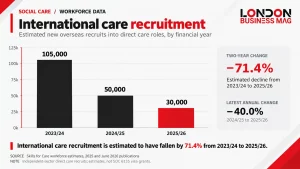
Using these published estimates, the total reduction from 2023/24 to 2025/26 is approximately 71.4%.
This is calculated as:
(105,000 − 30,000) ÷ 105,000 × 100 = 71.4%
These figures concern estimated international recruitment into adult social care, rather than exclusively counting visas granted under occupation code 6135.
The trend also cannot be attributed entirely to the July 2025 rule changes. Recruitment had already declined substantially during 2024/25.
This suggests that employers were responding to a broader combination of immigration policy, recruitment costs, labour market conditions and workforce decisions.
Insight 2: Falling Vacancies Do Not Mean the Sector Has Solved Its Staffing Problems
The reported vacancy rate improved from 7.0% in 2024/25 to 6.2% in 2025/26.
That represents a reduction of 0.8 percentage points.
However, approximately 96,000 positions remained vacant in 2025/26.
Skills for Care’s June 2026 publication reported a 10.5% year-on-year reduction in vacancies. This official percentage should be preferred over simply calculating the difference between the 111,000 and 96,000 headline figures from separate releases, because earlier estimates can be revised.
The distinction matters when using publicly available data to make comparisons.
Lower vacancies may reflect improved recruitment, increased retention, changes in demand or reduced creation of new positions. The figures alone do not identify a single cause.
Insight 3: Overall Workforce Growth Is Slowing
The number of filled posts increased by approximately 22,000 in 2025/26.
This compares with an increase of approximately 52,000 reported in the previous annual publication.
These headline figures suggest that employment growth has slowed.
For care organisations, the practical implication is that workforce planning cannot depend entirely on recruiting new employees.
Retention, training, employee wellbeing and competitive employment conditions may become increasingly important.
Insight 4: Domestic Workforce Pressures Remain Significant
Skills for Care reported that the number of filled posts held by workers with British nationality declined by approximately 40,000 during 2025/26.
This creates a notable contrast.
Overall filled posts increased, but the number occupied by British nationals decreased.
The published evidence therefore suggests that recruitment and retention challenges extend beyond immigration policy alone.
London Business Mag analysis: Employers may need to develop a more sustainable approach combining domestic recruitment, retention of existing international workers, clearer progression opportunities and compliant employment practices.
This is an interpretation of published workforce evidence rather than a claim based on an independently conducted employer survey.
Can Care Workers Switch Employers Under the 6135 Job Code?
Some existing sponsored workers can change employers, but the process depends on their immigration history.
A person who was last granted qualifying Skilled Worker permission in a care occupation may be eligible to apply for further permission with a different licensed sponsor.
They must have maintained the required continuous permission and satisfy the conditions attached to the new employment.
The new employer must offer a genuine eligible role and meet the relevant sponsorship requirements.
A worker should not assume that receiving a new contract automatically authorises them to start work for the new sponsor.
The relevant visa-update requirements must be followed.
Three Practical Eligibility Scenarios
Scenario 1: Existing sponsored care worker
A care worker has been sponsored legally in the UK and receives an offer from another licensed care provider.
Provided their qualifying immigration permission has remained continuous, they may be eligible to change sponsors after completing the required application process.
Scenario 2: Graduate visa holder working in adult social care
An individual holds valid Graduate visa permission and has legally worked for a care provider for more than three months.
The employer wants to retain them through Skilled Worker sponsorship.
The individual may qualify through the transitional pathway if the existing work was permitted, the employer is eligible and all immigration requirements are met.
Scenario 3: Overseas applicant with a confirmed care job offer
A care provider offers a job to an applicant living overseas.
The employer has a sponsor licence and offers an appropriate salary.
However, the applicant seeks new overseas entry clearance under SOC 6135.
The application is not eligible under the restriction introduced on 22 July 2025.
These hypothetical scenarios show why sponsorship eligibility depends on more than salary and employer authorisation.
What English Language Level Is Required for 6135 Sponsorship in 2026?
The English-language requirements for new Skilled Worker applicants changed on 8 January 2026.
New applicants generally need to demonstrate English language proficiency at CEFR level B2.
This covers reading, writing, listening and speaking.
However, certain existing visa holders continue to benefit from earlier B1 requirements.
| Applicant circumstances | General English-language position |
|---|---|
| First qualifying Skilled Worker application from 8 January 2026 | B2 |
| Qualifying existing Skilled Worker visa holder extending permission | B1 transitional rules may apply |
| Existing Skilled Worker visa holder updating their visa | May not need to provide English evidence again |
| Applicant switching from another immigration route | Generally B2 |
| Applicant with accepted exemption | Evidence requirement may differ |
A valid English qualification or other accepted evidence may satisfy the requirement.
Applicants should not assume that every extension requires a new B2 English test.
Equally, a person who previously demonstrated B1 English under another immigration route should not assume that this automatically satisfies the requirements for a new Skilled Worker application.
Do 6135 Care Workers Need a CQC-Registered Employer?
For sponsored care worker positions involving a working location in England, employers must generally hold active registration with the Care Quality Commission and undertake the relevant regulated activity.
Certain narrow transitional exceptions exist for qualifying workers sponsored under earlier arrangements.
The regulatory system differs elsewhere in the UK.
Care services in Scotland, Wales and Northern Ireland operate under their respective regulatory bodies.
An employer’s legal responsibilities therefore depend on where the relevant work is undertaken.
How Should Applicants Verify a Care Employer?
Applicants should examine both the organisation’s immigration sponsorship status and its care regulation status.
A useful assessment involves checking the employer’s legal registered name, sponsor licence position, CQC registration where relevant, proposed work location and actual employment duties.
These details should correspond with the employment offer and Certificate of Sponsorship.
Importantly, appearing on the government’s licensed sponsor register does not establish that every employment opportunity offered by that organisation is genuine or immigration-eligible.
Similarly, possessing CQC registration does not automatically guarantee that an employer can sponsor an individual worker.
What Happens When a Care Employer Loses Its Sponsor Licence?
Sponsor licence revocation can have significant consequences for international care workers.
A sponsored worker whose employer loses its licence may need to find a new eligible sponsor or consider another lawful immigration option within the applicable time limits.
Some affected international care workers may qualify for government-supported assistance aimed at helping them identify alternative ethical employment opportunities.
The Department of Health and Social Care has supported regional partnerships working with displaced international care workers.
For the 2026/27 financial year, the government announced funding of up to £7.5 million for these regional support arrangements.
Is Recruitment From the Displaced Care Worker Pool Mandatory?
An earlier sponsorship requirement introduced in April 2025 directed certain employers to attempt recruitment from a pool of displaced care workers.
That specific mandatory recruitment requirement was subsequently removed from the sponsor guidance.
Care employers can still consider suitable displaced workers, and government-backed regional partnerships may help connect eligible individuals with genuine vacancies.
The distinction matters because older online immigration articles may continue to describe the previous requirement as compulsory.
Care employers also need to understand the wider compliance consequences of sponsorship problems.
Our report on migrant worker visa licence revocations in the UK examines the risks associated with sponsorship non-compliance.
Can Care Workers Bring Their Dependants to the UK in 2026?
Most workers newly entering the care worker sponsorship route after the March 2024 changes cannot bring their partners and children as dependants through that route.
However, some transitional protections remain.
Workers who have continuously held qualifying care worker sponsorship and employment since before 11 March 2024 may remain eligible to sponsor qualifying family members.
Specific exceptions can also apply to certain children, including children born in the UK.
This means that two people employed in similar care positions may have different dependant eligibility because their immigration histories differ.
Applicants should therefore assess their family circumstances separately from their own eligibility to extend or change sponsored employment.
What Should Employers Check Before Sponsoring a 6135 Worker?
Care providers face an additional challenge in 2026: ensuring that their recruitment processes satisfy both immigration rules and wider employment obligations.
A genuine job vacancy is only one part of the process.
Employers also need adequate records demonstrating that the worker meets the relevant eligibility conditions.
Sponsorship Compliance Checklist for Care Providers
| Compliance area | Records employers should examine | Main risk |
|---|---|---|
| Immigration status | Current visa and immigration history | Applicant not eligible for sponsorship |
| Previous employment | Payslips and employment contracts | Three-month pathway not demonstrated |
| Job classification | Duties and job description | Incorrect occupation code |
| Salary | Contract, payroll and working hours | Annual or hourly threshold not met |
| Care regulation | Active CQC registration where required | Sponsor fails regulatory conditions |
| Recruitment costs | Payment records and recruitment agreements | Unlawful recovery of sponsorship costs |
| Ongoing sponsorship | Attendance, work locations and reporting records | Breach of sponsor duties |
Why Do Payroll Records Matter for Care Worker Sponsorship?
An advertised salary may differ from the remuneration and working arrangements recorded in payroll.
For example, a care worker might be offered a salary that satisfies the headline annual requirement, but an employer may subsequently change contracted hours or make deductions that affect compliance.
Not every payment or employment benefit can be counted towards the relevant immigration salary calculation.
Employers should therefore check the relationship between guaranteed basic pay, contractual hours and the salary declared on the Certificate of Sponsorship.
Minimum wage compliance must also be assessed separately.
Our guide to HMRC wage and payroll checks in 2026 explains common employer risks involving payroll records, working time and underpayment.
How Can Eligible Applicants Apply Under the 6135 Job Code?
The application process depends on the individual’s existing immigration position.
For someone potentially eligible under the current UK-based transitional arrangements, the starting point is to confirm that they meet the immigration status and employment history conditions.
The proposed employer must then verify that the job and sponsorship arrangements satisfy the relevant rules.
Once eligibility has been established, the employer may assign an appropriate Certificate of Sponsorship.
The applicant can then complete the relevant application to extend, update or switch their immigration permission.
What Documents Might Be Required?
Depending on their circumstances, an applicant may need to provide a valid passport, Certificate of Sponsorship reference, appropriate English-language evidence and any additional financial or other documents required under the relevant visa route.
The sponsor may also need to retain evidence of qualifying previous employment, including payslips and contracts.
The Certificate of Sponsorship should accurately describe the job, salary, working hours and work locations.
Incomplete or inconsistent information can create problems even when a candidate has relevant care experience.
What Will Happen to the 6135 Job Code After July 2028?
The three-month employment transitional pathway is currently scheduled to end on 22 July 2028.
This means certain applicants who are legally working for an eligible care employer can apply for sponsorship during the transitional period if they satisfy the remaining conditions.
However, the 2028 date should not be confused with an automatic expiry of every care worker visa.
The current rules separately recognise some existing workers who have maintained qualifying sponsored permission.
Nor does the end of the transitional period automatically mean that new overseas recruitment will reopen.
Any future changes will depend on government immigration policy and amendments to the Immigration Rules.
Care providers planning recruitment beyond 2028 should avoid assuming that today’s transitional arrangements will remain available indefinitely.
What Do the 2026 Changes Mean for the Future of UK Care Employment?
The latest immigration changes create different challenges for employers and employees.
For workers already in the UK, the main priority is understanding whether existing immigration permission and employment history allow sponsorship.
For care providers, the priority is building recruitment processes that are both legally compliant and financially sustainable.
The latest workforce statistics offer a particularly important insight.
Although care vacancies have fallen, approximately 96,000 posts remained vacant in 2025/26. International recruitment has also decreased substantially, while overall workforce growth has slowed.
Together, these developments suggest that retaining experienced care workers and improving domestic recruitment are likely to remain important business priorities.
An employer that focuses exclusively on filling immediate vacancies may overlook the longer-term cost of employee turnover, recruitment disruption and sponsorship compliance failures.
The more sustainable approach involves considering pay, job quality, training, working conditions and realistic workforce planning.
Conclusion
The 6135 job code in 2026 remains an important classification for UK care workers and home carers, but its sponsorship arrangements are substantially more restrictive than in previous years.
New overseas entry clearance applications under this occupation have been closed since July 2025, while certain existing UK workers remain eligible under transitional conditions.
Salary requirements, working hours, English-language ability, sponsor authorisation and immigration history must all be considered before an application is made.
The original salary calculations in this guide also demonstrate why a £25,000 employment offer cannot automatically be considered sufficient for every working pattern.
Meanwhile, published workforce data shows a substantial decline in international recruitment alongside continuing staffing pressures.
For applicants, understanding individual eligibility is essential. For employers, the most effective approach combines careful recruitment, accurate payroll arrangements, reliable compliance records and long-term workforce planning.
Frequently Asked Questions About the 6135 Job Code
What Does the 6135 Job Code Mean?
The 6135 job code is the UK’s SOC 2020 occupation classification for care workers and home carers. It covers direct care and personal support roles in eligible settings.
Is the 6135 Job Code Still Eligible for Sponsorship in 2026?
Yes, but only for certain applicants already in the UK who meet the current Home Office requirements. New overseas entry clearance applications under this occupation code have been closed since 22 July 2025.
What Is the Minimum Salary for the 6135 Job Code?
Eligible Health and Care Worker visa applicants generally require at least £25,000 annually and £12.82 per hour, subject to the applicable going-rate and working-hours requirements.
Can Someone Switch From a Graduate Visa to a 6135 Care Worker Visa?
Potentially. They must meet the transitional employment requirement, have worked legally for the proposed sponsor, and satisfy the remaining immigration conditions.
Can Existing Care Workers Change Sponsors?
Certain existing sponsored care workers may change employers if they have maintained the required qualifying immigration permission and obtain valid sponsorship for the new role.
Is B2 English Required for Every Care Worker?
No. New applicants generally face the B2 requirement, but certain existing Skilled Worker visa holders remain covered by B1 transitional provisions.
Can 6135 Care Workers Bring Dependants?
Most newly sponsored care workers cannot bring dependants under the route. Transitional arrangements and specific exceptions remain for qualifying individuals and children.
Does Every Care Employer Need CQC Registration?
Employers sponsoring care workers in roles based in England must generally hold active CQC registration and carry out the relevant regulated activity, subject to narrowly defined exceptions.
Is the 6135 Job Code Closing Completely in 2028?
The current three-month employment transitional pathway is scheduled to end in July 2028. This does not automatically end every existing care worker’s sponsored permission.
Research date: 12 October 2026.
This article combines publicly available Home Office immigration guidance, Low Pay Commission wage information and Skills for Care workforce statistics.
The salary tables and percentage comparisons were independently calculated from published figures. Applicant scenarios are hypothetical examples designed to explain how the rules operate.
Workforce figures represent published sector-wide estimates rather than individual SOC 6135 visa approvals. Historical estimates may be revised between publications.
Official information reviewed:
- Home Office, Sponsor a Skilled Worker, updated 8 April 2026.
- UK Immigration Rules, Appendix Skilled Worker.
- GOV.UK, Health and Care Worker Visa: Knowledge of English.
- Low Pay Commission, The National Minimum Wage in 2026.
- Skills for Care, The State of the Adult Social Care Sector and Workforce in England, 2025.
- Skills for Care, Size and Structure of the Adult Social Care Sector and Workforce in England, June 2026.
This article provides general information, not individual immigration or legal advice. Applicants and employers should verify the current rules before submitting an application.
Leave feedback about this