







Last updated: 15 September 2026
The Gordon Brothers Radley takeover has transformed the future of one of Britain’s best-known handbag and accessories brands.
Radley’s former UK operating company entered administration on 26 May 2026, with Gordon Brothers acquiring the Radley brand and related intellectual property. The deal preserved the value of the Radley name, but it did not preserve the company’s previous UK retail operation in its existing form.
Since the takeover, the situation has developed significantly. Radley’s former UK ecommerce operation has closed, its company-operated stores have shut, employees have been affected and the business that customers knew before administration has effectively been wound down.
However, Radley itself has not disappeared.
Gordon Brothers has said it plans to develop the brand through investment, international expansion, retail partnerships and a more asset-light business model.
That distinction is crucial for understanding what has happened: the former operating company entered administration and the old retail structure closed, but Gordon Brothers acquired the Radley brand with the intention of developing it for the future.
What Is the Latest Radley Administration Update?
As of September 2026, Radley’s former operating company remains under administration while Gordon Brothers owns the Radley brand and related intellectual property.
The administration began on 26 May 2026.
Radley’s official UK website now states that its UK website and stores are closed. The domain itself remains accessible, but it is no longer operating as the normal ecommerce business customers previously used to purchase handbags, purses and accessories.
The current position can be summarised as follows:
| Category | Current Position |
|---|---|
| Former operating company | In administration |
| Administration date | 26 May 2026 |
| New brand owner | Gordon Brothers |
| Radley brand | Continues |
| Intellectual property | Acquired by Gordon Brothers |
| Previous UK ecommerce operation | Closed |
| Company-operated UK stores | Closed |
| Future strategy | Brand development, partnerships and international expansion |
This means reports from May or June describing stores as temporarily continuing to trade should now be treated as historical information rather than the current position.
Did Radley Go Into Administration?
Yes. Radley’s former operating company entered administration on 26 May 2026.
This does not mean the Radley brand itself ceased to exist.
One of the most important parts of the restructuring was Gordon Brothers’ acquisition of the Radley brand and associated intellectual property. That separated the long-term commercial value of the brand from the financial difficulties affecting the company operating the stores and ecommerce business.
Similar distinctions have become increasingly important across British retail.
For example, the recent Quiz fashion chain administration involved the closure of the retailer’s direct operations while other retail arrangements associated with the brand continued separately.
Radley’s position therefore needs to be understood as both an insolvency story and a brand-acquisition story.
Who Owns Radley London Now?
Gordon Brothers owns the Radley brand.
The global asset specialist announced the acquisition on the same day that Radley’s former operating company entered administration.
Gordon Brothers described Radley as a British heritage accessories business with potential for further development in the UK and international markets.
Its acquisition focused on the brand and related intellectual property, rather than simply buying the existing store network and continuing the business unchanged.
That distinction explains why Gordon Brothers can own Radley even though Radley’s former UK shops and ecommerce operation have closed.
Brand ownership can include valuable commercial assets such as trademarks, designs, intellectual property rights and the ability to license and develop products under the Radley name.
What Did Gordon Brothers Buy From Radley?
Gordon Brothers acquired the Radley brand and its related intellectual property.
It did not simply take control of the entire existing retail operation and continue running every part of the company in the same form.
This type of transaction can allow an investor to preserve the most valuable elements of a struggling retailer while avoiding the full cost structure associated with its previous business model.
For Radley, the brand itself was valuable because it had been established for almost three decades and had significant recognition among handbag and accessories customers.
The traditional retail model was more difficult.
Physical stores carry substantial costs, including rent, business rates, staffing, stock management, utilities and logistics. When sales weaken or margins come under pressure, a large physical estate can become increasingly difficult to sustain.
Gordon Brothers’ approach suggests that Radley’s future will rely much less on that traditional structure.
Are Radley Stores Closed?
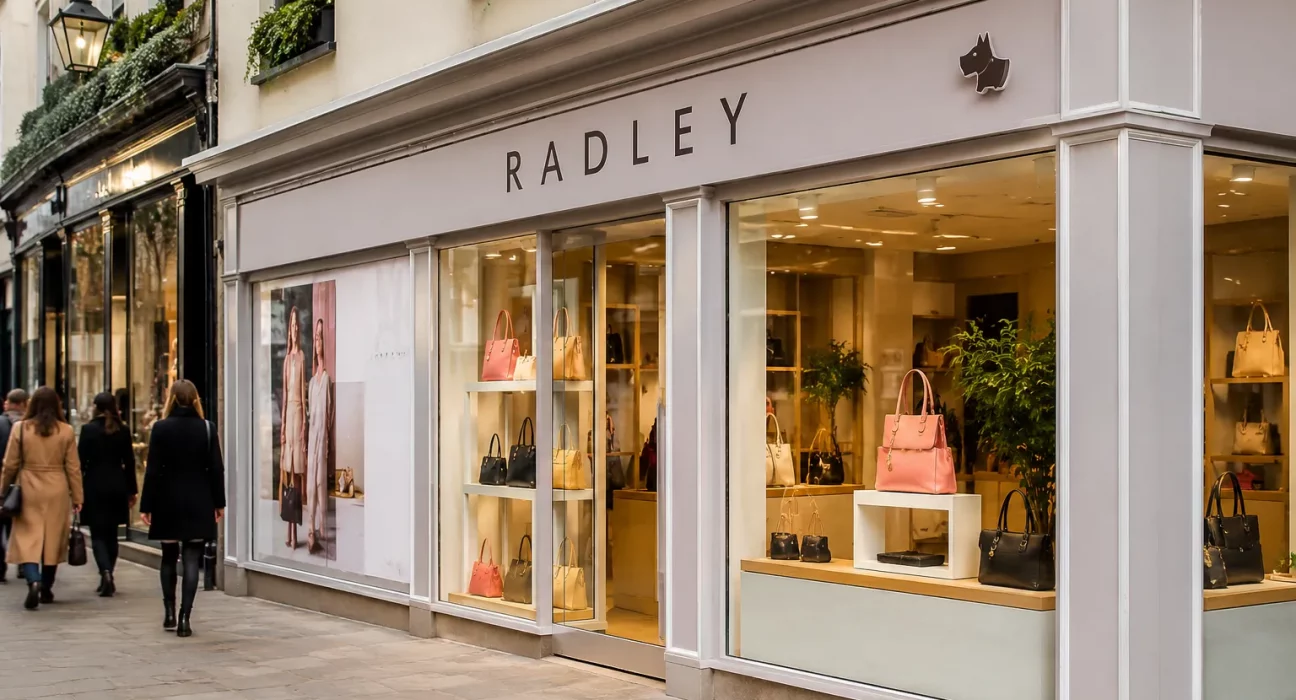
Radley’s company-operated UK stores are now closed.
The position changed gradually following the administration.
Immediately after Gordon Brothers acquired the brand, stores continued trading temporarily while remaining inventory was sold. That created some confusion among customers because the brand had been acquired while stores were simultaneously running closing-down sales.
By August 2026, the process had moved towards its final stage.
Radley’s ecommerce operation stopped normal sales, while the remaining directly operated stores proceeded towards closure.
The official Radley UK website now clearly states that its UK website and stores are closed.
This means customers searching for information about whether their local Radley branch remains open should not rely on articles published during the initial weeks of the administration.
When Did the Radley Website Close?
Radley’s former UK ecommerce operation stopped accepting normal online orders in August 2026.
Retail reporting at the time indicated that ecommerce trading was due to end late on 19 August, while the remaining physical stores were expected to complete their closure process later in the month.
The Radley domain itself has not disappeared.
Visitors can still access Radley’s UK website, but it no longer functions as the conventional ecommerce operation that existed before administration.
This distinction matters because saying that the “Radley website still exists” is not the same as saying that Radley continues normal UK online trading.
As of September 2026, the old ecommerce operation is closed.
Why Did Radley Enter Administration?
Radley faced a combination of financial and operational pressures before administration.
Like many mid-market fashion and accessories businesses, the company was operating in an increasingly difficult UK retail environment characterised by higher costs, cautious consumer spending and substantial competition.
Physical retail businesses face costs that online-first brands can often avoid or reduce. These include rent, staffing costs, energy bills, stock distribution and business rates.
At the same time, consumers have become increasingly comfortable purchasing fashion and accessories through digital retailers and large marketplaces.
That combination can put considerable pressure on businesses maintaining significant store portfolios.
Radley’s difficulties were therefore not occurring in isolation.
The wider pattern can also be seen in the recent River Island store closures, where financial pressures and changing shopping behaviour contributed to a major restructuring of another established British fashion retailer.
Radley’s administration is part of a broader transformation of the UK high street rather than an entirely isolated event.
What Happened to Radley’s Employees?
The administration had a significant impact on employees.
Initial reports following the May 2026 administration confirmed that 42 roles were lost immediately.
Other employees remained involved while the business completed its store and stock wind-down, meaning the final employment impact developed over time rather than occurring entirely on the first day of administration.
This is common in retail insolvencies.
Administrators may retain workers temporarily so that stores can continue trading, inventory can be sold and the business can complete an orderly closure process.
The human impact remains one of the most significant consequences of the Radley restructuring. Preserving a brand name does not necessarily mean preserving the workforce or store network that previously operated beneath that brand.
The distinction has also been visible elsewhere in the sector. The Claire’s Accessories UK administration demonstrated how a recognisable retail brand can survive in some form even after substantial store closures and job losses.
What Is the Timeline of the Gordon Brothers Radley Takeover?
The Radley story developed over several months rather than through a single event.
| Date | Development |
|---|---|
| 26 May 2026 | Radley’s former operating company entered administration |
| 26 May 2026 | Gordon Brothers announced the acquisition of the Radley brand and related intellectual property |
| Late May 2026 | Immediate redundancies were confirmed |
| June–July 2026 | Stores continued temporarily while remaining stock was cleared |
| 19 August 2026 | The former UK ecommerce operation was scheduled to stop normal online trading |
| Late August 2026 | Remaining directly operated stores moved through final closures |
| September 2026 | Radley’s official UK site states that the UK website and stores are closed |
| September 2026 | Gordon Brothers remains owner of the Radley brand |
This timeline is important because information published immediately after the acquisition can now give an incomplete picture.
In May, the main story was Gordon Brothers acquiring the brand.
By September, the important question is what remains after the retail operation has closed and what Gordon Brothers intends to do with the Radley name.
Is Radley Still Trading Online?
Not through the former UK ecommerce operation.
Radley’s UK website remains accessible, but customers cannot treat it as the same normal ecommerce business that existed before administration.
The company’s own website now states that its UK website and stores have closed.
That means earlier information suggesting that online trading would simply continue after the Gordon Brothers acquisition is no longer accurate.
A future Radley ecommerce business remains possible because Gordon Brothers owns the brand and intends to develop it.
However, there is an important difference between a potential future ecommerce strategy and the old Radley online business continuing without interruption.
No confirmed timetable for a new UK ecommerce launch should be assumed until Gordon Brothers or Radley makes an official announcement.
Can Customers Still Buy Radley Handbags?
Radley products may still appear through third-party retailers, existing stockists, resale platforms and other distribution channels.
The closure of Radley’s own UK stores does not mean every Radley product immediately disappeared from the market.
It is also likely that retail partnerships will become more important if Gordon Brothers follows through with its planned asset-light strategy.
That could allow Radley products to return or expand through department stores, wholesale accounts, licensed partners or other retailers without requiring Gordon Brothers to rebuild Radley’s former standalone store estate.
Customers should nevertheless be cautious when purchasing through unfamiliar websites.
When a recognised retailer closes its own ecommerce operation, misleading websites can sometimes attempt to attract shoppers with exaggerated clearance discounts or branding that makes them appear official.
Consumers should verify that they are dealing with a legitimate seller before purchasing.
What Does Gordon Brothers Plan to Do With Radley?
Gordon Brothers has indicated that it sees significant remaining value in the Radley brand.
The company has spoken about expanding Radley’s footprint across markets including the UK, United States, Australia and Asia.
Its strategy is expected to focus on a more asset-light business model.
That could involve a greater emphasis on wholesale distribution, retail partnerships, licensing and international expansion rather than operating a large network of company-owned stores.
Gordon Brothers has also identified opportunities to expand Radley beyond its traditional handbag category.
Potential growth areas previously mentioned include accessories and additional lifestyle categories.
This strategy could allow Radley to reach customers without recreating all of the fixed costs associated with its former retail structure.
What Does an Asset-Light Radley Business Mean?
An asset-light model generally involves owning fewer expensive operating assets while working with external partners.
For a fashion brand, that can mean selling products through department stores and other retailers rather than opening and operating every shop directly.
It can also mean licensing the brand for certain product categories or territories.
The advantages can include lower fixed costs, greater flexibility and faster international expansion.
However, there are also challenges.
Radley’s future success will depend on Gordon Brothers maintaining the quality, identity and customer recognition that made the brand valuable in the first place.
Expanding licensing too aggressively could weaken brand positioning, while insufficient investment could make it harder to regain customer attention after the closure of the UK retail operation.
The challenge is therefore not simply keeping the Radley name alive. It is turning that name into a commercially sustainable brand under a substantially different model.
Is Radley Closing Down Completely?
No — but the answer needs careful explanation.
Radley’s former operating business entered administration, its old UK ecommerce operation closed and its company-operated UK stores shut.
However, Gordon Brothers acquired the Radley brand and related intellectual property.
Therefore, describing Radley as having “completely disappeared” would be inaccurate.
A more precise description is:
Radley’s former UK retail operation has closed, but the Radley brand continues under Gordon Brothers ownership.
That distinction is likely to remain important as new products, distribution arrangements or partnerships are announced.
Will Radley Stores Reopen?
There is currently no confirmed programme to reopen Radley’s former UK company-operated store network.
Gordon Brothers’ stated strategy points towards a more asset-light future, suggesting that directly operating a large store estate is unlikely to be the immediate priority.
That does not mean Radley could never have a physical retail presence again.
The brand could appear in department stores, concessions, licensed shops, temporary locations or through wholesale partners.
However, those possibilities should not be reported as confirmed plans unless Gordon Brothers announces them.
For now, customers should regard the former directly operated UK Radley store network as closed.
Why Was the Radley Brand Worth Buying?
Administration does not automatically mean a company has no valuable assets.
In Radley’s case, the brand itself had substantial value.
Founded in London in 1998, Radley built recognition around British handbag design and became particularly associated with accessible premium accessories.
Years of marketing, customer loyalty and product development created an asset that could continue to have commercial value even if the old operating company could no longer trade profitably.
This is one reason investors sometimes acquire brands from administration without acquiring the entire underlying operating structure.
A strong brand can potentially be rebuilt through a completely different commercial model.
Gordon Brothers is effectively betting that Radley’s name, customer recognition and international potential remain valuable enough to justify further investment.
What Does the Radley Takeover Tell Us About UK Retail?
The Gordon Brothers Radley takeover highlights a significant trend affecting the British high street.
For many established retailers, the problem is not necessarily that customers have completely stopped recognising or wanting the brand.
The problem can be the cost of the business model used to sell its products.
A company may have valuable intellectual property and loyal customers while simultaneously struggling with expensive leases, staffing costs, logistics and declining store productivity.
This creates opportunities for investors to separate the brand from the expensive operating structure.
Instead of running dozens of stores, the new owner can concentrate on product development, marketing, licensing, wholesale distribution and ecommerce.
That can preserve valuable consumer brands, but it can also mean significant job losses and the disappearance of familiar high-street locations.
Radley therefore represents both a rescue and a closure story depending on which part of the business is being considered.
The brand survived.
The old retail structure did not.
What Happens to Radley Next?
The next major development will be Gordon Brothers turning its ownership of Radley into a new operating strategy.
Several questions remain unanswered.
Will a new Radley ecommerce platform launch in the UK? Which retailers will become major distribution partners? Will new licensed product categories appear? How strongly will Gordon Brothers invest in the UK compared with international markets?
Those questions are likely to determine whether Radley can successfully rebuild after administration.
The brand still benefits from decades of customer recognition, but the retail market remains highly competitive.
Gordon Brothers will need to preserve Radley’s identity while adapting the company to changing consumer behaviour and a less store-dependent business model.
Until specific partnerships or launch dates are formally announced, speculation should be clearly separated from confirmed information.
What Is Radley’s Current Position in September 2026?
Radley’s situation can now be summarised clearly.
The former operating company entered administration on 26 May 2026.
Gordon Brothers acquired the Radley brand and related intellectual property.
The former UK ecommerce operation subsequently stopped normal trading, while the remaining company-operated stores completed their closure process.
Radley’s official UK website now states that its UK website and stores are closed.
However, Gordon Brothers continues to own the brand and has indicated that it intends to invest in Radley’s development.
Therefore, customers asking whether Radley has disappeared should distinguish between the company that previously operated the stores and the brand that Gordon Brothers acquired.
They are no longer the same story.
Final Takeaway
The Gordon Brothers Radley takeover has preserved the Radley name, but it has not preserved the business exactly as customers knew it.
Radley’s former operating company entered administration on 26 May 2026. Gordon Brothers acquired the brand and related intellectual property, while the former UK retail operation moved through a controlled wind-down.
By September 2026, the previous ecommerce operation and company-operated stores had closed.
The important point is that Radley as a brand remains alive.
Gordon Brothers now has the task of rebuilding and expanding it through a different business model focused on brand investment, international growth, retail partnerships and potentially wider product categories.
For customers, the familiar Radley retail business has changed dramatically.
For the wider UK retail industry, the deal demonstrates how a valuable consumer brand can survive even when the company and physical infrastructure that previously supported it can no longer continue in the same form.
FAQs About the Gordon Brothers Radley Takeover
Has Radley Gone Into Administration?
Yes. Radley’s former operating company entered administration on 26 May 2026.
Who Bought Radley?
Gordon Brothers acquired the Radley brand and related intellectual property in May 2026.
Is Radley Closing Down?
Radley’s former UK ecommerce operation and company-operated stores have closed. However, the Radley brand continues under Gordon Brothers ownership.
Are Radley Shops Still Open?
Radley’s official UK website states that its UK website and stores are now closed.
Is the Radley Website Still Trading?
The UK domain remains accessible, but the former normal ecommerce operation has closed.
Can I Still Buy Radley Handbags?
Existing Radley products may remain available through third-party retailers and other stockists. Future distribution arrangements under Gordon Brothers are expected to become clearer as the brand’s new strategy develops.
Will Radley Come Back?
The Radley brand already continues under Gordon Brothers ownership. What has not yet been confirmed is exactly how its future UK ecommerce and physical retail presence will operate.
Will Gordon Brothers Reopen Radley Stores?
No programme to reopen the former company-operated store network has been confirmed. Gordon Brothers has instead emphasised a more asset-light growth strategy.