






Last Updated: 23 October 2026
How much does a Deliveroo driver make in the UK in 2026? According to Deliveroo’s latest payment agreement, riders receive minimum fees equivalent to £12.88–£17.18 per hour of estimated delivery time, depending on their vehicle. However, this does not mean every rider earns that amount for each hour spent working.
Unlike employees receiving fixed salaries, Deliveroo riders are generally self-employed and paid for completed orders. The number of deliveries, waiting time, vehicle expenses and customer tips all influence actual earnings.
An important development in 2026 is the growing difference between the pay advertised for active deliveries and the income riders retain after spending several hours online.
This updated guide examines official Deliveroo payment figures, original earnings calculations, recent rider evidence and tax changes to establish what working as a Deliveroo driver could realistically mean financially.
How Much Does a Deliveroo Driver Earn Per Hour in 2026?
Deliveroo updated its minimum rider payment rates from 1 April 2026 following negotiations with the GMB union.
The agreement introduced different payment floors depending on the vehicle registered to the rider’s account.
| Vehicle type | Minimum fee per estimated delivery hour | Minimum for a 20-minute estimated delivery |
|---|---|---|
| Bicycle | £12.88 | £4.29 |
| Electric bicycle | £12.99 | £4.33 |
| Scooter | £14.40 | £4.80 |
| Car | £17.18 | £5.73 |
These figures come from Deliveroo’s official rider pay floor announcement, published on 31 March 2026.
The 20-minute calculations show what the corresponding minimum would be for an order estimated to take one-third of an hour.
Why These Rates Are Different From Normal Hourly Wages
Deliveroo’s payment floor applies to the time the platform estimates an accepted order will take to complete.
It does not provide a guaranteed wage for every hour that a rider remains logged into the application.
For example, suppose a bicycle courier is online for one hour but receives only two deliveries, each estimated to take 15 minutes.
At the published minimum rate, the total payment would be approximately £6.44 before tips and expenses.
Even though the platform’s bicycle pay floor is £12.88 per estimated delivery hour, the courier has earned £6.44 across the full hour online.
This distinction is essential when evaluating the financial viability of delivery work.
New Analysis: How Waiting Time Changes Deliveroo Earnings
One of the most useful ways to measure delivery income is through order-time utilisation.
This represents the total estimated duration of completed orders as a proportion of the hours spent online.
For example, someone online for 40 hours who completes orders with a combined estimated duration of 30 hours has 75% estimated order-time utilisation.
We calculated the following scenarios using Deliveroo’s official minimum payment rates.
| Vehicle | 50% utilisation | 75% utilisation | 90% utilisation |
|---|---|---|---|
| Bicycle | £257.60 | £386.40 | £463.68 |
| Electric bicycle | £259.80 | £389.70 | £467.64 |
| Scooter | £288.00 | £432.00 | £518.40 |
| Car | £343.60 | £515.40 | £618.48 |
Calculation assumptions: 40 hours online per week, completed orders paid at the relevant minimum rate, and estimated order-time utilisation of 50%, 75% or 90%. Figures exclude tips, boosts, expenses and tax. They are hypothetical scenarios, not observed average rider earnings.
What Does This Tell Us About Actual Pay?
Consider a bicycle rider spending 40 hours online weekly.
At 50% utilisation, minimum-rate delivery fees would total £257.60. At 75%, they would increase to £386.40.
That represents an additional £128.80 without increasing online hours.
The difference comes entirely from spending more time completing paid orders and less time waiting.
The calculations highlight why comparing hourly payment floors without considering unpaid waiting can significantly overstate potential earnings.
How Does Deliveroo Pay Compare With the UK Minimum Wage?
The National Living Wage increased to £12.71 per hour for eligible workers aged 21 and over in April 2026.
London Business Magazine explains the wider implications in its guide to the UK minimum wage in 2026.
For a bicycle courier earning only the minimum Deliveroo fee, achieving £12.71 in gross revenue per hour online would require approximately 98.7% order-time utilisation.
That would leave almost no time between estimated delivery periods.
However, this is a financial comparison rather than a legal entitlement. Genuinely self-employed couriers are not automatically entitled to the National Minimum Wage.
How Much Can Deliveroo Drivers Earn Per Day, Week and Month?
Deliveroo riders do not receive a fixed salary, and reliable nationwide averages for actual 2026 take-home earnings are not established by the published payment floor.
Nevertheless, calculations based on the official rates can illustrate potential earnings under different working patterns.
The following examples assume 75% estimated order-time utilisation, with deliveries paid at the published minimum rates.
| Working pattern | Bicycle gross earnings | Car gross earnings |
|---|---|---|
| 4 hours online | £38.64 | £51.54 |
| 8 hours online | £77.28 | £103.08 |
| 20 hours weekly | £193.20 | £257.70 |
| 40 hours weekly | £386.40 | £515.40 |
| Average monthly revenue at 40 hours weekly | £1,674.40 | £2,233.40 |
Monthly figures annualise the weekly amounts across 52 weeks and divide by 12. They do not allow for holidays, sickness, seasonal changes or unavailable orders. All amounts are before expenses and tax.
Can a Deliveroo Driver Earn £100 a Day?
Yes, earning £100 in gross delivery fees during a day is possible.
Under our model, a car courier working eight hours online with 75% utilisation would generate approximately £103.08 at the minimum rate.
A bicycle courier would generate £77.28 under identical assumptions, requiring higher fees, tips, greater utilisation or additional working time to reach £100.
Importantly, earning £100 in a day does not mean taking home £100 after costs.
Can Deliveroo Provide a Full-Time Income?
Deliveroo can generate substantial revenue for riders who regularly complete orders, but there is no guarantee that 40 hours online will produce 40 hours of paid delivery activity.
Full-time couriers must also account for periods without orders, fluctuating demand, vehicle maintenance and time away from work.
This makes financial planning particularly important for someone relying on delivery fees as their main source of income.
Are Deliveroo Riders Being Paid Less Per Order?
Recent research and reporting have raised questions about changing payment algorithms and the financial pressure experienced by food delivery couriers.
A September 2026 investigation by The Guardian examined rider concerns about automated payment decisions.
One Deliveroo rider in Scotland, identified under the pseudonym Dylan, had recorded earnings and delivery information since 2023.
His records indicated the following changes:
| Period | Recorded average payment per order |
|---|---|
| 2023 | £3.67 |
| 2024 | £3.63 |
| 2025 | £3.51 |
| First half of 2026 | £3.42 |
From 2023 to the first half of 2026, the rider’s average fee declined by approximately 6.8%.
The investigation also reported that his delivery frequency remained around 3.6–3.8 orders per hour during that period.
Why Is This Significant?
When the number of deliveries remains broadly stable but the fee per order falls, a courier may have to complete additional work to maintain previous income levels.
However, these figures represent one rider’s recorded experience. They are not a nationwide Deliveroo earnings survey and cannot establish a national decline.
Deliveroo stated in its response to the investigation that its minimum hourly fee during orders had increased in 2026 and defended its approach to rider payments.
This contrast illustrates why both platform announcements and independently recorded earnings are useful when evaluating gig-economy work.
How Much Do Deliveroo Drivers Make in London?
London offers numerous delivery opportunities because of its concentration of restaurants, offices, residential developments and takeaway customers.
However, earnings vary between districts, times of day and individual riders.
Central London Versus Outer London
Central London contains areas with high restaurant density, including Soho, Covent Garden, Shoreditch and parts of the City.
Shorter distances between restaurants and customers may help riders complete more orders, although traffic, collection delays and competition can offset these advantages.
Outer London delivery areas may involve longer journeys, particularly where restaurants and residential neighbourhoods are more widely separated.
A rider completing a £6 delivery in 20 minutes could generate more revenue per hour of active work than another completing a £9 order that takes 45 minutes.
Yet the calculation changes if either rider must spend significant time waiting for their next order.
For this reason, it would be misleading to suggest that every central London rider earns more than riders in other parts of the capital.
What Makes a London Delivery Area Profitable?
The most important measures are the average payment per completed order, time required to complete deliveries, distance travelled without an order and total vehicle costs.
High individual delivery fees do not necessarily mean high hourly profits.
Prospective couriers should test local demand at different times rather than relying on fixed area-by-area earnings estimates.
What Expenses Do Deliveroo Drivers Pay?
Vehicle expenses are among the biggest differences between gross earnings and actual take-home income.
Although Deliveroo’s minimum car fee is higher than its bicycle fee, operating a car can involve substantially greater expenditure.
| Expense | Bicycle | Electric bicycle | Scooter | Car |
|---|---|---|---|---|
| Fuel or charging | None or minimal | Battery charging | Fuel | Fuel or electricity |
| Maintenance | Tyres, brakes, chains | Mechanical and electrical repairs | Servicing and tyres | Servicing, tyres and repairs |
| Insurance | Consider suitable cover | Consider suitable cover | Appropriate motor and delivery insurance | Appropriate motor and delivery insurance |
| Depreciation | Usually lower | Battery and cycle depreciation | Vehicle depreciation | Vehicle depreciation |
| Other costs | Safety equipment | Equipment and battery | Protective gear | Parking and other vehicle costs |
For car couriers, changing fuel prices can significantly affect profitability. The publication’s earlier analysis of the UK diesel price surge illustrates how changes at the pump can increase vehicle running costs.
Courier insurance is another essential consideration. Ordinary private motor insurance may not provide the necessary cover for paid food deliveries.
Original Calculation: Bicycle Versus Car Take-Home Pay
Consider two riders completing the equivalent of 30 estimated delivery hours during 40 hours online each week.
For comparison, assume weekly operating expenses of £20 for a bicycle rider and £140 for a car rider.
| Earnings measure | Bicycle | Car |
|---|---|---|
| Weekly gross delivery fees | £386.40 | £515.40 |
| Assumed weekly expenses | £20.00 | £140.00 |
| Weekly profit before tax | £366.40 | £375.40 |
| Annual profit over 46 working weeks | £16,854.40 | £17,268.40 |
| Estimated annual Income Tax and Class 4 NI | £1,113.94 | £1,221.58 |
| Average retained income per working week | £342.18 | £348.84 |
Illustrative calculations, not measured rider averages. The example assumes no other taxable income, a full Personal Allowance, England’s basic Income Tax rate, and Class 4 National Insurance at 6% on profits above £12,570. It does not model other reliefs, benefits, financing differences or additional tax obligations.
What Is the Main Finding?
Although the car rider generates £129 more in weekly gross fees, the difference after the modelled expenses and tax is approximately £6.66 per working week.
This does not mean bicycles are always more profitable.
Instead, it demonstrates that a higher delivery payment can be offset by higher operating costs.
A rider considering purchasing or financing a vehicle specifically for delivery work should calculate expected profit before making that commitment.
How Does Deliveroo Calculate Its Delivery Fees?
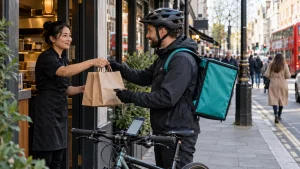
Deliveroo does not use a universal fixed fee per completed order.
According to the company’s published payment guidance, each offer is calculated using several factors, including estimated journey duration, road distance, location, time of day, local demand, registered vehicle and available boosts.
The app displays the proposed fee before the rider accepts the delivery.
Do Riders Receive More Money for Longer Journeys?
Longer journeys can attract higher fees because the calculation considers estimated time and distance.
However, the payment is not based on a fixed amount for every mile travelled.
A longer delivery may also require an unpaid return journey to a busy restaurant area, reducing its overall profitability.
Do Stacked Orders Pay More?
Stacked orders involve collecting or delivering more than one customer order during a combined journey.
These deliveries may help reduce the time spent travelling between restaurants.
However, the total payment should be assessed against the combined journey length and time needed to serve each customer.
Completing several orders together does not automatically mean earning the same amount as completing them separately.
Do Deliveroo Riders Receive Tips?
Deliveroo states that riders keep 100% of tips provided by customers, although tips may be shared when multiple riders work on a large order.
Tips can improve earnings, but they should not form the basis of a guaranteed income projection.
How Much Tax Do Deliveroo Drivers Pay in 2026/27?
Deliveroo riders generally operate as self-employed couriers and must manage their own tax obligations.
Where gross self-employment income exceeds £1,000 during a tax year, sole-trader registration and Self Assessment requirements will normally apply.
Income Tax and National Insurance Rates
For the 2026/27 tax year, the standard UK Personal Allowance remains £12,570.
For taxpayers in England, Wales and Northern Ireland, the basic Income Tax rate is 20% on taxable income within the basic-rate band.
Scottish Income Tax bands differ.
For self-employed individuals, Class 4 National Insurance generally applies at:
- 6% on annual profits above £12,570 up to £50,270.
- 2% on profits above £50,270.
Eligible riders can deduct allowable business expenses when calculating taxable profits, or use the trading allowance where appropriate, but should not deduct the same expense twice.
Important 2026 Change: Mileage Expenses
A particularly relevant development for car couriers is the change to HMRC’s simplified mileage rates.
From 6 April 2026, the simplified rate for the first 10,000 eligible business miles driven in a car increased from 45p to 55p per mile.
The rate for mileage above 10,000 remains 25p, while the motorcycle rate remains 24p.
For example, a courier using the simplified car mileage method and recording 8,000 qualifying business miles could calculate a £4,400 deduction.
This is a business expense deduction, not a direct payment or refund of £4,400.
Riders using the simplified mileage method cannot also claim the same vehicle’s fuel and maintenance costs separately under that method. Eligibility and previous vehicle expense claims can affect the treatment.
The separate 20p bicycle mileage allowance applying to employees should not be assumed to be available under the self-employed simplified vehicle expense scheme.
Does Deliveroo Pay Better Than Other Delivery Jobs?
Delivery companies use different payment models, making direct headline hourly comparisons difficult.
Deliveroo and Uber Eats generally offer fees linked to individual orders. Evri couriers commonly work under parcel-delivery arrangements where earnings relate to completed parcels or routes.
Readers considering alternative courier opportunities can compare the structure with how much Evri pays per parcel.
Traditional licensed taxi work operates differently again, with fares, licensing requirements and substantially different vehicle expenses. The site’s guide to London black cab driver earnings offers another comparison for people considering driving-based self-employment.
Deliveroo, Uber Eats and Just Eat
Without comparable 2026 datasets measuring rider earnings after expenses and across all logged-in hours, there is insufficient evidence to declare one of these platforms consistently better paid throughout the UK.
Riders comparing platforms should assess the total fees earned, logged-in hours, operating costs and reliability of local order demand.
Using multiple delivery applications may create additional opportunities, but riders must comply with each platform’s rules and avoid accepting orders they cannot complete reliably.
When Do Deliveroo Drivers Get Paid?
Deliveroo normally pays rider fees weekly on Tuesdays.
Riders who want earlier access to earned fees can use the app’s cash-out option, which carries a 50p charge.
Customer tips are also included in payments.
For riders managing fuel purchases, maintenance and other regular expenses, weekly payments can help with cash flow. However, the amount paid each week still depends on completed deliveries and other applicable earnings.
How Can Deliveroo Riders Improve Their Earnings?
The best strategy is to improve the amount retained per hour of actual work rather than simply increasing delivery volume.
Calculate Profit Per Logged-In Hour
A courier receiving £105 across seven online hours has generated £15 in gross revenue per logged-in hour.
If operating costs attributable to that shift are £21, the remaining £84 represents £12 per logged-in hour before Income Tax and National Insurance.
This calculation is more informative than reporting £105 as daily take-home earnings.
Compare Busy and Quiet Working Periods
Restaurant demand often changes throughout the day, particularly around lunch and evening meals.
However, busy periods can also create collection delays and more traffic.
Riders should compare several weeks of actual performance to identify the shifts that produce the most reliable income.
Record Total Business Costs
Maintaining accurate records of delivery fees, tips, working hours, business mileage and expenses makes it easier to understand profitability.
These records also support tax calculations and help identify when vehicle running costs are increasing faster than revenue.
Is Becoming a Deliveroo Driver Worth It in 2026?
Deliveroo remains an option for people looking for flexible self-employed work, especially those who prefer choosing when they are available.
Its official payment floor provides some transparency about the minimum fees payable for estimated order durations.
Nevertheless, unpaid waiting, changes in demand, vehicle expenses and the uncertainty of weekly order volumes create financial risks.
Our calculations demonstrate that increasing order-time utilisation can significantly improve earnings without increasing logged-in hours.
They also demonstrate that car riders may generate higher gross fees without necessarily retaining substantially more money than bicycle couriers.
Anyone considering Deliveroo as a primary income source should evaluate several weeks of local demand and calculate income after all business expenses.
Conclusion: How Much Does a Deliveroo Driver Really Make?
In 2026, Deliveroo’s official minimum payment rates range from £12.88 to £17.18 per estimated delivery hour, depending on vehicle type.
However, these rates should not be confused with guaranteed hourly wages or actual take-home earnings.
London Business Magazine’s calculations reveal that the proportion of time spent completing deliveries has a major influence on weekly income. Vehicle expenses can also reduce or eliminate much of the apparent advantage of higher car delivery fees.
Recent rider records reported in September 2026 further demonstrate why changes in payment per order deserve close attention.
The most reliable way to evaluate Deliveroo earnings is to measure total fees and tips, deduct operating expenses and taxes, and compare the remaining income against actual working hours.
For prospective riders, that provides a more realistic picture of delivery work than relying on advertised payment floors or unverified average salary figures.
Frequently Asked Questions
How Much Does Deliveroo Pay Per Hour in 2026?
The official 2026/27 minimum fee rates range from £12.88 for bicycles to £17.18 for cars per estimated hour of completed order time. These are not guaranteed payments for every hour online.
How Much Can a Deliveroo Driver Earn in Eight Hours?
At 75% estimated order-time utilisation and the official payment floor, a bicycle rider would generate approximately £77.28 and a car rider approximately £103.08. These illustrative amounts are before tips, expenses and taxes.
Can Deliveroo Drivers Earn £500 a Week?
Yes, it is possible. In our model, a car courier working 40 hours online at 75% estimated order-time utilisation would generate £515.40 in weekly fees before expenses. The amount is illustrative, not guaranteed or a verified national average.
Do Deliveroo Riders Get Paid for Waiting for Orders?
Not automatically. Deliveroo’s minimum fee arrangement is based on the estimated duration of accepted and completed orders, rather than all the time spent online.
Do Deliveroo Drivers Pay for Their Own Fuel?
Self-employed car and scooter couriers generally pay their vehicle operating costs. Although Deliveroo’s minimum fees differ by vehicle type, riders must consider actual expenses when assessing profitability.
Is Deliveroo Better as a Full-Time or Part-Time Job?
It depends on local demand, availability and financial needs. Part-time work may suit riders seeking supplementary income, while full-time couriers need to plan for fluctuating order volumes and expenses.
Do Deliveroo Drivers Receive Holiday Pay?
Deliveroo riders generally work under self-employed arrangements and do not automatically receive employee-style paid annual leave. Individual employment rights depend on the actual legal working relationship, not simply its description.
Leave feedback about this