








Last Updated : 30.09.2026
Band 2 NHS pay in England is £25,272 a year for 2026/27, equivalent to approximately £12.92 an hour for a standard full-time working week of 37.5 hours. The rate has applied from 1 April 2026 following a 3.3% increase to the previous year’s salary.
Band 2 covers many essential support positions, from healthcare support and domestic roles to portering and administrative work.
While the basic salary is relatively close to the National Living Wage, NHS employees may also receive pension benefits, annual leave, unsocial-hours enhancements, overtime and regional supplements.
Understanding the wider NHS pay bands can help employees see where Band 2 sits within the broader pay structure.
What Is Band 2 NHS Pay in 2026/27?
The standard Band 2 NHS salary in England is:
| Pay Detail | 2026/27 Rate |
| Annual Salary | £25,272 |
| Monthly Gross Pay | £2,106 |
| Weekly Gross Pay | About £484 |
| Standard Hourly Rate | £12.92 |
| Standard Working Week | 37.5 Hours |
These rates are effective from 1 April 2026.
The hourly figure is based on the NHS standard working year and 37.5 contracted hours each week.
Does Band 2 Have More Than One Pay Point?
Band 2 effectively operates as a single salary point in England.
The official structure still identifies an entry point and a top point with two years until pay-step eligibility, but both points are currently worth exactly £25,272. This means completing two years does not produce an additional salary increase within Band 2 itself.
Employees may still benefit from future national pay awards, but meaningful basic-pay progression normally requires moving into a higher-banded role.
This is an important change from older Band 2 arrangements where entry and top-of-band salaries could differ.
How Much Did Band 2 NHS Pay Increase in 2026?

Band 2 pay increased from £24,465 in 2025/26 to £25,272 in 2026/27, an increase of £807 a year following the 3.3% pay award.
The lowest NHS pay rates have become particularly important because the National Living Wage for workers aged 21 and over increased to £12.71 an hour from 1 April 2026.
That leaves standard Band 2 basic pay only around 21p an hour above the statutory National Living Wage.
The narrow difference helps explain why lower NHS pay bands remain an important part of wider discussions about future Agenda for Change reform.
How Has Band 2 NHS Pay Changed Since 2021?
Band 2 starting pay has risen substantially in cash terms over recent years.
| Pay Year | Band 2 Starting Salary |
| 2021/22 | £18,546 |
| 2022/23 | £20,270 |
| 2023/24 | £22,383 |
| 2024/25 | £23,615 |
| 2025/26 | £24,465 |
| 2026/27 | £25,272 |
Historical pay scales confirm these increases, although higher cash salaries do not automatically mean the same increase in purchasing power once inflation and living costs are considered.
Employees wanting to understand how salary points are set can also review the wider Agenda for Change pay structure.
Which Jobs Are Commonly Paid at NHS Band 2?
The exact band depends on the job description and responsibilities rather than simply the job title.
Common Band 2 roles can include:
- Healthcare Support Workers
- Healthcare Assistants
- Hospital Porters
- Domestic Assistants and Cleaners
- Catering Assistants
- Reception and Clerical Support Staff
- Sterile Services Assistants
- Therapy Support Workers
- Pharmacy Support Roles
- Maternity Support Roles Where Duties Match Band 2 Requirements
A role involving more complex clinical duties, supervision, specialist skills or greater responsibility may instead be evaluated at Band 3 or above.
What Is Band 2 NHS Pay in London?
Employees working in qualifying London and surrounding areas can receive a High Cost Area Supplement.
For Band 2 in 2026/27, the minimum supplement is particularly important because applying the headline percentage alone would produce a lower payment.
| Area | Basic Salary | HCAS | Total Annual Pay | Hourly Rate With HCAS |
| Inner London | £25,272 | £5,794 | £31,066 | £15.89 |
| Outer London | £25,272 | £4,870 | £30,142 | £15.42 |
| Fringe | £25,272 | £1,346 | £26,618 | £13.61 |
For Band 2, this means the effective Inner London addition is approximately 22.9% rather than simply 20%. Outer London works out at about 19.3% rather than 15%, while the fringe supplement is around 5.3%.
In broad terms:
- Inner London covers many central and inner London workplaces
- Outer London covers qualifying employers across outer London
- Fringe areas include qualifying locations around the London boundary in parts of counties such as Surrey, Hertfordshire, Essex and Kent
Eligibility depends on the employee’s NHS work location, so the relevant trust or employer should confirm which HCAS zone applies.
How Much Can Band 2 Staff Earn for Nights and Weekends?
Band 2 workers can receive additional pay when standard contracted hours fall at qualifying unsocial times.
| Working Period | Enhancement | Approximate Hourly Pay |
| Normal Hours | Basic Rate | £12.92 |
| Saturday or Qualifying Weekday Night Hours | 41% Extra | £18.22 |
| Sunday or Public Holiday | 83% Extra | £23.64 |
The 41% enhancement normally applies to Saturdays and weekday hours worked after 8pm and before 6am. Sundays and public holidays receive an 83% enhancement.
This can make a noticeable difference to annual earnings.
For example, using the rounded £12.92 hourly rate:
| Example Work Pattern | Approximate Annual Gross Pay |
| Standard Daytime Hours Only | £25,272 |
| One 7.5-Hour Qualifying Night or Saturday Shift Each Week | £27,344 |
| One 7.5-Hour Sunday Shift Every Four Weeks | £26,320 |
| Both Patterns Above | £28,392 |
These figures are illustrations because actual rota patterns and qualifying hours vary.
How Does NHS Band 2 Overtime Work?
Overtime generally applies when an employee works beyond 37.5 hours in a week.
Staff in Bands 1 to 7 normally receive time-and-a-half for overtime, while approved overtime on a general public holiday is paid at double time.
Using the standard Band 2 rate:
- Normal Rate: About £12.92 Per Hour
- Standard Overtime: About £19.38 Per Hour
- Public Holiday Overtime: About £25.84 Per Hour
Part-time employees normally receive their standard hourly rate for additional hours until they exceed 37.5 hours during that week.
What Is Band 2 NHS Take-Home Pay?
A full-time Band 2 worker earning £25,272 could receive approximately the following each month.
| Item | Approximate Monthly Amount |
| Gross Salary | £2,106 |
| NHS Pension Contribution | £137 |
| Income Tax | £184 |
| National Insurance | £85 |
| Approximate Take-Home Pay | £1,700 |
This example assumes an employee in England with a standard 1257L tax code, no student loan, no additional taxable income and membership of the NHS Pension Scheme.
At this salary level, the relevant employee pension contribution rate is 6.5%. The NHS employer contribution rate is 23.7% of pensionable pay.
On £25,272, 23.7% is approximately £5,990 a year in employer pension contributions. However, the NHS Pension Scheme is a defined-benefit arrangement, so this should not be treated as money being placed directly into an employee’s individual investment pot.
Actual take-home pay can change because of tax codes, pension choices, student loans, salary sacrifice and additional shifts.
Is Band 2 Better Than a National Living Wage Job?
The basic hourly difference is now small.
A worker aged 21 or over earning the 2026 National Living Wage receives at least £12.71 an hour, compared with approximately £12.92 for NHS Band 2.
At 37.5 hours a week, £12.71 equates to roughly £24,853 a year. Someone with no workplace pension deduction could take home approximately £1,784 a month, compared with around £1,700 for a Band 2 NHS employee contributing 6.5% to the NHS pension.
However, comparing only monthly take-home pay misses other employment benefits. NHS employees can receive pension benefits, paid annual leave, contractual sick pay, enhanced shift payments, training and career development.
More detail on these wider conditions is available through the benefits of working for the NHS.
What Benefits Do Band 2 NHS Employees Receive?
Depending on employment terms and length of service, benefits can include:
- NHS Pension Scheme Membership
- 27 Days of Annual Leave for New Full-Time Staff Plus Public Holidays
- Higher Annual Leave Entitlement With Longer Service
- Occupational Sick Pay
- Maternity, Paternity and Other Family Leave
- Training and Development Opportunities
- Flexible and Part-Time Working Opportunities
- Unsocial-Hours Enhancements
- Overtime Where Available
- Occupational Health and Wellbeing Support
Employees who are required to clean eligible work clothing themselves may also qualify for tax relief on employment expenses. The rules are explained in more detail under the HMRC uniform laundry allowance.
How Much Do Part-Time Band 2 NHS Staff Earn?
Part-time salaries are calculated on a pro-rata basis.
| Weekly Hours | Percentage of Full Time | Approximate Annual Basic Salary |
| 37.5 Hours | 100% | £25,272 |
| 30 Hours | 80% | £20,218 |
| 22.5 Hours | 60% | £15,163 |
| 18.75 Hours | 50% | £12,636 |
Shift enhancements can increase these totals if the employee works qualifying nights, Saturdays, Sundays or public holidays.
How Does Band 2 Compare With Band 3 and Band 4?
The 2026/27 England pay scales are:
| NHS Band | Entry Salary | Top Salary |
| Band 2 | £25,272 | £25,272 |
| Band 3 | £25,760 | £27,476 |
| Band 4 | £28,392 | £31,157 |
Moving from Band 2 to the starting point of Band 3 initially adds only £488 a year, equivalent to around 25p an hour.
The longer-term difference is larger because Band 3 currently progresses to £27,476, while Band 2 remains at £25,272.
Promotion is not automatic. Employees normally need to apply for a role that has been evaluated at the higher band.
How Can Band 2 Staff Progress Their NHS Career?
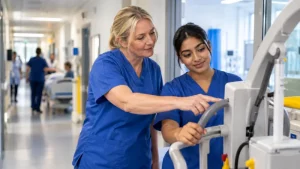
Progression can involve gaining new skills and applying for roles with greater responsibility.
Possible routes include:
- Completing the Care Certificate
- Undertaking Level 2 or Level 3 Qualifications
- Developing Clinical Support Skills
- Applying for Senior Healthcare Support Positions
- Completing NHS Apprenticeships
- Progressing Into Band 3 Support Roles
- Training as a Nursing Associate
- Moving Into Band 4 Assistant Practitioner or Nursing Associate Roles
- Continuing Further Training Towards Registered Professional Roles
The most appropriate route depends on the employee’s department, qualifications and long-term career plans.
Does Band 2 Pay Differ Across the UK?
Yes. NHS pay is devolved, so England, Scotland, Wales and Northern Ireland can operate different rates.
| Nation | Band 2 Position for 2026/27 |
| England | £25,272 |
| Scotland | £26,696 to £28,988 |
| Wales | £26,300 minimum Band 2 rate |
| Northern Ireland | Separate HSC pay arrangements apply |
Scotland operates two Band 2 salary points for 2026/27, with official rates of £26,696 and £28,988.
Wales introduced a minimum NHS Agenda for Change rate of £13.45 an hour from April 2026, which places Band 2 at approximately £26,300 for a full-time employee.
Northern Ireland follows separate HSC arrangements. Pay should therefore be checked against the latest Northern Ireland implementation circular rather than assuming the English figure automatically applies.
What Could Change Next for Band 2 Pay?
Band 2 pay is likely to remain closely linked to wider discussions about the bottom of the Agenda for Change structure.
The 2026 National Living Wage of £12.71 is only slightly below the £12.92 Band 2 hourly rate in England. This reduces the traditional pay gap between entry-level NHS employment and statutory minimum pay.
Future national pay awards or structural reforms could therefore be particularly important for Band 2 employees.
Anyone comparing salaries should always check the current pay year because NHS rates can change from April and later adjustments may sometimes be backdated.
Conclusion
Band 2 NHS pay in England is £25,272 a year or approximately £12.92 an hour for 2026/27. Unlike older versions of the pay structure, there is currently no financial difference between the Band 2 entry and top pay points.
Basic pay is only part of the picture. London supplements can take annual earnings above £30,000, while nights, weekends, public holidays and overtime can significantly increase gross income.
Employees should also consider pension membership, annual leave, sick pay and career development when comparing Band 2 employment with other jobs paying close to the National Living Wage.
For workers planning longer-term NHS careers, the biggest increase in basic earnings generally comes from gaining new skills and moving into Band 3 or higher roles.
FAQs About Band 2 NHS Pay
What Is the Band 2 NHS Salary in 2026/27?
Band 2 NHS pay in England is £25,272 per year for a full-time 37.5-hour working week.
What Is the NHS Band 2 Hourly Rate?
The standard 2026/27 Band 2 hourly rate is approximately £12.92 in England.
Do Band 2 NHS Staff Get Pay Increments?
Band 2 lists an entry and top point, but both are currently £25,272. Therefore, reaching the top point does not currently increase basic pay.
How Much Is Band 2 Pay in Inner London?
Band 2 staff receiving the Inner London HCAS earn £31,066 annually, equivalent to approximately £15.89 an hour.
How Much Extra Do Band 2 Staff Get for Sundays?
Qualifying Sunday hours receive an 83% enhancement, taking the rounded £12.92 basic hourly rate to approximately £23.64.
Is Band 2 Pay Above Minimum Wage?
Yes. From April 2026, Band 2 pays approximately £12.92 an hour compared with the £12.71 National Living Wage for workers aged 21 and over.
What Is the Difference Between Band 2 and Band 3 Pay?
Band 3 starts at £25,760 in England for 2026/27, £488 more per year than Band 2. Band 3 can then progress to £27,476.
Leave feedback about this